


Registering a Lasting Power of Attorney (LPA) is one of the most important steps you can take to protect yourself and your family. If you ever lose mental capacity, an LPA ensures that someone you trust can step in and make decisions on your behalf — without the delays, expense, and stress of applying to the Court of Protection for a deputyship order.
The LPA registration duration typically ranges from 8 to 10 weeks if the application is correctly submitted. However, in some cases — particularly where there are errors in the forms or objections are raised — it can take up to 20 weeks or even longer.
In this article, we explore the factors that influence the Lasting Power of Attorney registration process and provide practical guidance on how to avoid common delays so your LPA is in place when you need it.
Key Takeaways
- The typical LPA registration duration is 8 to 10 weeks from the date the Office of the Public Guardian receives a correctly completed application.
- In some cases, registration can take up to 20 weeks — particularly if there are errors, objections, or the OPG has a high volume of applications.
- Correctly completing and submitting the application first time is the single most important factor in avoiding delays.
- There is a mandatory 4-week waiting period built into the process to allow people named in the LPA to raise any objections.
- Without a registered LPA, your family may need to apply to the Court of Protection for a deputyship — a process that can take 6 months or more and costs significantly more than an LPA.
Understanding Lasting Power of Attorney (LPA)
A Lasting Power of Attorney is a legal document governed by the Mental Capacity Act 2005 that allows you to appoint one or more people (known as “attorneys”) to make decisions on your behalf if you lose the mental capacity to make those decisions yourself. It is one of the most practical and protective legal instruments available under English and Welsh law.
What is a Lasting Power of Attorney?
A Lasting Power of Attorney (LPA) is a legal instrument that enables you to choose someone you trust — whether a family member, friend, or professional — to act as your attorney and make decisions on your behalf. Depending on the type of LPA, this can cover your financial affairs, your health and welfare decisions, or both. The key point is that an LPA can only be created while you still have mental capacity. Once capacity is lost, it is too late — your family would instead need to apply to the Court of Protection for a deputyship order, which is far more expensive, time-consuming, and restrictive.
The Office of the Public Guardian (OPG) is the government body responsible for registering LPAs in England and Wales. An LPA is not legally valid until it has been registered with the OPG.
The most important thing to understand about a Lasting Power of Attorney is this: you must set one up while you still have the mental capacity to do so. By the time you think you need one, it may already be too late.
Types of Lasting Power of Attorney
There are two distinct types of Lasting Power of Attorney in England and Wales. They cover different areas of decision-making, and many people choose to put both in place:
| Type of LPA | Description |
|---|---|
| Health and Welfare LPA | This type of LPA allows your appointed attorney to make decisions about your daily care, medical treatment, where you live, and life-sustaining treatment. It can only be used once you have lost mental capacity — your attorney cannot make health decisions while you are still capable of making them yourself. |
| Property and Financial Affairs LPA | This type of LPA enables your attorney to manage your bank accounts, pay your bills, manage investments, sell or rent out property, and deal with HMRC on your behalf. Unlike the Health and Welfare LPA, this can be used while you still have capacity — with your consent — which is useful if, for example, you are physically unable to attend your bank in person. |
Importance of Having an LPA
Having a Lasting Power of Attorney is not just about planning for the worst — it is about giving your family the practical ability to help you when you need it most. Without a registered LPA, even your spouse or children cannot access your bank accounts, sell your home, or make medical decisions on your behalf. They would need to apply to the Court of Protection for a deputyship order — a process that typically takes 6 months or more, costs upwards of £1,000 in court fees alone (plus solicitor costs), and requires ongoing annual supervision fees and reporting to the OPG.
The importance of an LPA becomes especially clear when you consider how common mental incapacity is. Dementia alone affects around 900,000 people in the UK, and that number is projected to rise to over 1 million by 2030. But it is not just dementia — a stroke, a serious accident, or any sudden illness could leave you unable to manage your own affairs. An LPA ensures your family can act immediately, without waiting months for court approval. As Mike Pugh often says: “Plan, don’t panic.”

The Registration Process for LPA
Registering a Lasting Power of Attorney involves several distinct steps, and the order in which signatures and certifications are completed is critical. Getting the process wrong — even something as simple as signing in the wrong order — will result in the OPG rejecting your application and sending it back, adding weeks to your timeline.
Steps to Register a Lasting Power of Attorney
To register an LPA, you need to follow a specific sequence of steps. Here is an overview of the process:
- Complete the LPA form: You can do this online via the GOV.UK “Make a lasting power of attorney” service or by using paper forms. The online tool is generally faster and helps reduce errors by guiding you through each section.
- Sign the LPA in the correct order: The donor (the person making the LPA) must sign first, then the certificate provider, and finally the attorneys. The signing order is strictly enforced — if it is done out of sequence, the application will be rejected.
- Certificate provider verification: A certificate provider must confirm that the donor understands the LPA and is not being pressured into making it. The certificate provider must be either someone who has known the donor personally for at least two years, or a professional such as a solicitor, doctor, or social worker.
- Notify “people to be told” (if applicable): If you have named people who should be notified about the LPA, they must be informed before registration. They then have a 4-week window to raise any objections with the OPG.
- Submit the application to the OPG along with the registration fee. The current fee is £82 per LPA (so £164 if you register both types). Exemptions and remissions are available for those on certain means-tested benefits or with an income below £12,000.
- The OPG processes the application: They check the forms for errors, wait for the objection period to pass, and then register the LPA. Once registered, you will receive the stamped LPA document back — this is the document your attorney will need to show to banks, care homes, and other institutions.
For detailed guidance on registering an LPA, you can visit the official UK government website at https://www.gov.uk/power-of-attorney/register.
Required Documentation for Registration
The registration process requires specific documentation to be submitted alongside the LPA form. The necessary documents and requirements include:
- The completed and correctly signed LPA form (either the printed version from the online tool or the handwritten paper form).
- The registration fee of £82 per LPA (paid by cheque, or online if using the digital service).
- If claiming a fee exemption or remission, the appropriate supporting evidence (such as proof of means-tested benefits).
- Continuation sheets if additional space was needed to record preferences, instructions, or extra attorneys.
It is essential to ensure that all documents are correctly prepared and included to avoid delays. Even a small mistake — such as using correction fluid (Tipp-Ex) on the form instead of crossing out and initialling errors — can result in your application being returned.
| Document | Description | Requirement |
|---|---|---|
| LPA Form | Completed, correctly signed (in the right order), and witnessed LPA form | Mandatory |
| Registration Fee | £82 per LPA (exemptions and remissions may apply for those on low incomes or certain benefits) | Mandatory |
| Fee Exemption/Remission Evidence | Proof of eligibility for reduced or waived fee, such as means-tested benefit documentation | Only if claiming exemption or remission |
Timeline for LPA Registration
Understanding the realistic timeframe for Lasting Power of Attorney registration is essential so you can plan accordingly. The critical point is this: you should not wait until an LPA is urgently needed before starting the process, because registration cannot be rushed.
Average Time Frame for Processing
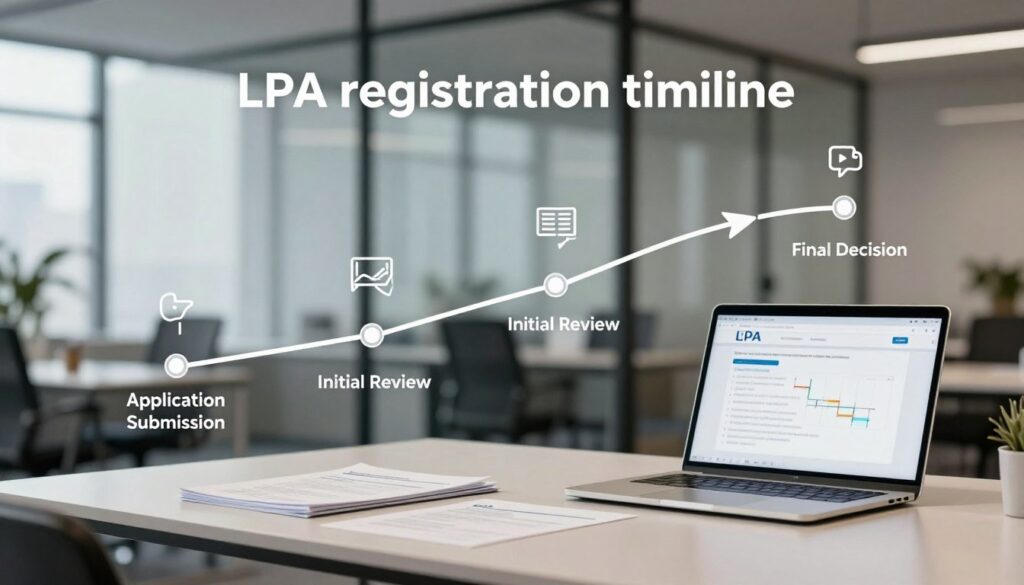
The average processing time for registering a Lasting Power of Attorney in England and Wales is typically between 8 and 10 weeks from the date the OPG receives a correctly completed application. However, it is not uncommon for the process to take up to 20 weeks, particularly during busy periods or if there are any issues with the application. Part of this time includes the mandatory 4-week waiting period during which named persons can object to the registration. This waiting period cannot be shortened or waived — it is built into the process by law.
Factors That Can Affect Processing Time
Several factors can impact the processing time for LPA registration. The most common are:
- Errors in the application form: Even seemingly minor mistakes — wrong dates, unsigned pages, or using the wrong form — will result in the OPG returning your application for correction.
- Missing information or documentation: Forgetting to include the fee, omitting continuation sheets, or failing to notify named persons before submitting will all cause delays.
- Objections from named persons or the OPG itself: If someone raises a factual or prescribed objection, the OPG must investigate before proceeding. This can add significant time to the process.
- OPG workload: The OPG processes hundreds of thousands of LPA applications each year. During peak periods, processing times can extend beyond the typical 8-10 week window.
To give you a clearer understanding, here is a breakdown of the potential delays and their impact on the overall processing time:
| Factor | Potential Delay | Impact on Processing Time |
|---|---|---|
| Errors in Application | 2-6 weeks | Application returned for correction — the clock restarts once resubmitted |
| Missing Information/Documentation | 4-8 weeks | Time taken to gather, correct, and resubmit required documents |
| Objections Raised | Variable — can be several months | OPG must investigate and may refer the matter to the Court of Protection |
| OPG Workload | Variable | Dependent on the volume of applications and staffing at the OPG |
For the most up-to-date information and to check the status of your application, you can visit our detailed guide on LPA registration.
Role of the Office of the Public Guardian
The Office of the Public Guardian (OPG) is the government body that sits at the centre of the LPA process. Without OPG registration, an LPA has no legal effect — it is simply a piece of paper. Understanding the OPG’s role can help you navigate the process more effectively.
What Does the Office of the Public Guardian Do?
The OPG was established under the Mental Capacity Act 2005 and is responsible for registering LPAs, maintaining the register of attorneys and deputies, and protecting people who lack capacity. Their responsibilities extend beyond simple form-processing — they have a duty to safeguard vulnerable individuals from abuse or exploitation by those appointed to act on their behalf.
The key functions of the OPG include:
- Registering Lasting Power of Attorney applications — checking that forms are correctly completed, signatures are in order, and the certificate provider has confirmed the donor’s understanding
- Maintaining a register of all registered LPAs and Court of Protection deputyship orders
- Supervising attorneys and deputies to ensure they act in the donor’s best interests and in accordance with the principles of the Mental Capacity Act 2005
- Investigating complaints and concerns — for example, if a family member suspects an attorney is misusing the donor’s money, the OPG can investigate and, if necessary, refer the matter to the Court of Protection
| OPG Function | Description |
|---|---|
| Registration | The OPG checks LPA applications for accuracy and validity, manages the objection period, and issues the registered (stamped) LPA document. |
| Record Keeping | They maintain a comprehensive, searchable register of all registered LPAs. Third parties (such as banks) can verify a registered LPA through the OPG’s Use a Lasting Power of Attorney service. |
| Supervision and Safeguarding | The OPG supervises attorneys and deputies, investigating any concerns about abuse, neglect, or financial exploitation of vulnerable adults. |
Contacting the Office for Updates
If you are awaiting the registration of your LPA and want to check on progress, you can contact the OPG directly. Have your application reference number ready — this will be on any correspondence the OPG has sent you. You can reach the OPG by telephone on 0300 456 0300 (Monday to Friday, 9am to 5pm), by email at customerservices@publicguardian.gov.uk, or by post. If you used the online tool to create your LPA, you may also be able to check progress through the GOV.UK service. You can find more information on how to obtain Lasting Power of Attorney and the registration process on our website.

For the most up-to-date information and guidance, we recommend visiting the official GOV.UK website or contacting the OPG directly. They are there to help ensure that your LPA is registered correctly and that your interests are protected.
Common Delays in LPA Registration
The OPG reports that a significant proportion of LPA applications are returned because of avoidable errors. Understanding the most common pitfalls can help you get your application right first time — which is the single most effective way to avoid delays.
Mistakes in Application Forms
One of the primary reasons for delays in LPA registration is mistakes in the application forms. These can range from simple errors to more fundamental problems that invalidate the entire document. The OPG is strict about compliance — they cannot register an LPA that does not meet the legal requirements, no matter how minor the error might seem.
Some of the most common mistakes to watch out for include:
- Signing out of order: The donor must sign first, then the certificate provider, then the attorneys. If any signature is dated before an earlier one in the sequence, the application will be rejected.
- Missing witness signatures: The donor’s signature must be witnessed. The witness cannot be one of the named attorneys.
- Using correction fluid: If you make an error on a paper form, you should cross it out neatly and have the correction initialled by the relevant party — never use Tipp-Ex or similar products.
- Incorrect or inconsistent names: Names must match across all sections of the form and correspond to official identification documents.
- Forgetting to include preferences or instructions: While these are optional, if continuation sheets are referenced but not included, the application will be returned.
Missing Information or Documentation
Missing information or documentation is another significant cause of delays. The OPG requires everything to be included with the application — they will not chase you for missing items but will instead return the application, and you will need to correct and resubmit it.
To avoid this, ensure you have the following ready before submitting your application:
- The completed, correctly signed LPA form with all continuation sheets
- The registration fee of £82 per LPA (or evidence of fee exemption/remission)
- Confirmation that all “people to be told” have been notified (if applicable) — you should keep copies of the notification letters and record the date they were sent
- Any additional information the OPG has specifically requested (if you are resubmitting a corrected application)
Here is a summary of the common delays and how to avoid them:
| Common Delay | Cause | Prevention |
|---|---|---|
| Mistakes in Application Forms | Signatures out of order, missing witnesses, use of correction fluid, inconsistent names | Follow the OPG’s guidance notes carefully, use the online tool to reduce errors, and double-check every page before posting |
| Missing Information or Documentation | Fee not enclosed, continuation sheets omitted, “people to be told” not notified | Use a checklist before sealing the envelope — ensure the fee, all pages, and all supporting documents are included |

By understanding the common delays in LPA registration and taking steps to avoid them, you can ensure a smoother and faster registration process. This not only reduces stress but also ensures that your LPA is in place when you need it — because the one thing you cannot do is predict when you might lose capacity.
How to Speed Up the LPA Registration
While there is no way to bypass the mandatory 4-week objection period, there are practical steps you can take to ensure your application moves through the OPG’s process as quickly as possible and is not returned for corrections.
Ensuring Correct Information Is Provided
The single most effective way to speed up LPA registration is to get your application right first time. Every error means the form comes back, you correct it, resubmit it, and the clock starts again. To avoid this:
- Read the OPG’s guidance notes in full before you start filling in the form. They are detailed and cover the most common mistakes people make.
- Check the signing order meticulously: Donor signs and dates first, then the certificate provider, then the attorneys. Each signature must be witnessed, and the dates must follow in sequence.
- Ensure consistency across the form: Names, addresses, and dates of birth should match exactly throughout the document and correspond to official identification.
- Include the correct fee: £82 per LPA, or the appropriate evidence if you qualify for an exemption or remission.
- Send by tracked post: Use Royal Mail Signed For or a similar tracked service so you can confirm delivery to the OPG.
By ensuring the accuracy and completeness of your application, you can significantly reduce the processing time and avoid the frustration of having your forms returned.

Using Online Services for Submission
Using the GOV.UK online LPA tool is one of the most effective ways to reduce errors and speed up the process. The online service guides you through each section step by step, validates information as you go, and produces a correctly formatted document ready for signing and posting. The benefits include:
- Built-in error checking: The online tool flags common mistakes before you print the document, catching issues that are easy to miss on a blank paper form.
- Clear signing instructions: The printed document includes numbered steps telling each person exactly when and where to sign, making it much harder to get the signing order wrong.
- Online fee payment: You can pay the £82 registration fee online, removing the risk of a cheque being lost or bouncing.
- Progress tracking: You can track the status of your application through the online service once it has been submitted.
By using the online service, you significantly reduce the chance of your application being returned — and that is the key to achieving the fastest possible registration time.
Frequently Asked Questions About LPA Registration
Understanding the intricacies of LPA registration is important, so here are some of the most frequently asked questions we receive. Registering a Lasting Power of Attorney is a significant step in planning for the future, and it is natural to have concerns about the process.
Can I Withdraw My Application?
Yes, the donor can withdraw (cancel) an LPA application at any time before it is registered. If you change your mind after registration, you can also revoke a registered LPA — provided you still have mental capacity to do so. To withdraw an application before registration, you must notify the Office of the Public Guardian (OPG) in writing, clearly stating your intention. Include your full name, date of birth, and any reference number the OPG has provided.
Key points to consider when withdrawing an LPA application:
- Notify the OPG in writing — a letter or the appropriate OPG form is required.
- Include your LPA registration reference number if one has been assigned.
- The registration fee is non-refundable if the OPG has already begun processing your application (though in some circumstances a partial refund may be available).
- If you wish to revoke a registered LPA (after registration), you must complete a “deed of revocation” and notify the OPG and your attorneys in writing.
What Happens if the Application Is Rejected?
If your LPA application is rejected, the OPG will write to you explaining the reasons. They will return the original documents so you can correct the issues and resubmit. Common reasons for rejection include signatures being out of order, the certificate provider not being eligible, missing pages, or the form being completed using an outdated version.
Steps to take if your LPA application is rejected:
- Read the OPG’s letter carefully — they will specify exactly what was wrong with your application.
- In some cases, you may be able to correct the issue on the existing form (for example, by obtaining a missing signature). In other cases, you may need to start the form again from scratch.
- Resubmit the corrected application with a fresh registration fee if the original fee cannot be carried over.
If you are unsure how to resolve the issue, consider seeking help from a specialist estate planning professional. Getting it right on the second attempt avoids further delay — and every week of delay is a week without the protection an LPA provides.
Post-Registration Steps
Once your Lasting Power of Attorney has been registered, the OPG will return the original stamped LPA document to you. This stamped document is the proof that the LPA is valid and registered — your attorneys will need to show it whenever they act on your behalf.
What to Do After LPA is Registered
After the registration of your LPA, there are several important practical steps to take:
- Inform Your Attorneys: Make sure your chosen attorney(s) know the LPA is now registered. Discuss your wishes and preferences with them so they are prepared to act if the need arises. A Health and Welfare LPA can only be used once you have lost capacity, so your attorneys need to understand your values, preferences, and any specific instructions or conditions you have included.
- Store the Original Safely: Keep the stamped original LPA document in a secure but accessible location. Let your attorneys and a trusted family member know where it is stored. Consider keeping it alongside your will and trust deed (if you have one) so everything is in one place.
- Provide Certified Copies: Rather than handing over the original to each institution, you can provide certified copies. A solicitor can certify a copy as a true copy of the original. Some banks will also accept the OPG’s online verification service as an alternative to seeing the physical document.
Who Needs a Copy of the LPA?
Your attorney(s) will need access to the registered LPA to act on your behalf. In practice, you should also proactively share certified copies or register the LPA with the following:
- Banks and Financial Institutions: Most major UK banks have specific processes for registering an LPA on their systems. It is much easier to do this in advance — when there is no urgency — than to do it in a crisis when your attorney suddenly needs to access your accounts. Some banks take several weeks to process an LPA registration on their own systems.
- Your GP and Healthcare Providers: For a Health and Welfare LPA, your GP surgery and any hospital or care providers should have a record of your LPA and know who your attorney is. This ensures your attorney can be consulted on medical decisions without delay.
- Your Solicitor or Estate Planning Professional: If you have a solicitor or work with a firm like MP Estate Planning, provide them with a copy so they can coordinate with your attorneys if needed, particularly if you also have trusts or other estate planning arrangements in place.
For more information on how to simplify the process with our expertise, you can visit our page on Power of Attorney Expertise.
Conclusion: Planning for the Future
As we have discussed throughout this article, registering a Lasting Power of Attorney is one of the most important — and most overlooked — pieces of forward planning you can do. The process takes time, and it cannot be rushed. The importance of planning ahead for LPA cannot be overstated: by the time you or your family realise an LPA is needed, it may already be too late to put one in place.
Starting Early
With a typical registration time of 8 to 10 weeks — and potentially much longer if there are errors or objections — the best time to start the LPA process is while you are fit and well, with no foreseeable health concerns. Many people put this off because they feel it is something for “later” or for “older people.” The reality is that strokes, accidents, and sudden illness do not discriminate by age. If you lose mental capacity without a registered LPA, your family faces a Court of Protection application that costs far more, takes far longer, and is far more stressful. As Mike Pugh puts it: “Plan, don’t panic.” An LPA alongside a properly drafted will and, where appropriate, a lifetime trust, gives you and your family comprehensive protection and genuine peace of mind.
Effective LPA Registration Timelines
Managing LPA registration timelines effectively comes down to preparation. Use the GOV.UK online tool to reduce errors, follow the signing instructions to the letter, include the correct fee, send by tracked post, and start the process well before you think you need it. If you would like professional support with your LPA alongside broader estate planning — including inheritance tax planning, trusts, and wills — MP Estate Planning can help guide you through every step. Not losing the family money provides the greatest peace of mind above all else.