


We know trustees face a lot of questions. This short guide sets out, in plain terms, what is expected after the end of the tax year. We cover the steps you must take to register, gather records and complete the Trust and Estate Self Assessment.
Our aim is simple: to protect the family and avoid avoidable mistakes. We explain the difference between trust capital and taxable income, and show how rules differ for bare, interest-in-possession, discretionary and settlor-interested arrangements.
We walk through the full journey: registering, filling the return, paying tax on time and issuing beneficiary statements. A clear family example — funding grandchildren’s education — makes the steps feel practical rather than legalistic.
Read on to find plain guidance for trustees and families for the 2024/25 year, with the key deadlines and actions that matter most.
Key Takeaways
- Trustees must report and pay tax after the tax year using the Trust and Estate return.
- Know the difference between capital and taxable income to avoid queries.
- Rules change by trust type — follow the right process for each arrangement.
- Keep clear records, meet deadlines and issue beneficiary statements promptly.
- Our example shows practical steps for a family education trust.
Who must report trust income and why HMRC compliance matters
A quick role check stops confusion: who controls the funds, who receives them and who must act.
We explain the duties so you can avoid surprise bills and letters from HMRC. If there are two or more trustees, nominate a principal acting trustee to lead admin. That person co‑ordinates the paperwork, but all trustees remain legally liable for any unpaid tax and interest.

Key roles made simple
- Trustees: run day‑to‑day compliance and file returns.
- Principal acting trustee: leads admin and liaises with advisers.
- Settlor: the person who established the arrangement; they may have extra duties in some cases.
- Beneficiary: may need to declare distributions personally if income is mandated to them.
What usually counts as taxable amounts
Common sources in a trust estate include bank interest, dividends and rental receipts. These amounts normally link to Income Tax obligations and the relevant rate depends on the type of arrangement.
Risks of non‑compliance
Get it wrong and the real cost is clear: unpaid tax, late filing penalties, plus late‑payment interest. There is also time lost and stress from follow‑up enquiries.
Before you start: ask three short questions — who receives the amount, who controls it and who is legally liable for paying tax. That simple check saves mistakes.
Identify your trust type before you start your tax return
We begin with a clear checklist. Choose the correct type and you follow the right path for paying tax and filing a return.

Bare trust responsibilities and who pays
In a bare trust the beneficiary is treated as the owner. They usually include the amounts on their Self Assessment and pay income tax themselves.
Read our bare trust inheritance guide for practical examples.
Interest in possession trusts
With interest possession trusts, a life tenant often receives mandated interest. Trustees normally pay at basic rates but the beneficiary declares it if it is paid to them directly.
Discretionary and accumulation arrangements
Where trustees decide who gets what, they lead on paying tax and filing the trust tax return. Trustees also issue statements when they make distributions.
Settlor-interested arrangements
If the settlor keeps a link to the assets, the settlor declares the income on their return. Trustees still pay tax as it arises and supply a statement.
“Classify first, act next — it keeps money and paperwork in order.”
| Type | Who pays | Who files |
|---|---|---|
| Bare trust | Beneficiary | Beneficiary |
| Interest in possession | Trustees (basic rate) or beneficiary if paid to them | Trustees or beneficiary |
| Discretionary / Accumulation | Trustees | Trustees |
| Settlor-interested | Settlor (declared); trustees pay and report | Trustees (SA900) and settlor |
Registering a trust with HMRC using the Trust Registration Service
Getting the legal entity recorded on the register is a practical first step for trustees.

When you must register
Register once the arrangement becomes liable for tax. That usually means when tax is due, or when you must file a return for the year.
Obtaining a Unique Taxpayer Reference
After registration you will receive a Unique Taxpayer Reference (UTR). You need this UTR before you submit any return or make online filings.
Keeping the register up to date
Use the online service to tell the authority about changes. Typical timing is to update details within 90 days of a change to beneficial ownership, trustee details or address.
- Have the trust deed, trustee names and dates ready before you start.
- Gather key party details and estate values to speed the form.
- Keep records of the version and page references from the deed.
Usability note: if you see a cookie settings page on GOV.UK, use change cookie settings to allow the service to work smoothly — it only takes a moment.
“Register early to protect the family and make annual returns easier.”
hmrc trust income reporting: what you need for the tax year
Before you file, assemble a clear set of papers so figures reconcile. A concise records pack saves time and reduces queries. Keep statements and vouchers that prove each receipt.

Records to gather for your return
- Bank statements covering the full tax year.
- Dividend vouchers and platform income summaries.
- Rental statements, invoices and expense receipts.
- Any form showing tax paid or credits.
Separating dividend, interest and other amounts
We split dividend-type amounts from interest and other receipts. Different rates apply to each type, so record them separately.
Accounting for tax already paid and the tax pool
Note any tax paid during the year. Create a simple “tax pool” ledger to track credits and earlier payments. This helps when you complete the trust estate tax return and reconcile totals to bank records.
“Don’t mix capital receipts with taxable amounts — that’s the commonest error.”
Year‑end tidy‑up checklist: reconcile bank totals, match vouchers to the return, log tax paid and keep a copy of each page. For help with registering or agent guidance see registering a trust as an agent.
Trust income tax rates and allowances for the 2024/25 tax year
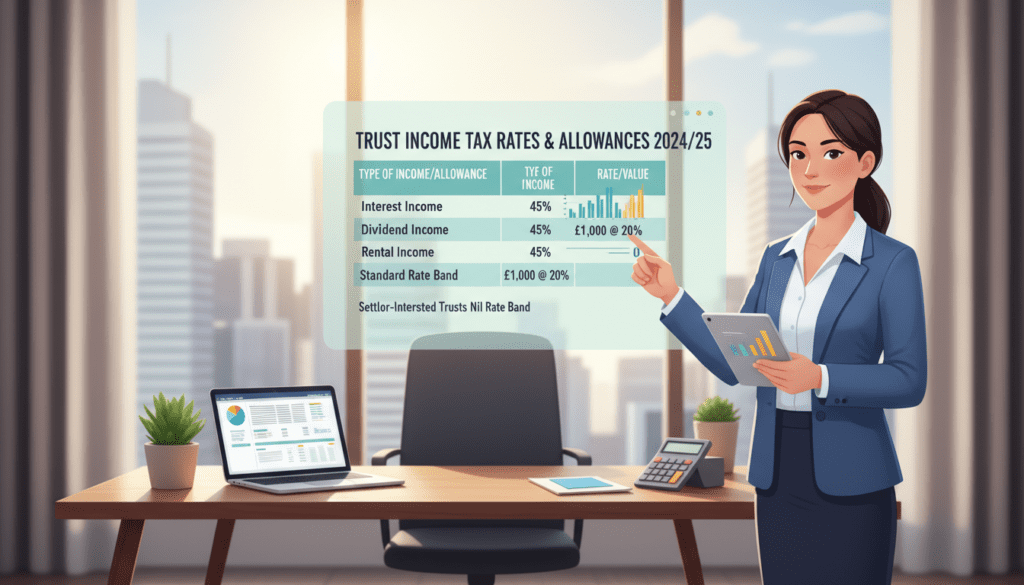
Clear rules on allowances and rates mean trustees can plan distributions with confidence. We explain the small tax‑free amount, the different rates for discretionary and interest‑in‑possession arrangements, and practical splits where one settlor has several arrangements.
The £500 tax‑free amount and when it applies
Most arrangements get a small tax‑free amount (normally £500). If total receipts for the year exceed this amount, tax is due on the whole sum — not just the excess.
Discretionary (accumulation) rates for 2024/25
Discretionary arrangements pay higher rates. For dividend‑type receipts the rate is 39.35%. For other receipts the rate is 45%.
Interest in possession rates and distributions
Where a life tenant has a right to income, rates are gentler. Dividend‑type amounts are taxed at 8.75% and other receipts at 20% for 2024/25. That often feels closer to basic‑rate treatment when amounts are paid out regularly.
“Treat the £500 limit as a threshold — once you pass it, the whole amount becomes taxable.”
Dividend allowance and multiple arrangements
Trustees do not qualify for the personal dividend allowance. Plan distributions without relying on that relief.
If the same settlor has more than one discretionary or accumulation arrangement, the £500 limit is split between them. If there are five or more, each arrangement normally gets £100.
| Arrangement | Dividend‑type rate | Other income rate |
|---|---|---|
| Discretionary / Accumulation | 39.35% | 45% |
| Interest‑in‑possession | 8.75% | 20% |
| Tax‑free amount per arrangement | Normally £500 (split if same settlor created multiple arrangements) | |
Back‑of‑the‑envelope example: a discretionary pot paying £1,000 of dividend‑type receipts faces tax at 39.35%, leaving about £605 after tax. Use this simple check when planning distributions.
For official guidance on how the rules apply in practice see our short guide to trusts and income tax and practical planning ideas at secure your family’s future.
How to complete and submit the Trust and Estate Self Assessment tax return
Completing the Trust and Estate Self Assessment is a practical task you can plan for, not a last‑minute scramble. Start with neat working papers that match bank records. That step will save time when you transfer figures to the final form.

Choosing paper SA900 versus electronic submission
There are two main routes. Use the SA900 paper form if you prefer a physical copy and can post by the deadline. Buy compatible software and file online if you want instant submission and fewer manual checks.
Key deadlines after the end tax year
- Paper form SA900 posted by 31 October.
- Online returns via software by 31 January.
What to include on the estate tax return
Report the estate’s income, any gains and the core trust estate details that tie to the register. Include trustee names, the Unique Taxpayer Reference and the version of accounts used.
Practical tips to reduce errors
- Prepare a clean working copy before the final entry.
- Match totals to bank statements and vouchers.
- Keep dividend‑type amounts separate from other receipts.
- Check trustee details against the online register to avoid mismatched data.
“A tidy set of working papers halves the chance of rework.”
| Action | Why it matters | When to do it |
|---|---|---|
| Choose form or software | Determines filing route and time needed | Start at year‑end |
| Prepare working papers | Reduces data entry errors | Before final return |
| Reconcile bank and vouchers | Supports figures if queried | Before submission |
| Submit and save a copy | Proof of filing and version control | By deadline |
After you send the return, the tax office will tell you the amount due. Keep records of the submission and payment receipts to close the year with confidence.
Paying Income Tax after filing and staying on top of deadlines
Filing is not the finish line; it starts the payment cycle and a few crucial checks. Once the tax return is sent, HMRC will process the figures and confirm how much you owe.
What happens after you submit and how you pay
We usually see a confirmation followed by a bill showing the amount due. Trustees should check that figure against their working papers, especially where different rates apply to dividend‑type receipts and other income.
Payment timing and avoiding late‑payment interest
Pay the Self Assessment bill by the deadline to avoid penalties and interest. Plan cashflow: note the payment date for the year and set diary reminders well before it falls due.
- Sanity‑check: match the bill to your totals for each income type and the applicable rates.
- Record keeping: log the tax paid in the estate accounts and keep receipts.
- Simple routine: diary reminder, one‑page payment checklist and a copy of the submitted return.
“Staying organised each year is the easiest way to protect the estate from unnecessary costs.”
Issuing beneficiary and settlor statements using form R185
Issuing the right statement helps beneficiaries claim overpaid tax and complete their own returns. We provide clear steps so you can prepare form R185 (trust) without delay.
When beneficiaries can reclaim tax and what they need
Beneficiaries may claim a refund if the tax credited on their statement exceeds their personal liability. The statement shows the amount of income and the tax paid.
Provide the beneficiary with the exact figures, tax paid and the period covered. They use these on their Self Assessment to reclaim or offset tax.
How to complete form R185 (trust) for each share
Complete an R185 for every beneficiary who asks. Enter the total receipts, split by type, and the tax paid against each line.
Where there are multiple recipients, use a fair shares approach. Allocate amounts exactly as distributions were made.
Settlor-interested statements and correct rates
If the settlor retains an interest, provide the settlor with the separate form, using the correct rate for that arrangement. The settlor then declares the amount on their own return.
Taxable pension lump sums (LSDB) and the 30‑day rule
For taxable lump sum death benefit payments, use form R185 (LSDB). Tell the beneficiary within 30 days so they can act promptly.
Tip: keep a dated copy of every issued statement in the estate file. Copies save time if figures are queried later.
| Situation | Form to use | Key action |
|---|---|---|
| Standard beneficiary distribution | form R185 (trust) | Issue statement showing amount and tax paid |
| Settlor retains interest | Separate settlor R185 | Use correct rate; settlor declares on own return |
| Taxable pension lump sum death benefit | form R185 (LSDB) | Notify beneficiary within 30 days |
“Clear statements avoid family disputes and make reclaiming tax straightforward.”
Other HMRC reporting duties trustees should not miss
Timely updates and clear records protect the estate and make year‑end simpler.
Tell the online service about changes
Trustees must update the register when names, addresses or beneficial ownership change. Use the online service quickly so the version on the register matches your papers.
Update within 90 days of a material change to avoid queries and simplify the estate tax return process.
When inheritance tax and form IHT100 apply
Some estates need an IHT100. If the arrangement triggers inheritance tax, complete the form and settle any bill promptly.
Failing to check inheritance tax can leave the estate facing larger costs than the annual tax bill.
Keep documentation in case evidence is requested
Keep bank statements, distribution notes, tax workings and copies of each submitted return. Store a dated version of accounts and the final version of the trust estate tax return.
This simple checklist supports future queries and links TRS updates to self assessment tax compliance.
- Retention checklist: bank statements, distribution notes, tax workings, submitted form copies.
- Save a dated page copy of each version and keep digital backups.
- Use the GOV.UK page prompts to change cookie settings or accept additional cookies if needed to complete online tasks.
“Keeping the register and records in step protects the estate and reduces stress.”
Conclusion
Here is a simple recap that turns year‑end tasks into a routine.
First, identify the correct type and register when the arrangement becomes liable for tax. Then gather clear records and prepare a neat set of working papers for the trust estate tax return.
File the estate tax return on time. Use paper SA900 by 31 October or file online by 31 January. Pay the bill by the deadline to avoid interest and penalties.
Remember the key numbers for 2024/25: the £500 threshold can make the whole amount taxable once it is passed. Issue R185 statements (and settlor statements where needed) so beneficiaries and settlors can declare correctly.
Next step: make a short annual checklist. Repeat it each year to keep the trust estate orderly, protect family assets and make the return process routine rather than a last‑minute scramble.