


Quick answer
Common UK trust compliance mistakes that trigger HMRC enquiries: (1) missing the Trust Registration Service deadline (90 days from trust creation, 30 if liable for tax) — penalties from £100 upward; (2) failing the annual TRS confirmation even where nothing has changed; (3) filing SA900 late or not at all where the trust has UK tax liability — £100 escalating penalties; (4) not paying the 10-year periodic charge on relevant property trusts (or paying late) — interest plus penalties; (5) incorrect application of BPR/APR — especially since the £2.5m cap from 6 April 2026; (6) not accounting for the 20% entry charge on lifetime transfers above £325k into discretionary trusts; (7) income distributions paid gross when trustees should have paid tax first; (8) poor recordkeeping of trustee decisions. This guide explains how UK trustees can avoid common HMRC trust compliance mistakes in 2026, the most-penalised errors, and the practical steps to stay compliant.
Last reviewed: 24 May 2026 by the MP Estate Planning editorial team. Jurisdiction: England and Wales. Scotland and Northern Ireland have different probate and intestacy rules; the IHT thresholds are UK-wide.
We know trustees often juggle family life and duties. Registering and reporting a trust is no longer just tax paperwork. It is an ongoing duty that sits alongside other legal responsibilities.
Rules have broadened and deadlines are tight. Even with advisers involved, trustees are expected to act. Most trusts must now register on the Trust Registration Service and updates must be timely.
We wrote this guide for real-life trustees who want to get it right. It explains what good practice looks like: correct registration, accurate records, timely reporting and sensible governance habits.
Get it wrong and delays, stress and possible penalties can follow. Trustees can face personal liability if they do not take reasonable care. For a practical next step, see our short guide to register a trust as a trustee.
Key Takeaways
- Registration is often required even when no tax is due.
- Trustees carry personal responsibilities for records and reporting.
- Timely updates reduce the risk of penalties and stress.
- Simple governance habits prevent most common errors.
- Practical guidance helps trustees fulfil requirements with confidence.
What trust compliance means for UK trustees today
Every trustee needs a clear sense of what day‑to‑day trust duties look like.
In practice, this means keeping the trust visible where required and updating key details when things change. Registration has widened under anti‑money‑laundering regulations, so many arrangements now fall into scope even with no tax to pay.

Who does what
All trustees share obligations. Even when a professional adviser helps, trustees must check records and act with reasonable care.
The lead trustee usually manages online access and is the main point of contact. That role is practical, not a shield from personal liability.
Liability and a simple example
Trustees can be held accountable if deadlines are missed or details are ignored. It is a measured risk, not a cause for panic.
Imagine siblings running a family trust: one is organised, the other busy. If filings are late, both remain on the hook.
- Next, we look at what must be registered and maintained and the common trip‑wires to avoid.
hmrc trusts compliance essentials: what you must register, report and review
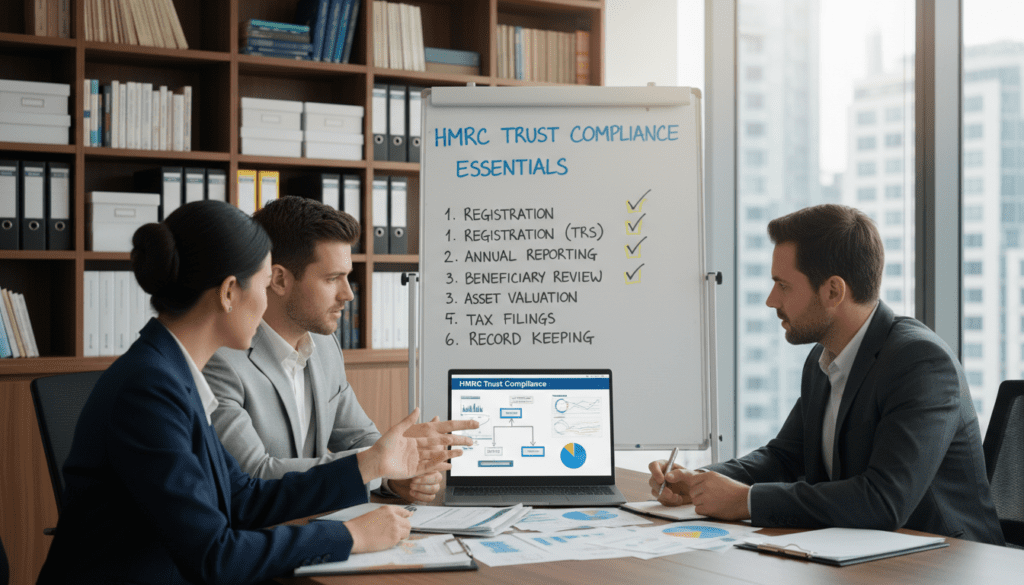
Clear, up-to-date files stop small admin slips turning into big problems. We outline the practical points every trustee should check and keep current.
Taxable and non-taxable in plain terms
Taxable means the trust can have UK tax to pay. That label brings extra filing duties.
Non-taxable often still needs registration. Since the 5MLD changes, many arrangements are within scope even with no tax due.
Core information to maintain
Make sure you can find key details quickly. Keep a single file with:
- Who the trustees are and contact details.
- Who the beneficiaries are and how they are identified.
- Clear descriptions of the assets and their values.
- Who holds control or influence over decisions.
Common mistakes that cause delays and penalties
Small gaps cause the biggest headaches. Typical errors include out-of-date beneficiary details, missing dates, vague asset descriptions and not recording trustee changes.
Trustees must not assume “no tax means no action”. Missing a deadline or relying entirely on an adviser can lead to penalties and extra work.
Mindset: treat the trust as a living file that needs light maintenance. Next, we explain TRS registration and how to avoid common submission errors.
How to register on the Trust Registration Service and avoid TRS errors
We walk trustees through the practical steps to get registration right and avoid common TRS mistakes.

When to register and limited exemptions
Most trusts created after 6 October 2020 need the trust registration service record. Exemptions are narrow and can be lost if the trust’s activity changes.
Tip: check the type trust and whether any tax liability applies before assuming you are exempt.
Deadlines and reporting changes
New trusts must register within 90 days of creation. Likewise, relevant changes must be reported within 90 days — the same 90‑day clock applies.
Remember, trustees must treat these clocks as admin deadlines, not optional tasks.
Annual declaration and using agents
Taxable trusts must file an annual declaration or return even when nothing changes. It is a simple confirmation rather than a full re‑submission.
Trustees can authorise agents to act on their behalf through the registration service. Use professional advice, but retain oversight and record authorisation carefully.
- Before you submit: verify names, dates and beneficiary categories.
- Summarise assets and record who controls decisions.
- Keep evidence on file in case you need to amend the register after changes.
“A short checklist before you click save prevents most TRS errors.”
Staying on top of HMRC trust reporting and tax return duties
Three rule changes you may need to consider (2026/27)
1. Pensions become subject to IHT from 6 April 2027. Most unused defined-contribution pension pots currently sit outside the estate for IHT — that ends on 6 April 2027 (gov.uk policy paper). HMRC estimates around 10,500 estates will face IHT for the first time as a result.
2. Business and agricultural property reliefs capped at £2.5m per person from 6 April 2026. Above the cap, only 50% relief applies — effective IHT of 20%. AIM shares dropped to 50% relief and do not use the £2.5m allowance (Saffery — APR/BPR reforms).
3. The NRB, RNRB and £2m taper threshold are frozen until 5 April 2031 following the 2024 and 2025 Budgets (gov.uk — NRB and RNRB freeze). With inflation, more estates will be pulled into IHT each year — a process commonly called “fiscal drag.”
Even modest activity in a family arrangement can mean a formal tax return is due. We explain what triggers a return and how to act fast if a Notice to File arrives.

When a tax return is mandatory, even if nothing is due
Trusts may need an annual tax return even when there is little income and no tax to pay. A notice from the tax office makes filing compulsory.
How to respond to a Notice to File when advisers are not alerted
Treat the letter as urgent. Open post promptly. Confirm who received the notice and tell your adviser immediately.
- Note the deadline and diarise the submission date.
- Confirm whether you or your agent will file the return.
- Keep a copy of correspondence and any authorisation for agents.
Record-keeping to support reporting: income, distributions and expenses
Good records make a return straightforward. Keep clear entries for income received, expenses paid and distributions to beneficiaries.
| Record type | Examples | Why it matters |
|---|---|---|
| Income | Rental receipts, bank interest statements | Shows taxable receipts and supports income declarations |
| Expenses | Repairs invoices, management fees | Allows allowable deductions and reduces tax where due |
| Distributions | Trust minutes, bank transfers to beneficiaries | Explains who received income and supports allocation on the return |
| Supporting documents | Statements, receipts, valuation notes | Evidence in case of queries or audits |
Think of the penalty pathway: missed notice → late return → result penalties. Simple habits prevent this.
“A modest rental and a small bank account still need tidy records to make any return quick and accurate.”
For practical help on appointing an agent, see our guidance on registering an agent. We also link ahead to the taxes trustees most commonly meet and the special reporting rules that often surprise people.
Paying the right taxes: income tax, Capital Gains Tax and Inheritance Tax reporting
Trust taxation is varied, not uniform. How income is treated depends on the type of arrangement and whether income is paid out or kept in. That distinction decides who pays income tax and when reporting is needed.

Income tax reporting for different types and income flows
Some types of arrangement mean beneficiaries are taxed on income when it is paid out. Others tax the arrangement itself on accumulated income.
Key action: identify the type trust and note whether income is distributed or retained. This decides rates, reporting and any tax liability.
Capital gains on UK residential property — 30‑day rule
Disposals of UK residential property create a tight deadline. Where gains arise, reporting and payment to the authorities must happen within 30 days of completion.
Common pitfalls are late login access, missing valuations and incomplete paperwork. Prepare a pre‑sale checklist: valuations, title details, completion date and agent authorisations.
Inheritance tax touchpoints and decade charges
Inheritance tax can matter at setup, during administration and on winding up. Forms and calculations may be needed at each stage.
Discretionary trusts also face ten‑year anniversary charges and possible exit charges. These dates are easy to miss and often trigger unexpected tax work.
| Event | What to check | Timescale |
|---|---|---|
| Income distributions | Who received income; record payments and documentation | Yearly; when paid |
| Property disposal | Valuation, completion date, payer details | Report and pay within 30 days |
| IHT on creation/winding up | Form completion, value calculations, liabilities | On event; file as required |
| Ten‑year and exit charges | Anniversary dates, calculations, beneficiary movements | Every 10 years and on relevant exits |
“Plan dates, keep valuations and document decisions — that simple habit saves time and cost.”
We can help you plan ahead and avoid common errors. For practical guidance on inheritance tax and planning, see our short guide to secure your family’s future.
Additional regimes trustees may need to consider beyond HMRC registration
If people or assets link abroad, extra reporting regimes can apply to your arrangement.

Automatic Exchange of Information: FATCA and CRS
AEOI (FATCA and the Common Reporting Standard) asks financial institutions to share data about accounts with overseas tax authorities.
In practice, a trust can be reportable if it holds bank accounts, investments or other reportable assets and has non‑UK connections.
How classifications change duties
A trust’s type, the people involved and the assets it holds determine whether reporting is needed.
Change a beneficiary, add overseas investments or alter the type of asset and the reporting requirements can change too.
Deadlines and Scotland’s land register
AEOI reporting follows the calendar year. Where required, reports are due by 31 May.
Separately, Scotland’s Register of Persons Holding a Controlling Interest in Land (RCI) can require reporting within 60 days for relevant property interests.
Penalties are real but avoidable: AEOI failure £300; incorrect AEOI filing £3,000; and TRS/RCI breaches can reach £5,000.
Simple habit: once a year review beneficiaries, assets and any cross‑border links. It keeps reporting clear and reduces the risk of penalties.
For practical detail on AEOI registration see our note on AEOI registration requirement.
Governance that prevents mistakes: documenting decisions, accounts and disclosures
Documenting who decided what and why makes future reporting straightforward and calm. Good governance makes planning easier and reduces stress for trustees and beneficiaries.
Using Deeds of Appointment for distributions and adding beneficiaries
Distributions should be formalised. Use a Deed of Appointment when you make payments or add a new beneficiary. That creates clear evidence and protects trustees if questions follow.
Trustee meeting minutes and written resolutions
Keep short minutes or written resolutions for investment choices, distributions and property matters.
- Note who voted and why.
- Record any professional advice relied on and attach it.
- Sign and date decisions so there is an audit trail.
Preparing annual trust accounts and managing beneficiary requests for information
Prepare tidy annual accounts as a snapshot of assets and activity. They are practical for planning and make returns and enquiries quicker.
Beneficiaries can request information. Decide what to share based on their interest in the trust and record your response.
“Clear records cut delays — good governance costs little but saves a great deal.”
Conclusion
A short, steady routine keeps a trust in order and your family protected.
Register when required and keep details current. File returns when asked and record key decisions as you go. These simple habits reduce the chance of penalties and personal liabilities.
Watch the deadlines: 90 days for TRS registration and updates, annual declarations for taxable arrangements, AEOI by 31 May and RCI within 60 days where relevant. Trustees may use advisers, but you remain responsible for the outcome.
Start today: check whether the trust is on the register, confirm the lead trustee’s access, review beneficiary and trustee details and set an annual compliance review date. For practical help on registration see registering a trust in Britain.
FAQ
What does trust compliance mean for UK trustees today?
Trust compliance means trustees must register details, keep accurate records and report tax when required. Newer anti-money laundering rules broadened what must be disclosed. We advise keeping a simple file with trustee names, beneficiaries, assets and sources of control to meet obligations.
Why has reporting to HMRC expanded under anti‑money‑laundering regulations?
The expansion aims to increase transparency and prevent illicit finance. More trusts now fall within scope, so trustees who once avoided reporting may now need to register and disclose beneficial owners and controllers.
Who is responsible for meeting trust duties and what personal liability exists?
Trustees carry legal responsibility. The lead trustee or appointing trustee often manages administration, but all trustees can be held personally liable for missed reporting or tax. We recommend clear roles and written delegation to reduce risk.
Which trusts must be registered, reported and regularly reviewed?
Most trusts with taxable events or identifiable beneficiaries must be on the register. This includes many discretionary and interest‑in‑possession arrangements. Exemptions are narrow and time‑limited, so review each trust rather than assume exemption.
How do taxable and non‑taxable trusts differ for reporting?
Taxable trusts trigger obligations such as filing returns and annual declarations. Non‑taxable trusts still often require registration and updates if beneficiaries or trustees change. Treat each trust on its facts and document the tax position.
What key information must trustees maintain?
Keep names and contact details of trustees and beneficiaries, descriptions of assets, dates of creation and documentation of who controls the trust. Accurate records make registration and any future tax work far easier.
What common mistakes lead to penalties or delays?
Typical errors are late registration, out‑of‑date beneficiary lists, missing tax returns and poor record‑keeping. Relying on memory rather than documents often causes problems in audits or when a Notice to File arrives.
When must a trust be registered on the Trust Registration Service (TRS)?
Register within the time limits set for the trust’s type. Many trusts must join the TRS soon after creation or when they become liable to tax. Limited exemptions exist, but you should confirm the position rather than assume one applies.
What deadlines commonly catch trustees out when registering on the TRS?
Registering within 90 days of the trust’s creation or when it becomes liable to tax is a frequent requirement. Missing this window can lead to penalties and extra administrative work to correct records.
How quickly must trustees report changes to the register?
Changes to trustees, beneficiaries or assets usually need updating within 90 days. Prompt updates prevent mismatches between records and HMRC’s view of the trust.
Do taxable trusts need to make an annual declaration even if nothing changes?
Yes. Many taxable trusts must confirm details each year through an annual declaration to keep the register accurate. This helps prevent enquiries and penalties.
Can trustees use agents or advisers to manage TRS registration?
Yes. Trustees can authorise agents to act on their behalf, but trustees remain responsible for accuracy. Keep a written authority and check submissions from advisers carefully.
When is a trust tax return mandatory even if no tax is due?
A return is often required if the trust receives income, makes distributions, or if it’s a type that triggers filings by law. You must file to keep records straight and to avoid penalties, even if the tax liability is zero.
What should trustees do if they receive a Notice to File and their adviser was not informed?
Respond promptly. Contact the adviser to resolve the issue and notify HMRC of who handles the trust. If there’s a delay, explain the situation and provide the missing information as soon as possible.
What records should be kept to support reporting?
Keep income details, distribution records, expense receipts and minutes of trustee decisions. Hold these for the period required by tax rules. Clear records reduce stress and speed up any enquiries.
How does income tax reporting change by trust type and income flow?
Different trust types have distinct rules for income allocation and rates. For example, distributions to beneficiaries affect who pays tax. Check the trust’s classification and record how income moves through the trust.
What are the rules for Capital Gains Tax on UK residential property held in a trust?
Gains on UK residential property often require reporting and payment within 30 days of disposal. This deadline is strict and penalties can follow missed filings, so plan sales with tax timing in mind.
What are the key Inheritance Tax touchpoints for trustees?
Inheritance Tax matters arise at set‑up for some trusts, on certain transfers, and when winding up. Trustees must track chargeable events and be ready to report or pay charges like entry, ten‑year or exit charges.
What are ten‑year anniversary and exit charges, and where do trustees go wrong?
Discretionary trusts face a periodic charge every ten years and potential exit charges on distributions. Mistakes include failing to calculate values correctly or missing reporting deadlines. Proper valuation and advance planning help avoid surprises.
What additional international reporting regimes might trustees need to consider?
Trustees may need to meet Automatic Exchange of Information rules such as FATCA and the Common Reporting Standard. These regimes require disclosure of overseas financial accounts and can affect reporting obligations.
How can trust activities or beneficiary changes alter AEOI classifications?
Adding foreign beneficiaries or holding foreign financial assets can change a trust’s AEOI status. Keep advisers informed of such changes so reporting stays accurate and timely.
What are the reporting deadlines for AEOI and related regimes?
Many AEOI reports follow a calendar‑year cycle and are due by 31 May. Check the specific rules for each regime and build deadlines into your annual calendar.
When must trusts report property interests in Scotland?
Trusts with controlling interests in Scottish land may need to report to Scotland’s Register of Persons Holding a Controlling Interest in Land within 60 days of acquiring the interest. Local land rules can add extra steps for trustees.
How does good governance reduce reporting mistakes?
Clear decisions, written minutes and proper accounts make reporting straightforward. We recommend regular trustee meetings, documented resolutions and up‑to‑date accounts so the trust runs smoothly.
When should a deed of appointment be used and why is it important?
Use a deed of appointment to record distributions or to add beneficiaries. It provides legal clarity and helps avoid disputes when assets move or roles change.
How should trustee meeting minutes and written resolutions be managed?
Keep concise minutes that record who attended, decisions made and reasons. For significant choices, use written resolutions so there’s a clear paper trail for future reference.
What should annual trust accounts include and how do they help with beneficiary requests?
Annual accounts should show income, expenses, distributions and asset values. Clear accounts answer beneficiary queries and support tax filings. Share appropriate information while respecting confidentiality.
Trust management platforms, GRC frameworks and what they actually mean for UK trustees
Search for trust management and you will quickly find results from cybersecurity vendors — Vanta, Hyperproof and similar platforms that help technology companies demonstrate compliance with ISO 27001 or SOC 2. Their use of the phrase trust management refers to building organisational credibility with customers around data security. It has no legal relationship whatsoever with the duties of a trustee under English and Welsh trust law. If you are a trustee reading those results hoping for guidance on HMRC registration or ten-year anniversary charges, you are in the wrong library entirely.
What ‘trust management platform’ typically means in a legal context
In estate planning practice, a trust administration platform — or simply a trustee’s file management system — is the combination of software, record-keeping protocols and professional relationships that allows trustees to discharge their statutory duties. This may include secure document storage for the trust deed and supplementary deeds, a ledger recording income receipts and distributions, and a calendar tracking HMRC deadlines. There is no single regulated product called a trust management platform in UK law. What matters, in our experience, is that whatever system trustees use produces an audit trail capable of satisfying HMRC’s Trust Registration Service requirements and supporting any enquiry under the Trustee Act 2000.
How GRC thinking can usefully inform trustee decision-making
Governance, Risk and Compliance (GRC) is a framework originating in corporate regulation, but its three pillars map reasonably well onto trustee fiduciary duty. Governance covers how trustees make and document decisions — minutes, resolutions and investment policy statements. Risk covers the trustees’ duty under section 4 of the Trustee Act 2000 to have regard to standard investment criteria, including the suitability and diversification of trust assets. Compliance covers the obligations explored throughout this article: TRS registration, tax returns, and reporting changes within the prescribed deadlines.
Where GRC frameworks are less useful is in suggesting that compliance is a periodic exercise. For trustees, it is continuous. A change of trustee, a change of beneficiary contact details, or a trust becoming liable to a new tax can each trigger an obligation to update HMRC within 90 days — a deadline that, in our experience, is missed more often than any other because no single trustee feels personally responsible for monitoring it. The Trustee Act 2000 does not excuse a trustee because they relied on a co-trustee to act.
What ‘digital trust compliance’ means for UK trustees in practice
HMRC’s guidance on digital assets held in trust is still developing, but trustees may already hold — or find themselves inheriting responsibility for — cryptocurrency wallets, NFTs, online investment accounts and other digital assets. Under current HMRC guidance, cryptoassets are generally treated as a form of property for capital gains and inheritance tax purposes. Where such assets are held on behalf of beneficiaries, trustees should typically obtain a professional valuation, record the acquisition cost and any disposals, and consider whether the asset forms part of the trust’s reportable estate. Trustees should seek advice from a regulated professional before making any decision about digital asset management, as HMRC’s position on novel asset classes can change at short notice.
Common questions about trust compliance and exempt assets
What does digital compliance mean?
In the context of UK trust law, digital compliance generally refers to two related obligations. First, trustees must ensure that digital assets held within the trust — such as online investment accounts, cryptoassets or valuable digital intellectual property — are properly identified, valued and reported to HMRC where required. Second, trustees must use HMRC’s online Trust Registration Service to register and maintain the trust record in digital form; paper registration is no longer available for most trusts. Neither obligation is straightforward, and in our experience trustees are often unaware that a beneficiary’s online share-dealing account transferred into trust on death may need to be reported separately.
What does exempt asset mean?
An exempt asset in the context of inheritance tax is an asset that falls outside the scope of IHT or qualifies for a relief that reduces its chargeable value to nil. Common categories include assets passing to a surviving spouse or civil partner (the spouse exemption), assets qualifying for Business Relief or Agricultural Relief, and gifts to qualifying charities. It is important to note that an asset being exempt is different from it being excluded property — excluded property, such as certain foreign-situated assets held by non-domiciled individuals, is treated differently again under the Inheritance Tax Act 1984.
What are exempt asset examples?
Examples that trustees and settlors commonly encounter include: qualifying business interests that attract 100% Business Relief under HMRC’s Business Relief rules; agricultural property meeting the conditions for Agricultural Property Relief; assets passing outright to a UK-domiciled spouse or civil partner; and gifts to charities registered in England and Wales. Each relief carries specific conditions, and in our experience the most common error is assuming that a business interest automatically qualifies without checking the trading activity test.
What is the difference between exempt and non-exempt assets?
A non-exempt asset is one that forms part of the chargeable estate and may attract IHT at the applicable rate. Where assets are held in a relevant property trust — most commonly a discretionary trust — non-exempt assets are subject to the periodic charge regime: a maximum rate of 6% at each ten-year anniversary, calculated on the value of relevant property above the available nil-rate band (currently £325,000 in 2025/26). Exempt assets, where properly structured and evidenced, do not form part of that calculation. The distinction is not always binary: an asset may be partially exempt, or exempt only if transferred in a particular way.
What assets qualify for the exemption?
Qualification depends on which relief is being claimed. For Business Relief, the asset must generally be a qualifying business or interest in a business, unquoted shares, or shares in certain AIM-listed companies, held for at least two years before the relevant transfer. For Agricultural Property Relief, the land or building must be occupied for agricultural purposes and meet the ownership or occupation period tests. Transfers into a discretionary trust above the nil-rate band attract an entry charge of up to 20% on the excess — so confirming whether relief applies before the transfer is made is considerably less costly than disputing HMRC’s assessment afterwards. Our team would always recommend obtaining specialist advice from a regulated professional, such as a solicitor or chartered tax adviser, before assuming an asset qualifies.