


Quick answer
Trustees must report all trust income to HMRC, typically by 31 January following the tax year end, regardless of whether tax is due. In the 2026/27 tax year, the trust personal allowance is generally £1,000 for most trusts, though bare trusts and interest in possession trusts may benefit from different rates. You’ll need to register on the Trust Registration Service (TRS) if managing a trust with taxable income, complete the Self Assessment return (form SA900), and issue R185 statements to beneficiaries by 31 May. Failure to register or file on time may result in penalties and interest charges. This guide explains trust income reporting obligations in 2026/27, the registration and filing requirements with HMRC, and how to issue proper beneficiary documentation.
Last reviewed: 24 May 2026 by the MP Estate Planning editorial team. Jurisdiction: England and Wales. Scotland and Northern Ireland have different probate and intestacy rules; the IHT thresholds are UK-wide.
Trustees face a lot of questions once the tax year ends. This practical guide sets out, in plain terms, exactly what is expected of you. We cover the steps you must take to register with HMRC, gather records, and complete the Trust and Estate Self Assessment (form SA900).
Our aim is simple: to help you protect the family and avoid costly, avoidable mistakes. We explain the difference between trust capital and taxable income, and show how the rules differ for bare trusts, interest in possession trusts, discretionary trusts, and settlor-interested arrangements.
We walk through the full journey: registering on the Trust Registration Service (TRS), completing the SA900 return, paying tax on time, and issuing R185 beneficiary statements. A clear family example — trustees funding grandchildren’s education — makes the steps feel practical rather than legalistic.
Read on for plain guidance aimed at trustees and families for the 2024/25 tax year, with the key deadlines and actions that matter most.
Key Takeaways
- Trustees must report and pay tax after the tax year using the SA900 Trust and Estate return.
- Understand the difference between capital and taxable income — confusing them is the most common cause of HMRC queries.
- Rules change by trust type — bare, interest in possession, discretionary and settlor-interested trusts each follow a different process.
- Keep clear records, meet deadlines, and issue R185 beneficiary statements promptly.
- Our worked example shows practical steps for a family education trust.
Who must report trust income and why HMRC compliance matters
A quick role check stops confusion: who holds legal title to the trust assets, who receives the income, and who must act.
We explain the duties so you can avoid surprise tax bills and letters from HMRC. Remember, a trust is not a separate legal entity — it is a legal arrangement where the trustees are the legal owners of the assets, holding them for the benefit of the beneficiaries. England invented trust law over 800 years ago, and this distinction between legal and beneficial ownership remains its foundation. If there are two or more trustees, nominate a principal acting trustee to lead the administration. That person co‑ordinates the paperwork, but all trustees remain jointly and severally liable for any unpaid tax and interest.

Key roles made simple
- Trustees: the legal owners of the trust assets who run day‑to‑day compliance and file returns. All trustees are personally responsible for ensuring tax is paid correctly and on time.
- Principal acting trustee: leads administration and liaises with HMRC and any professional advisers on behalf of all trustees.
- Settlor: the person who created the trust. In settlor-interested trusts, the settlor has additional tax obligations — the income is effectively treated as theirs for income tax purposes, even though the trustees must also report it.
- Beneficiary: may need to declare distributions personally on their own Self Assessment return, particularly in bare trusts and interest in possession trusts where income is mandated to them.
What usually counts as taxable income
Common sources of taxable income within a trust include bank and building society interest, dividends from shares and funds, and rental receipts from property held in trust. These amounts attract income tax at the relevant trust rate, which depends on the type of trust arrangement in place. Capital receipts — such as the proceeds of selling a trust asset — are not income and are dealt with separately under capital gains tax rules. The annual exempt amount for trust CGT is currently just £1,500 (half the individual level), with gains above that taxed at 24% for residential property or 20% for other assets.
Risks of non‑compliance
Get it wrong and the real cost is clear: unpaid tax, late filing penalties (starting at £100 and escalating with daily and tax-geared penalties for prolonged failures), plus daily late‑payment interest. HMRC can also open a compliance enquiry, which means significant time, stress, and professional fees to resolve. In serious cases involving carelessness or deliberate error, HMRC can go back up to 20 years.
Before you start: ask three short questions — who receives the income, who controls it, and who is legally liable for paying the tax? That simple check prevents the most common mistakes.
Identify your trust type before you start your tax return
Three rule changes you may need to consider (2026/27)
1. Pensions become subject to IHT from 6 April 2027. Most unused defined-contribution pension pots currently sit outside the estate for IHT — that ends on 6 April 2027 (gov.uk policy paper). HMRC estimates around 10,500 estates will face IHT for the first time as a result.
2. Business and agricultural property reliefs capped at £2.5m per person from 6 April 2026. Above the cap, only 50% relief applies — effective IHT of 20%. AIM shares dropped to 50% relief and do not use the £2.5m allowance (Saffery — APR/BPR reforms).
3. The NRB, RNRB and £2m taper threshold are frozen until 5 April 2031 following the 2024 and 2025 Budgets (gov.uk — NRB and RNRB freeze). With inflation, more estates will be pulled into IHT each year — a process commonly called “fiscal drag.”
We begin with a clear checklist. Identifying the correct trust type is essential because it determines who pays the tax, at what rate, and which sections of the SA900 you need to complete. In English and Welsh trust law, the primary classification is whether the trust is a lifetime trust (created during the settlor’s lifetime) or a will trust (taking effect on death). The secondary classification — bare, interest in possession, or discretionary — determines how the trust operates day to day and, critically, how HMRC taxes the income.

Bare trust responsibilities and who pays
In a bare trust, the beneficiary has an absolute right to both capital and income once they reach 18 (or 16 in Scotland). The trustee is merely a nominee — holding legal title but with no discretion over how assets are dealt with. For tax purposes, HMRC treats the beneficiary as the owner. That means the beneficiary includes the income on their own Self Assessment return and pays income tax at their personal rate — the trustees do not normally need to file an SA900 for a bare trust unless HMRC specifically requests one. It is worth noting that bare trusts offer no inheritance tax efficiency and cannot protect assets from care fees or divorce — the beneficiary can collapse the trust at any time once they reach 18, under the principle in Saunders v Vautier.
Read our bare trust inheritance guide for practical examples.
Interest in possession trusts
With an interest in possession trust, a life tenant (the income beneficiary) has a right to receive the trust income as it arises. The capital beneficiary (often called the remainderman) receives the trust assets when the life tenant’s interest ends — typically on their death. Trustees account for and pay tax at the basic rate — 20% on non-dividend income and 8.75% on dividend income for 2024/25. The life tenant then declares the gross income on their own Self Assessment return and receives credit for the tax already paid by the trustees. If the life tenant is a higher or additional rate taxpayer, they will have further tax to pay. This type of trust is commonly used in wills to protect against sideways disinheritance — for example, ensuring a surviving spouse can live in the family home while preserving the capital for children from a first marriage. It is worth noting that interest in possession trusts created after 22 March 2006 are generally treated as relevant property for inheritance tax purposes, unless they qualify as an immediate post-death interest (IPDI) or a disabled person’s interest.
Discretionary and accumulation trusts
In a discretionary trust, no beneficiary has any automatic right to income or capital — the trustees decide who gets what and when. This is the key protection mechanism and the reason discretionary trusts are by far the most common type used in estate planning (around 98–99% of the trusts we set up). Discretionary trusts can last up to 125 years under the Perpetuities and Accumulations Act 2009. Trustees take the lead on paying tax and filing the SA900 return. The trust rate for non-dividend income is 45%, and for dividend income it is 39.35%. The first £1,000 of income benefits from the standard rate band at basic rates. When trustees make distributions to beneficiaries, they must issue R185 statements showing the tax already paid.
Settlor-interested trusts
If the settlor (or their spouse or civil partner) can benefit from the trust in any way, it is a settlor-interested trust. In this case, the income is taxed as the settlor’s for income tax purposes — the settlor declares it on their personal Self Assessment return. However, the trustees must still file the SA900 and pay tax on the income as it arises, supplying the settlor with a statement of income and tax paid so the settlor can claim credit. A revocable trust is always settlor-interested, and HMRC treats its assets as remaining within the settlor’s estate — which is why revocable trusts provide no inheritance tax benefit whatsoever. This is one of the reasons that irrevocable trusts are the standard for effective IHT planning and asset protection.
“Classify first, act next — it keeps the money and the paperwork in order.”
| Trust Type | Who pays income tax | Who files |
|---|---|---|
| Bare trust | Beneficiary (at their personal rate) | Beneficiary (on their Self Assessment) |
| Interest in possession | Trustees at basic rate; life tenant declares gross income and pays any further tax due | Trustees (SA900) and life tenant |
| Discretionary / Accumulation | Trustees at trust rates (45% / 39.35%) | Trustees (SA900) |
| Settlor-interested | Settlor (declared on their return); trustees pay and report | Trustees (SA900) and settlor |
Registering a trust with HMRC using the Trust Registration Service
Getting the trust recorded on the Trust Registration Service (TRS) is a mandatory first step. Since the implementation of the 5th Money Laundering Directive, all UK express trusts — including bare trusts — must be registered, regardless of whether they have a tax liability. The TRS register is not publicly accessible (unlike Companies House), so your family’s details remain private. This is one of the practical advantages of using a trust — your arrangements are not on a public register for anyone to search.

When you must register
Register within 90 days of the trust being created. If the trust has a UK tax liability, it must also be registered before trustees can file an SA900 return. Trusts that already existed before the TRS rules came into force should have been registered by the relevant deadline — if yours has not been, register as soon as possible to avoid penalties.
Obtaining a Unique Taxpayer Reference
After registration, HMRC will issue a Unique Taxpayer Reference (UTR) for the trust. You need this UTR before you can submit any SA900 return or make online tax payments. Allow time for the UTR to arrive — it typically comes by post within a few weeks of successful TRS registration.
Keeping the register up to date
Use the online TRS service to notify HMRC about changes to the trust. You must update the register within 90 days of any change to beneficial ownership, trustee details, or the trust’s registered address. Failing to keep the register current can result in penalties.
- Have the trust deed, all trustee names, and key dates ready before you start the registration process.
- Gather details of the settlor, all beneficiaries (including potential beneficiaries for discretionary trusts), and the estimated value of the trust assets.
- Keep a copy of the TRS registration confirmation alongside your trust deed for future reference.
Practical note: if you encounter a cookie settings page on GOV.UK, use change cookie settings to allow the service to work smoothly — it only takes a moment.
“Register early to protect the family and make annual returns easier. Plan, don’t panic.”
HMRC trust income reporting: what you need for the tax year
Before you file, assemble a clear set of papers so your figures reconcile. A well-organised records pack saves considerable time and reduces the risk of HMRC queries. Keep statements and vouchers that prove each receipt throughout the tax year — do not wait until January to gather them.

Records to gather for your return
- Bank and building society statements covering the full tax year (6 April to 5 April).
- Dividend vouchers, consolidated tax certificates, and investment platform income summaries.
- Rental income statements, letting agent accounts, property expense invoices and receipts.
- Any R185 forms or certificates showing tax deducted at source.
Separating dividend, interest and other income
Different trust tax rates apply to different income types, so record them separately from the start. Dividend income is taxed at 39.35% (discretionary trusts) or 8.75% (interest in possession trusts). Non-dividend income — such as rental income and bank interest — is taxed at 45% or 20% respectively. Mixing these categories on your return is a common cause of errors and HMRC queries.
Accounting for tax already paid and the tax pool
Note any tax deducted at source during the year (for example, tax withheld by banks or letting agents). Create a simple “tax pool” ledger to track credits carried forward from previous years and tax paid in the current year. The tax pool is crucial for discretionary trusts: when you make distributions to beneficiaries, you can only attach a tax credit up to the amount in the pool. If the pool runs low, you may need to top it up by paying additional tax before making distributions — otherwise the beneficiary cannot reclaim the full tax credit, and HMRC may raise a query.
“Don’t mix capital receipts with taxable income — that’s the most common error trustees make.”
Year‑end tidy‑up checklist: reconcile bank totals, match vouchers to the return, log tax paid, and keep a copy of every document. For help with the registration process or appointing an agent to deal with HMRC on your behalf, see registering a trust as an agent.
Trust income tax rates and allowances for the 2024/25 tax year
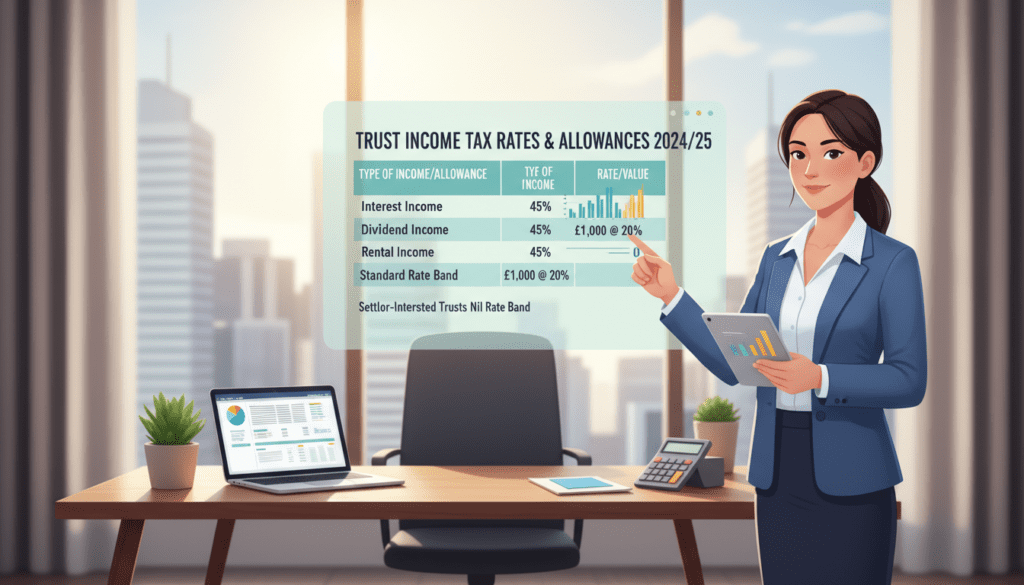
Clear rules on allowances and rates mean trustees can plan distributions with confidence. We explain the standard rate band (often called the “tax‑free amount,” although it is not truly outside the scope of IHT — just taxed at the lower basic rate), the different rates for discretionary and interest in possession trusts, and how the allowance is split where one settlor has created several trusts.
The £1,000 standard rate band and when it applies
Discretionary and accumulation trusts receive the first £1,000 of income at the basic rate (20% for non-dividend income, 8.75% for dividends) rather than the higher trust rates. This is sometimes called the “standard rate band.” Once income exceeds £1,000, the excess is taxed at the full trust rates. If one settlor has created more than one trust, the £1,000 band is divided equally between them, with a minimum of £200 per trust.
Discretionary (accumulation) rates for 2024/25
Discretionary trusts pay the highest income tax rates. For dividend income the trust rate is 39.35%. For all other income (including rental income and bank interest) the rate is 45%. These rates apply to income above the standard rate band. Despite these higher rates, the discretionary trust remains the most effective arrangement for asset protection precisely because no beneficiary has an automatic right to any income or capital — which is what protects assets from care fees, divorce settlements, and bankruptcy. As Mike Pugh puts it, trusts are not just for the rich — they’re for the smart.
Interest in possession rates and distributions
Where a life tenant has a right to the trust income, the trustees pay tax at the basic rate: 8.75% on dividend income and 20% on all other income for 2024/25. The life tenant then declares the gross income on their own return, receives credit for the tax already paid by the trustees, and pays any additional tax due at their personal marginal rate.
“Treat the standard rate band as a threshold — once you pass £1,000, the full trust rates kick in on the excess.”
Dividend allowance and multiple trusts
Trustees do not qualify for the personal dividend allowance that individuals receive. This means all dividend income within the trust is taxable from the first pound (subject only to the standard rate band).
If the same settlor has created more than one discretionary or accumulation trust, the £1,000 standard rate band is divided equally between them. If there are five or more trusts, each receives the minimum of £200.
| Trust Type | Dividend income rate | Other income rate |
|---|---|---|
| Discretionary / Accumulation | 39.35% | 45% |
| Interest in possession | 8.75% | 20% |
| Standard rate band per trust | £1,000 (divided equally if same settlor created multiple trusts; minimum £200 each) | |
Worked example: a discretionary trust receives £5,000 of dividend income in 2024/25. The first £1,000 is taxed at the basic dividend rate of 8.75% (= £87.50). The remaining £4,000 is taxed at 39.35% (= £1,574). Total tax: £1,661.50, leaving approximately £3,338.50 after tax. Use this type of quick calculation when planning distributions — and remember to update the tax pool ledger accordingly.
For official guidance on how the rules apply in practice see HMRC’s guide to trusts and income tax, and for broader planning ideas see secure your family’s future with inheritance tax guidance.
How to complete and submit the Trust and Estate Self Assessment tax return
Completing the SA900 Trust and Estate Self Assessment return is a practical task you can plan for, not a last‑minute scramble. Start with neat working papers that reconcile to bank records. That single step will save you considerable time when transferring figures to the final return.

Choosing paper SA900 versus electronic submission
There are two filing routes. You can use the paper SA900 form and post it to HMRC, or you can purchase HMRC-recognised commercial software and file electronically. Note that unlike personal Self Assessment, the SA900 cannot be filed through HMRC’s own online portal — you need third-party software for electronic filing. Electronic submission is faster, provides instant confirmation, and reduces the risk of transcription errors.
Key deadlines after the end of the tax year
- Paper SA900: must be received by HMRC by 31 October following the end of the tax year.
- Online SA900: must be filed by 31 January following the end of the tax year.
- Payment of tax due: also by 31 January (the same date as the online filing deadline).
What to include on the SA900 return
Report all trust income (split by type), any chargeable gains, details of distributions made to beneficiaries, and the core trust details that correspond to the TRS registration. Include the trust’s Unique Taxpayer Reference, the names and addresses of all trustees, and the trust accounts for the period. For capital gains, the annual exempt amount for trusts is currently half the individual level — just £1,500 for 2024/25 — with gains above that taxed at 24% for residential property or 20% for other assets.
Practical tips to reduce errors
- Prepare a clean set of working papers before entering figures on the final return.
- Match every total to the underlying bank statement or voucher.
- Keep dividend income separate from rental income and interest — each has a different tax rate.
- Cross-check trustee details against the TRS register to avoid mismatched data that could trigger a query.
- Consider instructing a specialist trust accountant if the trust has complex income sources or if you are filing for the first time — the law, like medicine, is broad, and using a specialist avoids costly mistakes.
“A tidy set of working papers halves the chance of rework.”
| Action | Why it matters | When to do it |
|---|---|---|
| Choose paper or software filing | Determines your filing route and the deadline you must meet | Soon after the tax year ends (6 April) |
| Prepare working papers | Reduces data entry errors and speeds up the return | Before completing the final return |
| Reconcile bank statements and vouchers | Provides supporting evidence if HMRC queries any figures | Before submission |
| Submit and save a copy | Proof of filing and version control for your records | By 31 October (paper) or 31 January (online) |
After you send the return: if you filed on paper, HMRC will calculate the tax due and send you a statement. If you filed electronically, the software calculates the liability as part of the submission. Keep records of both the submission confirmation and payment receipts to close the year with confidence.
Paying income tax after filing and staying on top of deadlines
Filing is not the finish line — it starts the payment cycle and a few crucial checks. Once the SA900 return is submitted, HMRC will confirm the amount of tax owed (if you filed on paper) or your software will have calculated it at the point of submission.
What happens after you submit and how you pay
Trustees can pay by several methods: online banking, BACS, CHAPS, debit card via HMRC’s online payment service, or by cheque. Whichever method you choose, always use the trust’s UTR as the payment reference so HMRC can allocate the payment correctly. Allow sufficient processing time — CHAPS payments are same-day, but BACS and online banking typically take three working days.
Payment timing and avoiding late‑payment interest
Tax for the trust must be paid by 31 January following the end of the tax year. For example, tax for 2024/25 is due by 31 January 2026. Late payment attracts automatic interest (currently charged at the Bank of England base rate plus 2.5%) and may also trigger late payment penalties. Plan cashflow well in advance: set a diary reminder for early January at the latest.
- Sanity‑check: match the tax bill to your working papers for each income type and the applicable trust rates.
- Record keeping: log the tax paid in the trust accounts, update the tax pool ledger, and keep payment receipts alongside the submitted return.
- Simple routine: diary reminder in December, a one‑page payment checklist, and a saved copy of the submitted SA900.
“Staying organised each year is the easiest way to protect the trust from unnecessary costs. Not losing the family money provides the greatest peace of mind above all else.”
Issuing beneficiary and settlor statements using form R185
Issuing the right statement helps beneficiaries claim back overpaid tax and complete their own Self Assessment returns accurately. Here are clear steps so you can prepare form R185 (Trust Income) without delay.
When beneficiaries can reclaim tax and what they need
Beneficiaries may be entitled to reclaim tax if the tax credit shown on their R185 statement exceeds their personal tax liability. This commonly arises when a beneficiary is a basic rate taxpayer (or a non-taxpayer, such as a child or student) but the trust has paid tax at the higher trust rates of 45% or 39.35%. The R185 shows the gross amount of income and the tax already paid by the trustees.
Provide each beneficiary with the exact figures: the gross income allocated to them, the tax paid on that income, and the period the statement covers. The beneficiary uses these figures on their own Self Assessment to reclaim or offset the tax.
How to complete form R185 (Trust Income) for each beneficiary
Complete an R185 for every beneficiary who received a distribution during the tax year. Enter the total income distributed, split by type (dividend and non-dividend), and the corresponding tax paid against each line. Where there are multiple recipients, allocate amounts in exact proportion to the distributions actually made — do not average or estimate. The tax credit you attach to each distribution must not exceed the amount available in the trust’s tax pool.
Settlor-interested statements and correct rates
If the trust is settlor-interested, provide the settlor with a separate statement showing the total income arising in the trust, split by type, and the tax paid at the relevant trust rates. The settlor then declares the gross income on their personal Self Assessment return and receives credit for the tax the trustees have already paid. Any shortfall (or overpayment) is settled through the settlor’s own tax calculation.
Taxable pension lump sum death benefit payments and the 30‑day rule
For taxable lump sum death benefit payments received by the trust (for example, from a pension scheme following a death after age 75), use form R185 (LSDB). You must provide the beneficiary with this statement within 30 days of making the payment to them, so they can include it on their own return and pay any additional tax promptly. Note that from April 2027, inherited pensions will become liable for inheritance tax as well — making it even more important to understand how pension death benefits interact with trust arrangements. For families with significant pension funds, a Life Insurance Trust can be an effective way to direct death benefit payouts outside the estate and avoid the 40% IHT charge.
Tip: keep a dated copy of every R185 statement issued in the trust administration file. These copies save significant time if HMRC or a beneficiary queries the figures later.
| Situation | Form to use | Key action |
|---|---|---|
| Standard beneficiary distribution | R185 (Trust Income) | Issue statement showing gross income and tax paid, split by income type |
| Settlor retains an interest | Separate settlor R185 | Show income and tax at correct trust rates; settlor declares on own return |
| Taxable pension lump sum death benefit | R185 (LSDB) | Notify and provide statement to beneficiary within 30 days of payment |
“Clear statements avoid family disputes and make reclaiming tax straightforward.”
Other HMRC reporting duties trustees should not miss
Timely updates and clear records protect the trust and make year‑end compliance simpler.
Keeping the Trust Registration Service up to date
Trustees must update the TRS register whenever there is a change to the trust — for example, a trustee is replaced, a beneficiary’s details change, or the trust address is updated. Use the online TRS service to make these changes promptly.
Update within 90 days of any material change to avoid penalties and ensure the register matches your trust deed and minutes.
When inheritance tax reporting and form IHT100 apply
Discretionary trusts are subject to the relevant property regime for inheritance tax purposes. This means trustees may need to file an IHT100 form in three situations: when assets are first transferred into the trust (if the value exceeds the available nil rate band of £325,000 (gov.uk — Inheritance Tax)), at every 10-year anniversary of the trust, and when capital is distributed out of the trust (an “exit charge”). For most family trusts holding a property worth less than the nil rate band, the actual IHT charge at each of these points will often be nil — but the reporting obligation may still apply, and failing to file can result in penalties.
To put this in perspective: the maximum 10-year periodic charge is 6% of the trust property above the nil rate band. For most family homes below the nil rate band, this is zero. Even where an exit charge applies, it is proportional to the last periodic charge — typically less than 1%. Getting inheritance tax wrong, however, can be far more costly than the annual income tax bill, so seek specialist advice if you are unsure whether an IHT100 is required. Remember that the nil rate band has been frozen at £325,000 since 2009 and is confirmed frozen until at least April 2031 — which means more ordinary family homes are being caught by these thresholds as property values rise.
Keep documentation in case HMRC opens an enquiry
Keep bank statements, distribution records, tax calculations, R185 copies, and a copy of each submitted SA900 return for at least six years after the end of the relevant tax year. HMRC can open an enquiry into a trust return within 12 months of the filing date, but can go back further if they suspect carelessness or deliberate error — up to 6 years for carelessness and up to 20 years for deliberate understatement of tax.
A well-organised file also makes life easier when trustees change or when the trust reaches a 10-year anniversary and IHT calculations are needed. Remember that the trust deed, letter of wishes, and minutes of trustee decisions form the core of your governance records — keep them safe alongside the tax paperwork.
- Retention checklist: bank statements, distribution notes, tax workings, R185 copies, submitted SA900 copies, trust deed, letter of wishes, and minutes of trustee decisions.
- Save a dated copy of each document and keep secure digital backups alongside physical copies.
- Use the GOV.UK page prompts to change cookie settings or accept additional cookies if needed to complete online TRS tasks.
“Keeping the register and records in step protects the trust and reduces stress for everyone involved.”
Conclusion
Here is a simple recap that turns year‑end trust administration into a manageable routine.
First, identify the correct trust type — bare, interest in possession, discretionary, or settlor-interested — because this determines who pays the tax and how the return is completed. Make sure the trust is registered on the TRS and that you have a UTR.
Then gather clear records and prepare a neat set of working papers for the SA900 return. Separate income by type (dividends, rental income, interest) and reconcile everything to bank statements.
File the SA900 on time: paper by 31 October, or electronically by 31 January. Pay the tax due by 31 January to avoid interest and penalties.
Remember the key numbers for 2024/25: the £1,000 standard rate band is taxed at basic rates, but all income above it is taxed at 45% (non-dividend) or 39.35% (dividend) for discretionary trusts. Issue R185 statements to beneficiaries (and settlor statements where needed) so everyone can declare correctly on their own returns.
Do not forget the wider picture: discretionary trusts also sit within the relevant property regime for inheritance tax, with potential 10-year periodic charges and exit charges — though for most family trusts holding a property below the nil rate band of £325,000, these charges are often nil. Keep the TRS register current, retain records for at least six years, and consider instructing a specialist trust accountant or solicitor if any aspect feels uncertain. The law — like medicine — is broad, and you wouldn’t want your GP doing surgery.
Next step: create a short annual checklist covering TRS updates, record-gathering, SA900 filing, tax payment, and R185 statements. Repeat it each year to keep the trust orderly, protect family assets, and make the return process routine rather than a last‑minute scramble. Plan, don’t panic.
FAQ
Who must report trust income and why does HMRC compliance matter?
Trustees (or the principal acting trustee) must report the trust’s income on form SA900 so that tax is paid correctly. A trust is not a separate legal entity — it is a legal arrangement where the trustees hold legal title to the assets for the benefit of the beneficiaries. All trustees are jointly and severally liable for unpaid tax. Staying compliant prevents interest charges, escalating penalties (starting at £100 for late filing), and unwanted HMRC enquiries that can take months to resolve.
What roles do trustees, the principal acting trustee, settlor and beneficiaries have?
Trustees are the legal owners of the trust assets who manage records and file returns — all are personally liable for the tax. The principal acting trustee leads dealings with HMRC and professional advisers. The settlor is the person who created the trust and may remain liable for income tax in settlor-interested trusts. Beneficiaries receive distributions and may need R185 statements to declare income or reclaim overpaid tax on their own Self Assessment returns.
What usually counts as taxable income in a trust?
Taxable income typically includes bank and building society interest, dividends from shares and funds, rental receipts from property held in trust, and certain periodic payments. Each income type is taxed at a different rate, so they must be separated on the SA900 return. Capital receipts — such as proceeds from selling a trust asset — are not income and are dealt with separately under capital gains tax rules.
What happens if the trust fails to report income to HMRC?
Late or missing SA900 returns trigger automatic penalties starting at £100, with further daily penalties and tax-geared penalties for prolonged failures. HMRC also charges late-payment interest on any unpaid tax (currently the Bank of England base rate plus 2.5%). Acting quickly to correct errors through voluntary disclosure usually reduces the charges significantly.
How do I identify the trust type before starting a return?
Check the trust deed to see how distributions are made and who benefits. The main types are bare trusts (beneficiary owns the assets absolutely), interest in possession trusts (life tenant has a right to income), discretionary trusts (trustees decide who gets what — the most common type for estate planning, making up around 98–99% of the trusts we set up), and settlor-interested trusts (settlor or spouse can benefit). Identifying the type determines who pays tax, at what rate, and which SA900 sections to complete.
Who pays tax for a bare trust?
In a bare trust, the beneficiary is treated as the owner for tax purposes. The beneficiary pays income tax at their personal rate on their own Self Assessment return, not the trustees. Trustees do not normally need to file an SA900 for a bare trust unless HMRC specifically requires one. The beneficiary has an absolute right to capital and income at age 18 (16 in Scotland) and can collapse the trust at any time once they reach majority.
What are interest in possession trusts and how are they taxed?
An interest in possession trust gives a named beneficiary (the life tenant) the right to receive the trust income as it arises. Trustees pay tax at the basic rate (20% on non-dividend income, 8.75% on dividends). The life tenant then declares the gross income on their own return and receives credit for the tax already paid by the trustees — paying any further tax due at their personal marginal rate.
How are discretionary and accumulation trusts reported?
Trustees report all income on the SA900 and pay tax at the trust rates: 45% on non-dividend income and 39.35% on dividends (above the £1,000 standard rate band). No beneficiary has any automatic right to income or capital — the trustees decide. When distributions are made, trustees issue R185 statements so beneficiaries can declare the income and reclaim any overpaid tax.
How do settlor-interested trusts affect tax liability?
If the settlor or their spouse/civil partner can benefit from the trust, the settlor is liable for income
How trust distributions are taxed and what the type of trust determines
One of the most common areas of confusion for trustees and beneficiaries alike is understanding whether a distribution from a trust creates a tax liability, and if so, who bears it. The answer typically depends on the type of trust involved, the nature of the underlying income, and — in the case of revocable arrangements — whether the settlor is still alive.
Discretionary and accumulation trusts: beneficiary tax credits and the tax pool
When a discretionary trust makes a payment to a beneficiary, that distribution is generally treated as carrying a 45% tax credit, reflecting the rate already paid by the trustees. The beneficiary must declare the grossed-up amount on their personal Self Assessment return. If the beneficiary is a basic-rate taxpayer, they may be able to reclaim the difference between 45% and their own marginal rate. However, this mechanism only works correctly if the trustees have maintained an accurate tax pool — a running record of tax paid at trust rates. In our experience, one of the most frequent compliance failures we encounter is a trustee who has made multiple distributions across several beneficiaries without correctly reconciling the tax pool, leaving the trust unable to support the credits issued. HMRC may open an enquiry if the tax pool is exhausted and credits have been overstated. For detailed guidance on how the tax pool operates, see HMRC’s Trusts, Settlements and Estates Manual at TSEM3770.
Bare trusts and interest in possession trusts: income taxed as the beneficiary’s own
In a bare trust, the beneficiary is absolutely entitled to both the income and the capital, so the income is generally treated as theirs for tax purposes in the year it arises — not when it is distributed. The trustees act as nominees, and HMRC typically expects the beneficiary to report the income directly on their own return. Interest in possession trusts work similarly in that the life tenant is entitled to the income as it arises, meaning any income tax liability attaches to them rather than to the trust itself, subject to the applicable rates for that type of income.
Revocable trusts, irrevocable trusts and what changes on the settlor’s death
A revocable trust — where the settlor retains the power to take back assets — is typically treated as a settlor-interested trust for UK tax purposes. HMRC will generally attribute the income of that trust to the settlor during their lifetime, regardless of whether distributions are made. Once the trust becomes irrevocable, or upon the settlor’s death, the attribution rules fall away and the trustees or beneficiaries become liable in their own right, depending on the trust type. It is worth noting that converting a revocable arrangement to an irrevocable one can itself trigger a charge to inheritance tax if relevant property rules apply, so this is an area where we would strongly encourage trustees to seek advice from a qualified solicitor or chartered tax adviser before making structural changes.
Common questions about reporting trust income
Are distributions from a trust reported on K-1?
The K-1 form is a United States tax document used by partnerships, S-corporations and trusts to report each beneficiary’s or partner’s share of income, deductions and credits to the IRS. It has no equivalent in the UK tax system. In England and Wales, trustees use form SA900 (the Trust and Estate Tax Return) to report the trust’s income, and beneficiaries receive a form R185 from the trustees showing the income paid to them and the tax deducted. Beneficiaries then include this on their own Self Assessment return. If you are dealing with a trust that has any US connection, you should take specialist cross-border tax advice, as dual reporting obligations may apply.
Do you pay tax on a trust in South Africa?
South African trust taxation is governed by the South African Income Tax Act and administered by the South African Revenue Service (SARS) — it is outside the scope of this guide, which focuses exclusively on UK trusts within the England and Wales framework. If a trust has assets or beneficiaries in both the UK and South Africa, there may be treaty considerations and you should consult a tax adviser with expertise in both jurisdictions.
How much inheritance tax on $500,000?
UK inheritance tax is calculated in sterling and is currently charged at 40% on the value of an estate above the available nil-rate band, which stands at £325,000 per individual for 2024/25 (with a residence nil-rate band of up to £175,000 available in qualifying circumstances). The dollar figure in this question suggests a non-UK context; within the UK, the calculation would depend on the sterling value of the estate, any available reliefs such as business or agricultural property relief, and whether assets pass to a surviving spouse or civil partner, in which case the transfer may generally be outside the scope of IHT. Our team can help you map out what reliefs may apply to a particular estate, though formal IHT advice should be confirmed with a qualified solicitor or chartered tax adviser.
What is meant by financially dependent, and who can be a financial dependent?
In the context of UK estate planning and trusts, financial dependence typically refers to a person who relies on another — or on a trust — for their financial support, either wholly or substantially. HMRC and the courts may consider financial dependency relevant in a number of scenarios, including claims under the Inheritance (Provision for Family and Dependants) Act 1975, pension nominations, and certain trust distributions. A financial dependent can generally include a cohabiting partner, a child (whether biological, adopted or treated as a child of the family), an elderly parent, or any other individual who can demonstrate that they were being maintained by the deceased or the trust immediately before a relevant event. The key test is usually a factual one: was the person receiving a measurable contribution to their living costs from the trust or estate? This is an area where the specific facts matter greatly, and in our experience the threshold for demonstrating dependency is examined carefully by HMRC and the courts alike.
How do trust tax brackets work in practice and at what income level do the higher rates apply?
For discretionary and accumulation trusts in 2024/25, the first £1,000 of income falls within a standard rate band and is taxed at the basic rate — 20% on non-dividend income and 8.75% on dividends. Once income exceeds this £1,000 threshold, the trust rate of 45% applies to non-dividend income (such as interest, rental income and employment income), while 39.35% applies to dividend income above the band. These rates are significantly higher than the rates most individuals pay, which is why trustees should consider carefully whether income should be accumulated or distributed, and why accurate record-keeping around the tax pool matters so much. The SA900 must be filed online by 31 January following the end of the tax year, or by 31 October if a paper return is submitted — and late filing attracts automatic penalties under the self-assessment regime. Our team routinely assists trustees in structuring their reporting to ensure these deadlines are met and that the correct rates are applied from the first pound of income above the standard rate band.