


Establishing a trust in the UK is one of the most effective steps you can take towards protecting your family’s future and ensuring that your assets pass to your loved ones — not to HMRC, creditors, local authority care assessors, or an ex-spouse’s divorce solicitor.
At MP Estate Planning, we understand that securing your family’s financial well-being is a top priority. An Asset Protection Trust (APT) — specifically, an irrevocable discretionary lifetime trust — can provide genuine peace of mind by safeguarding your wealth and ensuring it reaches the people you choose, in the way you choose.
By setting up an APT, you take control of your estate planning and make informed decisions about your wealth preservation. As Mike Pugh, founder of MP Estate Planning, puts it: “Trusts are not just for the rich — they’re for the smart.” And with the average home in England now worth around £290,000 and the inheritance tax nil rate band frozen at £325,000 since 2009, more ordinary homeowners are caught by IHT than ever before.
Key Takeaways
- An Asset Protection Trust can shield your family home from care fees, IHT, divorce, and creditor claims.
- Estate planning using a properly drafted trust ensures your assets pass according to your wishes — not the intestacy rules or the courts.
- Wealth preservation through a discretionary trust means no single beneficiary has a legal right to the assets, which is the key to protection.
- Trust assets bypass probate entirely — trustees can act immediately on your death, while sole-name assets are frozen for months.
- England invented trust law over 800 years ago. A well-planned discretionary trust can protect your family’s assets for up to 125 years.
Understanding Asset Protection Trusts
Understanding how Asset Protection Trusts work under English and Welsh law is essential for anyone looking to protect their family’s wealth from the main threats: inheritance tax (currently 40% above the nil rate band), local authority care fee assessments (averaging £1,200–£1,500 per week), divorce (with a UK divorce rate of around 42%), and the delays of probate.
What is an Asset Protection Trust?
An Asset Protection Trust (APT) is a legal arrangement — not a separate legal entity — designed to hold and protect your assets outside of your personal estate. Under English trust law, when you transfer assets into a properly structured irrevocable discretionary trust, legal ownership passes to the trustees. You no longer personally own those assets, which means they are no longer vulnerable to the threats that target personally-held wealth.
It’s important to understand that asset protection through a trust is not about hiding assets — it’s about changing the legal ownership structure using one of the oldest and most established areas of English law. Trust law has existed in England for over 800 years, and discretionary trusts are used by families at every level of wealth.
How Does an APT Work?
The process of setting up an APT involves several key steps, beginning with the drafting of a trust deed and the appointment of at least two trustees. The trustees become the legal owners of the trust assets, and they manage those assets according to the terms of the trust deed for the benefit of the named beneficiaries.
- The settlor (you) transfers assets — typically the family home — into the trust.
- The trustees (which can include you) hold legal title and manage the trust assets according to the trust deed.
- The beneficiaries (your family) benefit from the trust assets at the trustees’ discretion — crucially, no single beneficiary has a legal right to demand anything from the trust.
This discretionary structure is the foundation of the trust’s protective power. Because no beneficiary “owns” the assets, those assets generally cannot be targeted in a beneficiary’s divorce, bankruptcy, or care fee assessment.
Key Terminology in APTs
Understanding the terminology associated with APTs is vital for effective legal protection. Here are the essential terms:
- Settlor: The person who creates the trust and transfers assets into it. In Mike’s family trusts, the settlor is typically also appointed as a trustee, keeping them involved in decisions.
- Trustee: The legal owner of the trust assets, responsible for managing them according to the trust deed. A minimum of two trustees is required, and up to four can be registered on a property title at the Land Registry.
- Beneficiary: A person who may benefit from the trust. In a discretionary trust, beneficiaries have no automatic right to income or capital — the trustees decide who gets what, when, and how.
- Trust deed: The legal document that creates the trust and sets out its terms, the trustees’ powers, and the class of beneficiaries.
- Letter of wishes: A non-binding document from the settlor giving guidance to trustees about how they would like the trust to be managed. This can be updated at any time without changing the trust deed.
For UK-specific information on how trusts protect the family home, you can refer to our guide to Family Home Protection Trusts, which explains how an APT can be used to protect your most valuable asset.
The Importance of Asset Protection
In today’s financial landscape, where house prices have risen dramatically but the IHT nil rate band has been frozen at £325,000 since 2009, protecting your assets has never been more important. Ordinary homeowning families — not just the wealthy — are now firmly in HMRC’s crosshairs.
Why Protect Your Assets?
Protecting your assets is essential because the threats to family wealth are real, quantifiable, and largely predictable. Consider the numbers:
- Inheritance tax: 40% on everything above £325,000 (or £500,000 if you qualify for the residence nil rate band). A married couple can potentially shelter up to £1,000,000 — but only if they plan correctly and leave their home to direct descendants.
- Care fees: Averaging £1,200–£1,500 per week in England, with London and the south reaching £1,700+. Between 40,000 and 70,000 homes are sold annually to fund care. If your savings exceed £23,250, you’re classified as a self-funder.
- Divorce: With a UK divorce rate of around 42%, the risk that a child’s inheritance could be lost in their divorce settlement is statistically significant.
- Probate delays: When you die, all assets held in your sole name are frozen. Bank accounts, property, investments — all inaccessible until a Grant of Probate is obtained and the administration is complete, which typically takes 3–12 months, sometimes longer with property.
An Asset Protection Trust addresses all four threats simultaneously. Assets held in trust bypass probate entirely — trustees can act immediately. And because the trust is discretionary, no beneficiary has a legal entitlement that can be targeted by creditors, ex-spouses, or care fee assessors.
Families with young children can particularly benefit from a discretionary trust, as it allows trustees to manage funds for the children’s benefit until they are mature enough to handle an inheritance — unlike a bare trust, where the beneficiary gains an absolute right to everything at age 18, regardless of whether they’re ready for that responsibility.
Key Benefits of Asset Protection:
- Financial security for your loved ones — protected from threats they may not even see coming
- Protection against creditor claims, divorce settlements, and local authority care fee assessments
- Ensuring your assets are distributed according to your wishes, not the intestacy rules
Risks of Not Having Protection
Failing to protect your assets can expose your family to devastating financial consequences. Without a trust in place, here’s what can happen:
| Risks | Consequences Without APT | Benefits With APT |
|---|---|---|
| Care Fee Assessment | Home included in financial assessment — could be sold to fund care at £1,200–£1,500/week until savings depleted to £14,250 | Home held in trust — not personally owned, so not assessable as the individual’s capital (if planned well in advance) |
| Divorce of a Beneficiary | Inherited assets may be treated as matrimonial property and divided in the settlement | Trust assets remain under trustees’ control — as Mike puts it: “What house? I don’t own a house” |
| Inheritance Tax | 40% IHT on everything above the nil rate band — potentially hundreds of thousands of pounds lost to HMRC | Properly structured trusts can reduce or eliminate the IHT liability over time |
| Probate Delays | Assets frozen for 3–12 months or longer while the estate is administered. Will becomes a public document | Trust assets pass immediately to trustees’ control — no freeze, no public record, no delay |
As Mike Pugh says: “Not losing the family money provides the greatest peace of mind above all else.” By understanding these risks and taking proactive steps, you can secure your family’s financial future. We recommend considering an Asset Protection Trust as a vital component of your overall estate plan.

Types of Asset Protection Trusts
When it comes to safeguarding your assets, understanding the different types of trusts available under English and Welsh law is crucial. The right type of trust depends on your specific circumstances — what assets you’re protecting, what threats you’re planning against, and your long-term goals for your family.
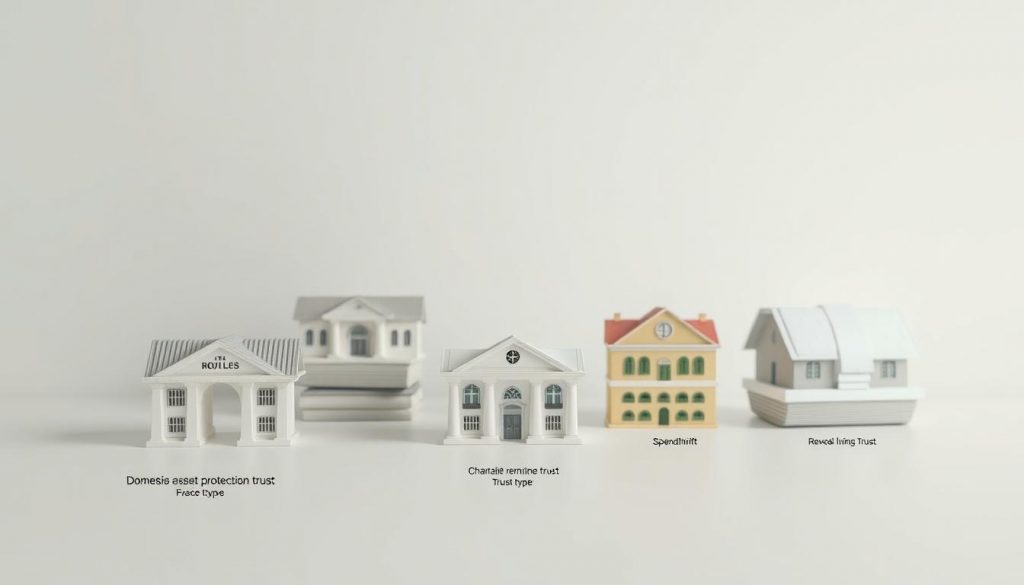
Discretionary Trusts vs. Bare Trusts
The most important distinction in UK trust law is how the trust operates — specifically, the level of control and protection it provides. The two main types are:
A discretionary trust is by far the most commonly used type for asset protection (around 98–99% of trusts set up for this purpose). In a discretionary trust, the trustees have absolute discretion over who receives what, when, and how much. No beneficiary has a legal right to demand income or capital from the trust. This is precisely what makes it so effective — if a beneficiary doesn’t “own” the assets, those assets generally can’t be targeted in their divorce, bankruptcy, or care fee assessment. Discretionary trusts can last for up to 125 years.
A bare trust, by contrast, offers virtually no protection. The beneficiary has an absolute right to the capital and income once they reach age 18. At that point, they can collapse the trust entirely under the principle established in Saunders v Vautier. Bare trusts are not IHT-efficient and cannot protect against care fees or divorce. They are essentially a holding arrangement, not a protective one.
- Discretionary Trusts: Maximum protection — no beneficiary has any right to the assets. Trustees decide everything. This is the standard for serious asset protection.
- Bare Trusts: Minimal protection — beneficiary owns the assets outright at 18. Not suitable for asset protection planning.
Lifetime Trusts vs. Will Trusts
The other key classification is when the trust takes effect:
A lifetime trust (also called an inter vivos trust) is created during your lifetime. This is the type Mike Pugh primarily works with, because it provides immediate protection. Once your home or other assets are transferred into a lifetime trust, they are protected straight away — you don’t need to die for the trust to activate.
A will trust only comes into existence when you die. While will trusts have their place — particularly interest in possession trusts designed to prevent sideways disinheritance — they offer no protection during your lifetime. Your assets remain in your personal estate, exposed to all the usual threats, until the moment of death.
- Lifetime Trusts: Take effect immediately. Provide protection during your lifetime against care fees, divorce, and other threats. Start the 7-year clock for IHT purposes where applicable.
- Will Trusts: Take effect only on death. Useful for certain planning purposes but offer no lifetime protection.
Within lifetime trusts, the trust can be either revocable (you can cancel it) or irrevocable (you cannot). For genuine asset protection, irrevocable trusts are the standard. A revocable trust provides no IHT benefit whatsoever — HMRC treats the assets as still belonging to the settlor because it remains a settlor-interested trust. Mike’s trusts are irrevocable but include “Standard and Overriding Powers” built into the trust deed, which give trustees defined flexibility without undermining the trust’s irrevocable status.
The choice of trust type depends entirely on your specific circumstances and goals. This is specialist work — as Mike says: “The law — like medicine — is broad. You wouldn’t want your GP doing surgery.”
Benefits of a UK Asset Protection Trust
A UK Asset Protection Trust offers a range of concrete, measurable benefits for families looking to secure their financial future. Understanding these advantages — with real numbers — helps you make informed decisions about your estate planning.
Shielding Assets from Creditors and Care Fees
One of the primary benefits of a discretionary Asset Protection Trust is its ability to shield assets from external threats — including creditors, bankruptcy, divorce, and local authority care fee assessments.
Here’s how it works in practice: because the trust is discretionary, no individual beneficiary has a legal right to the trust assets. If a beneficiary faces bankruptcy, the trustee in bankruptcy generally cannot access the trust because the beneficiary doesn’t own anything within it. If a beneficiary gets divorced, the trust assets are not part of their personal wealth — they can truthfully say they don’t own the property.
For care fee protection, the principle is similar. In England, if your capital exceeds £23,250, you’re classified as a self-funder for residential care — meaning you pay the full cost, which averages £1,200–£1,500 per week. If your home is held in a properly structured trust and has been there for a significant period of time before any need for care arose, it is generally not assessable as your capital. The critical factor is timing: you must plan years in advance, before any foreseeable need for care. Local authorities can challenge transfers under “deprivation of assets” rules if care fee avoidance was a significant operative purpose — but unlike the 7-year IHT rule, there is no fixed time limit. The longer the gap between the transfer and the need for care, the stronger your position.
MP Estate Planning’s approach is thorough: each trust is supported by at least 9 documented legitimate reasons for the transfer, none of which mention care fees. Care fee protection is an ancillary benefit of sound estate planning — not the primary purpose.
Reducing Inheritance Tax Liability
Another significant benefit of a UK Asset Protection Trust is its potential to reduce inheritance tax liabilities. IHT is charged at 40% on the value of your estate above the nil rate band (£325,000 per person, frozen since 2009 and confirmed frozen until at least April 2031). The residence nil rate band adds another £175,000 per person — but only if a qualifying residential property passes to direct descendants (children, grandchildren, or step-children). The RNRB is not available if the estate passes to nephews, nieces, siblings, friends, or charities. The RNRB also tapers away by £1 for every £2 the estate exceeds £2,000,000 in value.
For a married couple, the combined maximum exemption is £1,000,000 (£650,000 NRB + £350,000 RNRB), since both allowances are transferable between spouses. But here’s the problem: with the average home in England now worth around £290,000, a couple with a mortgage-free home and modest savings can easily breach these thresholds — especially a single person who can only claim £500,000 at most.
Different trusts address IHT in different ways. Mike’s Family Home Protection Trust (Plus) retains access to the RNRB while providing care fee and asset protection. His Gifted Property Trust is designed to remove 50% or more of the home’s value from the estate while avoiding the Gift with Reservation of Benefit rules, starting the 7-year clock for IHT purposes. For buy-to-let or investment properties, the Settlor Excluded Asset Protection Trust takes the property outside the estate entirely.
It’s important to understand that trusts are tax-efficient planning tools — they don’t eliminate tax, but they can significantly reduce it. For most family homes transferred into trust below the NRB threshold of £325,000, there is no entry charge. The maximum periodic 10-year charge on a discretionary trust is 6% of the trust property value above the NRB — which for most family homes means this charge is also nil. And if the entry and periodic charges are nil, the exit charge will be zero too.
By leveraging the benefits of a properly structured UK Asset Protection Trust, you can ensure that more of your wealth reaches your family and less goes to HMRC. When you compare the one-time cost of setting up a trust (from £850 for straightforward cases) to the potential IHT bill of tens or hundreds of thousands of pounds, the maths speaks for itself.
Creating Your Asset Protection Trust
Establishing an Asset Protection Trust is a practical, achievable step — not a complex legal marathon. At MP Estate Planning, Mike Pugh is the first and only company in the UK that actively publishes all trust prices on YouTube, because transparency matters. Here’s what the process actually involves.
Steps to Set Up an APT
Setting up a trust in the UK involves several key steps that require specialist guidance but are straightforward when handled by an experienced professional:
- Initial Consultation and Threat Analysis: Identify the specific threats to your estate — IHT, care fees, divorce, probate delays — using a structured assessment. MP Estate Planning uses its proprietary Estate Pro AI, a 13-point threat analysis tool, to identify exactly which threats apply to your situation.
- Choose the Right Trust Type: Based on the analysis, determine whether a Family Home Protection Trust, Gifted Property Trust, Settlor Excluded Trust, Life Insurance Trust, or a combination is most appropriate.
- Select the Assets: Identify which assets will be transferred into the trust — typically the family home, but it can also include investment properties, savings, or life insurance policies.
- Appoint Your Trustees: Choose at least two trustees. The settlor can (and usually should) be one of them, keeping control within the family. Up to four trustees can be registered on a property title at the Land Registry.
- Draft the Trust Deed: The trust deed is the legal document that creates the trust, sets out the trustees’ powers, defines the class of beneficiaries, and establishes how the trust operates. A letter of wishes accompanies the deed, providing non-binding guidance to the trustees.
- Transfer the Assets: For unmortgaged property, this involves a TR1 form to transfer legal title to the trustees, plus a Form RX1 restriction at the Land Registry. If there’s a mortgage, a Declaration of Trust is used to transfer the beneficial interest while legal title remains with the mortgagor (because the lender’s consent would be needed to transfer legal title). Over time, as the mortgage decreases and the property value increases, all that growth happens inside the trust.
- Register with the Trust Registration Service (TRS): All UK express trusts must be registered within 90 days of creation. The TRS register is not publicly accessible (unlike Companies House).
For more detailed information on setting up a trust, especially for a child, you can refer to our guide on how to start a trust for a child.
Choosing the Right Trustee
Selecting the right trustees is one of the most important decisions in the trust creation process. The trustees will be the legal owners of the trust assets and responsible for managing them in accordance with the trust deed and their fiduciary duties.
When choosing trustees, consider the following:
- Include the settlor: Mike’s standard approach is for the settlor to be appointed as a trustee. This keeps you directly involved in all decisions about your assets during your lifetime.
- Choose people you trust implicitly: Trustees have significant legal responsibilities and powers. Family members, trusted friends, or professional trustees are all options.
- Plan for succession: The trust deed should include a clear process for removing and appointing replacement trustees if circumstances change — illness, death, family disputes, or simply a change of heart.
- Consider practical availability: Trustees need to be available to make decisions and sign documents when required. Choose people who are likely to be accessible for the long term.
By carefully selecting your trustees and following these steps with specialist guidance, you can ensure that your assets receive the legal protection they deserve. The cost for a straightforward trust starts from £850 — roughly the equivalent of one week’s care fees. It’s a one-time investment compared to an ongoing liability that could drain your entire estate.
Who Needs an Asset Protection Trust?
The honest answer is: far more people than realise it. With the IHT nil rate band frozen at £325,000 since 2009, average house prices now around £290,000 in England, and care fees running at £1,200–£1,500 per week, asset protection planning is no longer the preserve of the wealthy. It’s essential for any homeowning family.
Business Owners and Entrepreneurs
For business owners and entrepreneurs, an Asset Protection Trust can be a vital tool in separating personal wealth from business risk. If your business faces financial difficulty — whether through market downturns, legal claims, or insolvency — your personal assets, including your family home, could be at risk if they’re held in your own name.
By transferring personal assets into a discretionary trust, you create a clear legal separation between your business exposure and your family’s security. The trust assets are owned by the trustees, not by you personally. This means that even if the worst happens to the business, your family’s home and financial security remain protected.
Ordinary Homeowning Families
You don’t need a high-value estate to benefit from a trust. If you own a home — and particularly if you own it outright or have significant equity — you are exposed to the four main threats:
- IHT: A single person with a £350,000 home and £50,000 in savings has a potential IHT bill of £30,000. For a couple without proper planning, the bill can be far higher.
- Care fees: One in four people over 65 will need residential care. At £1,200–£1,500 per week, a £300,000 home can be consumed in four to five years.
- Beneficiary divorce: If you leave your home to your children outright and one of them divorces, up to half the value could be lost in the settlement.
- Probate delays: Your family can’t access, sell, or remortgage your property until the Grant of Probate is obtained — a process that freezes everything.
Families with young children can also benefit significantly from a discretionary trust. Rather than leaving assets outright — where children could gain access at 18 under a bare trust — a discretionary trust allows trustees to manage and distribute funds when your children reach an age you consider appropriate. This is genuine protection, not just financial planning.

| Who Benefits | Key Benefits | Real-World Example |
|---|---|---|
| Business Owners/Entrepreneurs | Separation of personal and business assets, protection from business liabilities | Business fails but family home remains safe in trust — creditors cannot reach it |
| Homeowning Families | Protection from IHT, care fees, and probate delays | Home in trust means local authority cannot include it in care fee financial assessment (when planned well in advance) |
| Families with Young Children | Controlled distribution — assets managed by trustees until children are mature enough | Children receive support for education and housing, but don’t receive a lump sum at 18 that could be squandered |
As Mike Pugh says: “Keeping families wealthy strengthens the country as a whole.” By understanding whether a trust is right for your situation, you can take proactive steps towards genuine financial security. We’re here to guide you through the process with plain-speaking, transparent advice.
Common Misconceptions About APTs
There are several persistent misconceptions about Asset Protection Trusts that prevent families from taking action. Let’s address the most common ones head-on.

APTs Are Only for the Wealthy
This is perhaps the most damaging misconception of all. The truth is that trusts are more relevant to ordinary families now than at any point in recent history. Here’s why: the IHT nil rate band has been frozen at £325,000 since 2009. In that time, average UK house prices have risen significantly — the average home in England is now worth around £290,000. A homeowner with a paid-off property and modest savings is now an IHT target.
Add to that the care fee crisis — with residential care averaging £1,200–£1,500 per week and between 40,000 and 70,000 homes sold annually to fund care — and it becomes clear that asset protection is not a luxury. It’s a necessity for any family that owns property.
When you compare the cost of setting up a trust (from £850 for straightforward cases) to the potential loss of your home to care fees or a 40% IHT bill, it’s one of the most cost-effective forms of financial protection available. That trust costs roughly the equivalent of one to two weeks of care fees — a one-time investment versus an ongoing cost that continues until death or your savings are depleted to £14,250.
Asset Protection Trusts Are Illegal
Another common misconception is that trusts are somehow illegitimate — that they’re “tax dodges” or schemes for hiding assets. This couldn’t be further from the truth. England literally invented trust law over 800 years ago. Trusts are one of the oldest and most established areas of English law, recognised and regulated by HMRC, the courts, and statute.
Trusts are tax-efficient planning tools, not tax avoidance schemes. They must be set up correctly, registered with the Trust Registration Service, and administered in full compliance with UK law. HMRC knows about every trust through the TRS — there is nothing hidden or secretive about them.
The key is that the trust must be set up properly, for legitimate reasons, and by a specialist who understands the law. A general solicitor or a DIY trust kit simply won’t provide the same level of protection as a trust drafted by a specialist in this area.
By dispelling these misconceptions, we can see that APTs are valuable tools for any homeowning family. Whether you’re a business owner, a parent planning for your children’s future, or a homeowner concerned about care fees and IHT, an APT can provide genuine legal protection and lasting peace of mind. Plan, don’t panic.
Maintaining Your Asset Protection Trust
Setting up an Asset Protection Trust is not a “set it and forget it” exercise. Like any important legal arrangement, it requires periodic attention to ensure it continues to do its job effectively — protecting your family’s wealth against evolving threats and changing legislation.
Regular Reviews and Updates
Regular reviews are essential to ensure that your trust remains aligned with your circumstances and complies with current legislation. Tax thresholds change, family situations evolve, and new legislation can affect how trusts operate. We recommend reviewing your trust every few years or whenever a significant life event occurs:
- Family changes: Marriage, divorce, births, deaths, or estrangement may mean beneficiary classes or the letter of wishes need updating.
- Trustee changes: If a trustee dies, becomes incapacitated, or is no longer suitable, the trust deed should include a clear process for removing and appointing replacement trustees.
- Legislative changes: The IHT landscape is evolving — from April 2027, inherited pensions become liable for IHT, and Business Property Relief and Agricultural Property Relief rules are changing from April 2026 (with relief capped at 100% for the first £1,000,000 of combined business and agricultural property, then 50% on the excess). Your trust structure may need adjusting to account for these developments.
- Property and asset changes: If trust property is sold, remortgaged, or new assets are acquired, the trust administration needs to reflect this.
The letter of wishes — the non-binding document that guides your trustees — can be updated at any time without needing to amend the trust deed itself. This gives you ongoing flexibility to adjust your wishes as life changes.
The Role of Professional Guidance
Professional guidance from a specialist is invaluable in maintaining your trust effectively. As Mike Pugh says: “The law — like medicine — is broad. You wouldn’t want your GP doing surgery.” Trust law is a specialist area, and ongoing advice from someone who works with trusts every day makes a real difference.
| Benefits of Professional Guidance | Description |
|---|---|
| Specialist Knowledge | Trust specialists stay current with changes in IHT thresholds, HMRC practice, and trust taxation — areas that general solicitors may not monitor closely. |
| Compliance and Administration | Trustees must file SA900 trust tax returns, maintain TRS registration, and comply with trust law duties. Professional guidance ensures nothing is missed. |
| Strategic Adaptation | As your circumstances change — retirement, downsizing, receiving an inheritance — your trust strategy may need to adapt. A specialist can advise on the most tax-efficient approach. |
Consider a practical example: a family with their home in a Family Home Protection Trust decides to downsize. The sale and purchase of property within a trust involves specific legal steps — the trustees (as legal owners) must handle the transaction, and the new property must be correctly settled into the trust. Without specialist guidance, this could be handled incorrectly, potentially undermining the trust’s protections.

By combining regular reviews, updated letters of wishes, and professional guidance from a trust specialist, you can ensure that your Asset Protection Trust remains a robust, effective tool for securing your family’s financial future — not just today, but for up to 125 years.
Conclusion: Taking Action for Financial Security
Throughout this article, we’ve explored how an Asset Protection Trust works under English and Welsh law, the specific threats it protects against — IHT at 40%, care fees averaging £1,200–£1,500 per week, beneficiary divorce, and probate delays — and why it’s relevant to far more families than most people realise.
Next Steps for Setting Up Your APT
The most important step is also the simplest: have a conversation with a specialist. Not a general solicitor, not a financial adviser who dabbles in trusts, but someone who works with trusts and inheritance tax planning every single day. At MP Estate Planning, every consultation begins with our Estate Pro AI 13-point threat analysis, which identifies exactly which risks apply to your estate and which trust structures will address them.
The Importance of Expert Guidance
Specialist guidance is not optional when it comes to trusts — it’s essential. A trust that is poorly drafted, uses the wrong structure, or fails to account for Gift with Reservation of Benefit rules can be worse than having no trust at all. The right specialist will ensure your trust is properly structured, correctly registered with the TRS, and administered in compliance with HMRC requirements.
The cost of getting started is from £850 for a straightforward trust — roughly one week’s care fees, or a fraction of the IHT bill your family could face without planning. As Mike Pugh puts it: “Plan, don’t panic.” The time to act is now, while you’re healthy, while you have choices, and while the assets are still yours to protect.