


Protecting your family’s assets is one of the most important things you can do. Estate planning gives you the tools to manage your legacy, look after your loved ones, and keep your wealth in the family. A trust — a legal arrangement with over 800 years of history in England — is one of the most effective ways to do exactly that.
Good wealth management starts with proper planning. By placing assets into a trust, you can protect them from inheritance tax (IHT), care fees, divorce, and family disputes. Currently, IHT is charged at 40% on everything above the nil rate band of £325,000 per person — a threshold that has been frozen since 2009 and will remain so until at least April 2031. With the average home in England now worth around £290,000, ordinary homeowners are increasingly being caught by this tax. A well-structured trust can help ensure more of your estate reaches your family rather than being eroded by taxes, legal costs, or care home fees.
Key Takeaways
- Trusts can help protect your family’s assets from inheritance tax, care fees, divorce, creditors, and sideways disinheritance.
- A trust is a legal arrangement — not a separate legal entity — where trustees hold legal ownership and manage assets for the benefit of your chosen beneficiaries.
- Establishing a trust ensures your assets are distributed according to your wishes, bypassing probate delays and keeping your affairs private — unlike a will, which becomes a public document once a Grant of Probate is issued.
- A well-structured discretionary trust can provide long-term financial security for your loved ones, with no beneficiary having an automatic right to the assets — which is precisely what shields them from external claims.
- Trusts are not just for the rich — they’re for the smart. Anyone with a home or savings worth protecting should consider one.
What is a Family Trust?
Understanding a family trust is essential for effective estate planning. A trust is a legal arrangement — not a company or a separate legal entity — where you (the settlor) transfer assets to trustees, who then hold and manage those assets for the benefit of your chosen beneficiaries. The trustees become the legal owners, but they must manage the assets according to the terms set out in the trust deed. This separation of legal ownership (held by the trustees) and beneficial interest (enjoyed by the beneficiaries) is the foundation of English trust law and has been used for over 800 years.
Family trusts are particularly valuable for homeowners wanting to protect their property and other assets. They help ensure your wealth goes exactly where you want it to — and stays protected along the way. Whether the concern is inheritance tax, care fees, divorce, or simply making sure your children and grandchildren benefit rather than outsiders, a properly structured trust addresses all of these.
Definition and Purpose
A trust in estate planning is a legal arrangement where trustees manage assets for the benefit of named beneficiaries. You, the settlor, create the trust by executing a trust deed that sets out the rules — including who the beneficiaries are, what powers the trustees have, and how assets should be managed and distributed. The core purpose is to protect your family’s financial future while maintaining appropriate oversight of how your assets are dealt with.
Key aspects of a family trust include:
- Trustees hold legal ownership of assets on behalf of beneficiaries — the beneficiaries enjoy the benefit without owning the assets outright, which is what provides the protection
- Providing long-term financial protection and security for your family against inheritance tax, care fees, divorce, creditors, and sideways disinheritance
- Allowing for flexible distribution of assets — particularly with a discretionary trust, where trustees can adapt to changing family circumstances over the trust’s lifetime (up to 125 years under current English law)
Key Features of a Family Trust
Family trusts offer several important advantages. They provide flexibility, tax-efficient planning, and asset protection. Understanding these features helps you decide whether a family trust is the right step for your family.
| Feature | Description | Benefit |
|---|---|---|
| Flexibility | Discretionary trusts allow trustees to adapt distributions based on changing family circumstances over up to 125 years — covering multiple generations | Your estate plan can evolve as your family’s needs change — no need to rewrite your will every time life changes. If a beneficiary faces divorce or financial difficulty, trustees can adjust accordingly |
| Tax-Efficient Planning | Properly structured irrevocable trusts can reduce inheritance tax liabilities. If the settlor survives seven years after the transfer, the asset falls entirely outside their estate — potentially saving 40% on everything above the nil rate band | Maximises the value of the estate that actually reaches your beneficiaries rather than going to HMRC |
| Asset Protection | Assets held in a discretionary trust are protected from creditors, divorce claims, and local authority care fee assessments — because no beneficiary has an automatic legal right to the assets | Ensures your family home and savings are preserved for future generations, rather than being lost to an ex-spouse, a creditor, or care home fees of £1,100-£1,500+ per week |
As Mike Pugh, founder of MP Estate Planning, often says: “Trusts are not just for the rich — they’re for the smart.” A well-structured family trust can provide genuine peace of mind, knowing your assets are managed and distributed exactly as you wish — and protected from the threats that catch so many families off guard.
“England invented trust law 800 years ago. It remains one of the most powerful tools available to ordinary families who want to protect what they’ve worked hard to build.”

Setting up a family trust is one of the most effective steps you can take to secure your family’s financial future. At MP Estate Planning, we guide you through every stage — from initial consultation and 13-point threat analysis through to trust deed execution, property transfer, and Trust Registration Service (TRS) registration — ensuring your estate planning is handled with care and expertise.
Benefits of Putting Your Estate into a Trust
Trusts are a cornerstone of effective estate planning, offering real, tangible benefits that protect your family’s future. They’re not a magic wand — but when structured properly by a specialist, they address the key threats that can erode a family’s wealth over generations.
By placing your assets into a trust, you take control of how they’re managed and distributed — both during your lifetime and after your death. Trust assets bypass the probate process entirely, which means your family avoids delays, frozen accounts, and public scrutiny of your estate.
Bypassing Probate Delays
One of the biggest trust advantages is bypassing probate delays. When someone dies with assets held solely in their own name, those assets are frozen until a Grant of Probate (or Letters of Administration if there’s no will) is issued by the Probate Registry. This process typically takes 3 to 12 months — and if property needs to be sold, it can stretch to 9 to 18 months or longer. During this time, your family cannot access bank accounts, sell property, or distribute anything.
Assets held in trust are different. Because the trustees already hold legal ownership, they can act immediately — there’s no need to wait for probate. Your beneficiaries receive their inheritance faster and without the stress and uncertainty of a frozen estate. It’s also worth noting that a will becomes a public document once a Grant of Probate is issued — anyone can obtain a copy for a small fee. Trust arrangements remain entirely private, with the TRS register not being publicly accessible (unlike Companies House).
Asset Protection
A properly structured discretionary trust provides powerful asset protection. Because beneficiaries of a discretionary trust have no automatic right to the trust assets — they have merely a hope or expectation, not a legal entitlement — those assets are shielded from a range of threats including creditors, divorce settlements, and local authority care fee assessments.
Consider divorce: with around 42% of marriages in the UK ending in divorce, the risk is real. If your child inherits a property outright and later divorces, their ex-spouse could claim a share of it. But if that property is held in a discretionary trust, the answer to the court is simple: “What house? I don’t own a house.” The same principle applies to care fees — between 40,000 and 70,000 homes are sold every year to fund care, with residential care costing £1,100 to £1,500 per week or more. A trust structured correctly, years in advance, with documented legitimate reasons for its creation, can help protect against these costs. The key word is “years” — you cannot transfer assets after a foreseeable need for care has arisen, as the local authority may treat this as a deprivation of assets.

Tax Advantages
Trusts also offer genuine tax advantages when structured correctly — they are tax-efficient planning tools, not tax avoidance schemes. By transferring assets — particularly your family home — into an irrevocable trust, you can reduce your taxable estate for inheritance tax purposes. The transfer into a discretionary trust is a chargeable lifetime transfer (CLT), but for most family homes valued below the nil rate band of £325,000 (or £650,000 for a married couple using two separate trusts), there is no entry charge at all. If the settlor survives seven years after the transfer, the value falls completely outside the estate for IHT purposes.
It’s important to understand the difference here: a revocable trust provides no IHT benefit, because HMRC treats the assets as still belonging to the settlor (known as a settlor-interested trust). For genuine IHT savings, the trust must be irrevocable. Mike’s trusts are structured as irrevocable trusts with “standard and overriding powers” — giving trustees defined flexibility without making the trust revocable.
For more detail on putting your house in a trust in the UK, read our guide on how to put your house in a trust. It offers detailed steps and expert advice tailored to English and Welsh law.
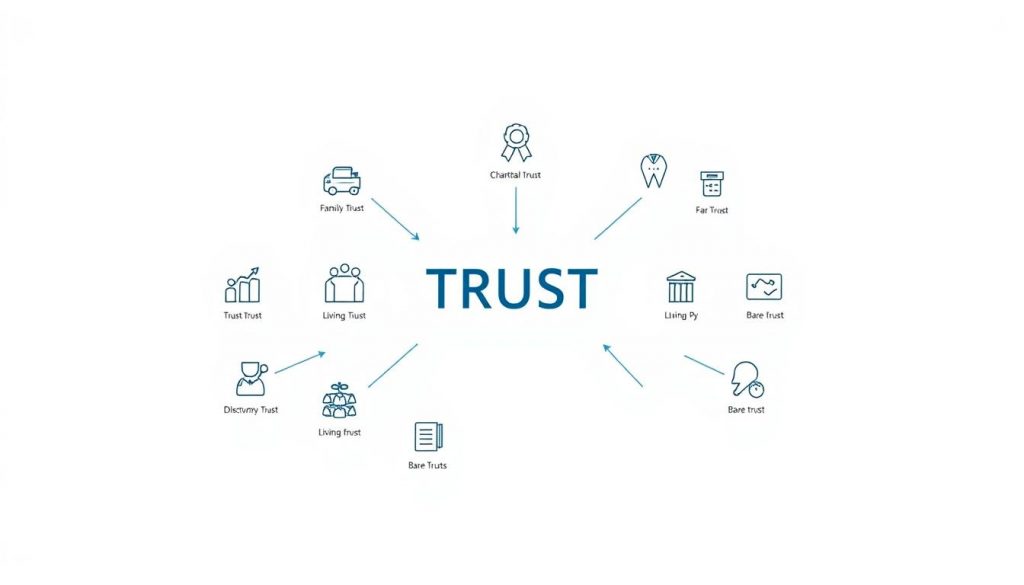
Types of Trusts Available in the UK
In the UK, understanding the different types of trusts is essential for effective estate planning. The right trust depends on what you’re trying to achieve — whether that’s protecting your home from care fees, reducing inheritance tax, preventing sideways disinheritance, or shielding assets from divorce.
In England and Wales, trusts are primarily classified by when they take effect — a lifetime trust (created during the settlor’s lifetime) or a will trust (created on death through the settlor’s will) — and then by how they operate. The three main operational types are discretionary trusts, interest in possession trusts, and bare trusts. Whether a trust is revocable or irrevocable is a feature within lifetime trusts, not the primary way trusts are classified in the UK.
Discretionary Trusts
Discretionary trusts are by far the most common and flexible type — accounting for the vast majority of family trusts set up for asset protection and inheritance tax planning. The trustees have absolute discretion over who receives what, when, and how much. No beneficiary has an automatic right to income or capital, and this is precisely what makes them so powerful for protection.
Key features of discretionary trusts include:
- Trustees have complete discretion over how and when to distribute income and capital — they can adapt to changing family circumstances over the trust’s lifetime.
- No beneficiary has a guaranteed right to the trust assets. This is the crucial protection mechanism: because no one “owns” the assets, they cannot be claimed by a divorcing spouse, a creditor, or a local authority assessing care fees.
- They can last up to 125 years under current English law, covering multiple generations.
- They fall under the relevant property regime for IHT purposes — but for most family homes below the nil rate band, the entry, periodic, and exit charges are typically zero.
Interest in Possession Trusts
Interest in possession trusts give one beneficiary (the “life tenant”) the right to receive income from the trust assets — or to use the trust property, such as the right to live in a house — during their lifetime. When the life tenant’s interest ends (usually on their death), the capital passes to the “remainderman” (the ultimate beneficiary, typically children or grandchildren).
Key characteristics of interest in possession trusts:
- The life tenant has a right to the income or use of trust property — for example, the right to live in the family home for the rest of their life.
- The capital is preserved for the remainderman — ensuring it passes to your chosen beneficiaries rather than being diverted if the life tenant remarries or enters a new relationship.
- They are commonly used in will trusts to prevent sideways disinheritance — for example, ensuring a surviving spouse can live in the family home while protecting the children’s inheritance if the spouse later remarries.
- Post-March 2006 interest in possession trusts are generally treated under the relevant property regime for IHT, unless they qualify as an Immediate Post-Death Interest (IPDI) or disabled person’s interest — both of which receive more favourable treatment.
Bare Trusts
Bare trusts are the simplest form of trust. The beneficiary has an absolute right to both the capital and income — and once they turn 18 (16 in Scotland), they can demand the assets outright under the principle established in Saunders v Vautier. The trustee is essentially a nominee with no discretion over the assets.
Key features of bare trusts:
- The beneficiary has absolute rights to the assets and income once they reach 18 — they can collapse the trust and take everything.
- The trustee has no discretion — they hold assets purely as a nominee and must hand them over on demand once the beneficiary is of age.
- They offer no protection against care fees, divorce, or creditors, because the beneficiary is treated as owning the assets outright.
- They are not IHT-efficient — HMRC treats the assets as belonging to the beneficiary for tax purposes.
- They are sometimes used for holding assets for minors, but a discretionary trust is almost always the better choice when asset protection is a priority.
The table below summarises the key differences:
| Trust Type | Beneficiary Rights | Trustee Discretion |
|---|---|---|
| Discretionary Trust | No automatic rights — strongest protection against divorce, creditors, and care fees | Complete discretion over income and capital |
| Interest in Possession Trust | Right to income or use of property during lifetime — protects capital for remainderman | Limited discretion (usually over capital only) |
| Bare Trust | Absolute rights from age 18 — no protection whatsoever | No discretion — trustee acts as nominee |
Choosing the right trust type is critical. For most families looking to protect their home and assets, a discretionary trust is the most effective option. We always recommend speaking with a specialist — the law, like medicine, is broad. You wouldn’t want your GP doing surgery.
Understanding the Process of Establishing a Trust
Setting up a trust is one of the most important steps you can take to protect your estate and care for your family. While the process requires specialist knowledge, a good trust specialist will guide you through every stage — making it straightforward and ensuring your planning is properly tailored to your circumstances.
When establishing a trust, you’ll need to consider your financial situation, your family dynamics, and the specific threats you want to protect against — whether that’s inheritance tax, care fees, divorce, sideways disinheritance, or a combination of these. The starting point is always a thorough assessment of your estate and the risks it faces.
Choosing the Right Trust
Selecting the right trust is the crucial first step. The choice depends on what you want to achieve. In England and Wales, the main trust types used for family estate planning are discretionary trusts, interest in possession trusts, and bare trusts — though for most families, a discretionary trust will be the right choice.
- Discretionary trusts give trustees full flexibility over how to distribute trust assets, providing the strongest asset protection against divorce, creditors, and care fees. They are the standard choice for families wanting to protect their home and savings.
- Interest in possession trusts give a named beneficiary (the life tenant) the right to income or use of the property — commonly used in will trusts to protect a surviving spouse while preserving the children’s inheritance from sideways disinheritance.
- Bare trusts give the beneficiary absolute entitlement from age 18 — offering no meaningful protection against any of the key threats and no IHT advantages. They are rarely the right choice for asset protection.
Mike Pugh’s range of trust products — including the Family Home Protection Trust (Plus), Gifted Property Trust, and Settlor Excluded Asset Protection Trust — are all designed around these core trust types, tailored to specific planning objectives.
Drafting the Trust Deed
Once the right trust type is selected, the next step is drafting the trust deed. This is the founding legal document that sets out who the settlor and trustees are, who the beneficiaries are, what powers the trustees have, and how the trust operates. A well-drafted trust deed is essential — ambiguity or errors can undermine the entire arrangement and leave your family exposed to the very threats you were trying to protect against.
For property trusts, additional steps are involved: a TR1 transfer form for unmortgaged property (transferring legal title to the trustees), or a declaration of trust for mortgaged property (transferring the beneficial interest while the legal title remains with the mortgagor until the mortgage is repaid — because the lender’s consent would be needed to transfer legal title). A restriction is also registered at the Land Registry using form RX1, which prevents the property being dealt with without the trustees’ knowledge.
This separation between legal ownership and beneficial ownership is the foundation of English trust law — and it’s what makes the whole arrangement work. It’s specialist work, though — always use a trust professional with specific experience in this area, not a general-practice solicitor.
Appointing Trustees
Choosing the right trustees is one of the most important decisions you’ll make. Trustees are the legal owners of the trust assets and have a fiduciary duty to act in the best interests of the beneficiaries. A minimum of two trustees is required, and up to four trustees can be registered on a property title at the Land Registry.
Importantly, the settlor can also be a trustee — which means you remain involved in decisions about your own assets. This is something many families prefer, and it’s perfectly standard practice. Many families appoint the settlor plus trusted family members, or include a professional trustee for more complex arrangements. The trust deed should also include a clear process for removing and replacing trustees, ensuring continuity over the trust’s lifetime — which can be up to 125 years.
Trustees’ key responsibilities include:
- Managing trust assets prudently and in accordance with the trust deed — acting in the beneficiaries’ best interests at all times.
- Making distributions of income and capital in line with the trust’s terms and the beneficiaries’ needs — in a discretionary trust, this means exercising genuine judgement about who receives what and when.
- Keeping accurate records, filing the annual SA900 trust tax return with HMRC, and registering the trust on the Trust Registration Service (TRS) within 90 days of creation. All UK express trusts — including bare trusts — must be registered under current rules.
By choosing the right trust, having a professionally drafted trust deed, and appointing capable trustees, you build a robust arrangement that protects your family for generations — and gives you genuine peace of mind. Not losing the family money provides the greatest peace of mind above all else.
Who Can Be a Trustee?
Choosing the right trustees is one of the most critical decisions when setting up a trust. Trustees become the legal owners of the trust assets and carry significant responsibilities. They must be people you trust implicitly — because they will manage your family’s wealth, potentially for decades or even across multiple generations.
Any adult of sound mind can be a trustee. The settlor can also serve as a trustee, which many families prefer because it means you remain directly involved in managing your own assets. You’ll need a minimum of two trustees, and up to four can be registered on a property title at the Land Registry.
Responsibilities of a Trustee
Trustees have a fiduciary duty — a legal obligation to act in the best interests of the beneficiaries at all times. This is not a role to be taken lightly. Their responsibilities include:
- Managing trust assets prudently and in accordance with the trust deed — including maintaining the property, dealing with insurance, and making sound financial decisions
- Making distributions to beneficiaries as the trust deed permits — in a discretionary trust, this means exercising genuine judgement about who receives what and when, based on the beneficiaries’ needs and circumstances
- Complying with all legal obligations, including filing the SA900 trust tax return with HMRC annually, maintaining the trust’s registration on the Trust Registration Service (TRS), and reporting any changes to trustees or beneficiaries
- Acting impartially between beneficiaries and always putting their interests first — not the trustees’ own interests
Qualities to Look For in a Trustee
Choosing the right trustees can make the difference between a trust that works well and one that causes problems. Look for these qualities:
- Reliability and integrity — trustees must be people who will honour the spirit of your wishes and who can be counted on to act responsibly over the long term
- Financial competence — they don’t need to be accountants, but they should be comfortable managing money and assets responsibly, and willing to seek professional advice when dealing with tax or investment matters
- Willingness to work collaboratively with other trustees and to take their role seriously — including attending to administrative obligations
- Understanding of the trust’s purpose and genuine concern for the beneficiaries’ wellbeing — someone who shares your values about protecting the family
By selecting trustees with these qualities and ensuring the trust deed includes a clear process for removing and replacing trustees if circumstances change, you can be confident your trust will be managed exactly as you intend — for the benefit of your family, not just for today, but for generations to come.

Tax Implications of Family Trusts
Understanding how family trusts are taxed is essential for effective estate planning. Trusts are tax-efficient planning tools — not tax avoidance schemes — and knowing the rules helps you make informed decisions that genuinely benefit your family.
Inheritance Tax Considerations
Discretionary trusts fall under what HMRC calls the “relevant property regime.” This involves three potential tax points — but in practice, for most family homes, the charges are often zero or very small:
- Entry charge: A transfer into a discretionary trust is a chargeable lifetime transfer (CLT). If the value exceeds the available nil rate band (£325,000 per person), the excess is taxed at 20%. For most family homes valued below this threshold, the entry charge is zero. A married couple using two separate trusts can potentially shelter up to £650,000 with no entry charge at all.
- Periodic 10-year charge: A maximum of 6% of the trust property’s value above the nil rate band, calculated on each 10-year anniversary of the trust. For most family homes below the NRB, this charge is zero.
- Exit charge: Proportional to the last periodic charge, calculated when assets leave the trust. If the entry and periodic charges are nil, the exit charge will be zero too. Even at its maximum, the exit charge works out at less than 1% — a fraction of the 40% IHT rate it’s designed to mitigate.
With proper planning, trusts can significantly reduce the IHT bill — or eliminate it entirely for estates within the nil rate band. The key is to plan early. For lifetime transfers into a discretionary trust, if the settlor survives seven years, the CLT is reassessed and taper relief may reduce any tax due. It’s also important to be aware of the Gift with Reservation of Benefit (GROB) rules: if you transfer your home into a trust but continue living in it rent-free, HMRC may treat the property as still being in your estate. This is why specialist structuring is essential — the right trust avoids these pitfalls.
Income Tax on Trusts
Trusts are subject to income tax on any income they generate. The trust tax rate is 45% on non-dividend income and 39.35% on dividends, with the first £1,000 taxed at the basic rate. Trustees must file an SA900 trust tax return with HMRC each year.
For capital gains tax, trusts pay 24% on residential property gains and 20% on other gains, with an annual exempt amount currently set at half the individual level. However, transferring your main residence into a trust typically does not trigger a CGT charge, as principal private residence relief (PPR) applies at the point of transfer. Holdover relief may also be available when assets are transferred into or out of certain trusts, deferring any immediate CGT charge.
It’s important to note that for a family home held in trust — which typically doesn’t generate rental income if the settlor or beneficiaries occupy it — the ongoing income tax implications are often minimal. The main financial benefit of a trust lies in IHT savings (potentially saving your family 40% on everything above the nil rate band), asset protection against care fees (saving £1,100-£1,500+ per week), and divorce protection. Working with a specialist who understands trust taxation is essential to ensure your planning is both effective and compliant.
Common Misconceptions About Trusts
There’s a great deal of misinformation about trusts, and these myths can stop families from taking steps that could save them hundreds of thousands of pounds. Let’s address the most common misconceptions head-on.
Trusts Are Only for the Wealthy
This is perhaps the biggest myth of all. The nil rate band for inheritance tax has been frozen at £325,000 since 2009, while the average home in England is now worth around £290,000. That means a homeowner with even modest savings is already close to — or over — the IHT threshold. Trusts are not just for the rich — they’re for the smart.
Consider a couple who own a home worth £350,000 and have £100,000 in savings. Without planning — and assuming they don’t qualify for the Residence Nil Rate Band or have used only one nil rate band — their estate could face an IHT bill of up to £50,000 (40% of the amount above £325,000). With proper trust planning and full use of available reliefs, that bill could be reduced significantly or even eliminated entirely. Trusts protect ordinary families — parents, homeowners, people who’ve worked hard and want to pass on what they’ve built rather than seeing it consumed by tax, care fees, or family disputes.
Trusts Eliminate Inheritance Tax
Trusts don’t magically eliminate IHT — anyone who claims they do is misleading you. What trusts can do is significantly reduce or defer your IHT liability through legitimate, well-established legal planning. For example, assets placed into an irrevocable trust where the settlor survives the seven-year period fall outside the estate entirely. But the planning must be done properly, using the right trust structure, avoiding the GROB rules, and ideally years in advance of any foreseeable need for care.
It’s also critical to understand that a revocable trust provides no IHT benefit at all — HMRC treats the assets as still belonging to the settlor. For genuine IHT planning, the trust must be irrevocable. Similarly, bare trusts offer no IHT advantages because the beneficiary is treated as owning the assets outright.
For more on how trusts and inheritance tax work together, see our guide to using trusts for inheritance tax planning. It provides clear, practical insights into how IHT planning actually works under English law.
Setting Up a Trust is Complicated
With the right specialist, setting up a trust is a well-established process that thousands of families complete every year. The key is using someone who specialises in trusts — not a general high-street solicitor who might handle one trust a year alongside conveyancing and divorce work. The law, like medicine, is broad — you wouldn’t want your GP doing surgery.
At MP Estate Planning, trust setup costs start from £850, which is roughly the equivalent of one week’s care home fees. When you compare a one-off cost to the potential loss of your entire family home — which could be consumed by care fees at £1,100-£1,500 per week until your assets are depleted to £14,250 — the value speaks for itself. Mike is the first and only company in the UK that actively publishes all prices on YouTube, so you know exactly what you’re paying before you pick up the phone.
Plan, don’t panic. The process is straightforward when you’re in expert hands.
How to Choose the Right Trust for Your Family
Choosing the right trust starts with understanding your family’s specific situation and what you want to protect against. Every family is different, and the best trust structure depends on your unique circumstances — there is no one-size-fits-all solution.
Assessing Your Family’s Needs
To select the right trust, start by considering the key threats to your estate and your family’s particular needs:
- The size and composition of your estate — Is your main asset your family home? Do you have buy-to-let properties, investments, or life insurance policies? Each asset type may require a different trust structure.
- The needs and circumstances of your beneficiaries — Are any of your children going through a divorce, facing financial difficulties, or vulnerable in some way? A discretionary trust protects them in all these scenarios.
- Your inheritance tax position — With the nil rate band frozen at £325,000 and the Residence Nil Rate Band at £175,000 (available only when a qualifying residential interest passes to direct descendants), do you know what your family’s IHT bill would be today? Remember, the RNRB is not available for estates passing to nephews, nieces, siblings, or friends — only children, grandchildren, and step-children.
- Care fee exposure — Are you or your spouse over 60? With residential care costing £1,100-£1,500 per week, and the self-funding threshold set at just £23,250, have you considered how your home might be at risk? Between 40,000 and 70,000 homes are sold each year to fund care.
- Divorce risk and sideways disinheritance — With around 42% of UK marriages ending in divorce, is your children’s inheritance protected if they divorce or if a surviving spouse remarries?
At MP Estate Planning, we use a proprietary 13-point threat analysis (Estate Pro AI) to assess every aspect of your estate — identifying risks that most people never consider until it’s too late.
Consultation with a Legal Professional
Choosing the right trust requires specialist expertise. This is not an area for DIY or for generalist solicitors — the law, like medicine, is broad. You wouldn’t want your GP doing surgery, and you shouldn’t want a general-practice solicitor handling your trust.
A specialist trust professional will help you understand which trust type suits your family — whether that’s a Family Home Protection Trust (Plus) to protect your home from care fees while retaining IHT reliefs including the RNRB, a Gifted Property Trust to remove value from your estate and start the seven-year clock while avoiding the GROB rules, a Settlor Excluded Asset Protection Trust for investment and buy-to-let properties, or a Life Insurance Trust to protect a payout from 40% IHT (typically free to set up). They’ll draft the trust deed, handle the property transfer, register the trust on the Trust Registration Service, and ensure everything is legally watertight.
The right advice now can protect your family for generations. Not losing the family money provides the greatest peace of mind above all else.
Maintaining Your Family Trust
Once your family trust is established, ongoing maintenance ensures it continues to work as intended — protecting your assets and your family for years to come. A trust is not a “set it and forget it” arrangement; it needs periodic attention to remain effective and compliant.
Maintaining a trust involves a few key activities. Regular reviews and updates keep the trust aligned with your wishes, your changing circumstances, and any developments in UK trust law or tax legislation.
Regular Reviews and Updates
We recommend reviewing your trust arrangements at least every three to five years, or whenever a significant life event occurs — such as a marriage, divorce, birth, death, or major change in financial circumstances. Key review activities include:
- Reviewing the trust deed to ensure it still reflects your current wishes and family situation — for example, do you need to add grandchildren as beneficiaries, or has a trustee’s circumstances changed?
- Assessing the trust assets, their current value, and whether the trust structure remains the most appropriate — particularly if property values have changed significantly.
- Checking for any changes in UK law that might affect your planning. The tax landscape changes regularly. For example, from April 2027, inherited pensions will become liable for IHT — which may require adjustments to your overall estate plan. Similarly, from April 2026, Business Property Relief and Agricultural Property Relief will be capped at 100% for the first £1 million of combined qualifying property, with only 50% relief on the excess.
Record Keeping and Compliance
Trustees have a legal obligation to maintain proper records and comply with HMRC and the Trust Registration Service (TRS). Failure to do so can result in penalties. Key compliance tasks include:
- Maintaining accurate and up-to-date records of all trust assets, any income received, and any distributions made to beneficiaries.
- Filing the annual SA900 trust tax return with HMRC and paying any tax due — even if the trust has no taxable income in a given year, a return may still be required depending on the circumstances.
- Keeping the trust’s registration on the TRS up to date — all UK express trusts (including bare trusts) must be registered within 90 days of creation, and any changes to trustees or beneficiaries must be reported. It’s worth noting that the TRS register is not publicly accessible, unlike Companies House — your trust arrangements remain private.
By staying on top of these responsibilities — or working with a trust specialist who handles them for you — you ensure your family trust remains fully compliant and continues to deliver the protection you set it up for. A small amount of ongoing attention protects a lifetime’s worth of planning.
Conclusion: Secure Your Legacy with a Family Trust
Creating a family trust is one of the smartest decisions you can make to secure your legacy and protect the people you love. It bypasses probate delays, shields your assets from care fees, divorce, and creditors, and can significantly reduce your family’s inheritance tax bill. Understanding these family trust benefits is the first step towards taking control of your estate planning.
Securing your legacy means more than distributing assets — it means keeping your family wealthy, and keeping families wealthy strengthens the country as a whole. With the right trust structure and specialist guidance, you can create a plan that protects your family for up to 125 years. At MP Estate Planning, we’ve helped thousands of families protect their homes and savings — with trust setup costs starting from just £850, roughly the cost of one week’s care home fees. We’re here to help you too — because trusts are not just for the rich, they’re for the smart.