


We will guide you, step by step. This practical introduction explains why you may need to use the Trust Registration Service (TRS) and how to check whether your charitable trust arrangement needs to be registered with HMRC. We keep language plain and direct so you can act with confidence.
First, know the difference: registering a trust on the TRS is not the same as registering a charity with the Charity Commission for England and Wales. You may need to register with HMRC even if no tax is currently due. That can happen when a Unique Taxpayer Reference (UTR) is required or when anti-money laundering rules under the Money Laundering Regulations apply.
We will show the quickest route to check whether your arrangement needs to be registered. We set out the main decision points: is it an express trust, does a Schedule 3A exclusion apply, and does it have a UK connection?
Trustees remain personally responsible for compliance. We explain deadlines, what good record-keeping looks like, and how to be ready when banks or solicitors ask for proof of registration.
Key Takeaways
- Use the Trust Registration Service to check requirements quickly — even charitable trust arrangements may need to register.
- TRS registration is entirely separate from Charity Commission registration.
- Even non-taxable trusts can need to be listed under anti-money laundering rules (the 5th Money Laundering Directive).
- We explain UTRs, excluded express trusts and UK connections in plain English.
- Trustees are personally responsible for compliance, though solicitors or accountants can help with the online process as authorised agents.
Understanding what a charitable investment trust is in the UK
A charitable investment trust is a legal arrangement — not a separate legal entity — in which assets are held and managed by trustees for charitable purposes or causes. Under English and Welsh law, trust law has existed for over 800 years, and a trust works by separating legal ownership (held by the trustees) from beneficial ownership (held by or directed towards the beneficiaries). The trustees are the legal owners of the assets; the trust itself has no separate legal personality. We use plain language here so you can see the practical roles and duties involved.

Key roles in plain terms
Settlor — the person who creates the trust and places assets into the arrangement. In a charitable context, this may be an individual donor or an organisation transferring funds.
Trustees — the individuals or organisations who hold legal title to the trust assets. They manage the trust, make decisions and owe fiduciary duties to act in the best interests of the charitable objects. A minimum of two trustees is required for most trust arrangements in England and Wales.
Beneficiaries — in a charitable trust, these are the charitable purposes or objects rather than named individuals. However, some trust arrangements name specific charities, classes of people, or a combination — for example, “registered charities working in medical research” or “future grandchildren.” Where named individuals are beneficiaries alongside charitable objects, the arrangement may be a mixed trust with different tax and regulatory implications.
Controllers — for TRS purposes, HMRC uses the term “controller” to describe anyone who exercises control over the trust. This might include a person with power to appoint or remove trustees, or someone who directs how assets are managed. Their details must be disclosed on the register.
Why charity-linked trust arrangements still need official listing
Even when a registered UK charity is named as a beneficiary, the duty to provide beneficial ownership information rests on the type of arrangement and the transparency rules that apply. HMRC collects details for settlors, trustees, beneficiaries and controllers under the Money Laundering Regulations.
- Named charity as beneficiary — this is different from the arrangement itself being a trust established exclusively for a registered UK charity (which may qualify for a Schedule 3A exclusion).
- Practical impact — banks, solicitors and investment providers routinely ask for proof of TRS registration before they will open accounts, accept transfers or proceed with transactions.
| Role | HMRC details required | Typical duty |
|---|---|---|
| Settlor | Name, date of birth, nationality, country of residence | Record the origin of assets and the creation of the trust |
| Trustees / Trustee | Personal details, NI number (if UK resident), contact information | Manage trust assets, maintain records, file returns where required |
| Beneficiary / Beneficiaries | Named individuals or class description | Maintain accurate beneficiary lists and supporting evidence |
For a quick check of whether you must register, see the government’s guidance on registering a trust. For a practical step-by-step guide to trust setup and obligations, our team summary is here: unlock the benefits of a UK trust.
Why HMRC requires trust registration on the Trust Registration Service
We explain why the Trust Registration Service exists and how it helps prevent the misuse of trust arrangements for money laundering and other financial crime.
The core aim is straightforward: improve transparency around who controls and benefits from trust assets, and support anti-money laundering controls. The TRS was introduced following the 4th Money Laundering Directive and significantly expanded under the 5th Money Laundering Directive, which brought most UK express trusts within the registration requirement — even those with no tax liability. All UK express trusts (including bare trusts) must now register within 90 days of creation unless a specific Schedule 3A exclusion applies.

Anti-money laundering regulations and transparency duties
Beneficial owners are the people who ultimately benefit from or control an arrangement. HMRC collects their details so that regulated firms — banks, solicitors, financial advisers — can satisfy their own due diligence obligations under the Money Laundering Regulations.
In practice, this matters whenever you open bank accounts, transfer property, deal with investments or enter business relationships with UK-regulated firms. These firms will request proof of TRS registration before they act. Unlike the Companies House register, the TRS register is not publicly accessible — information is only shared in specific, regulated circumstances.
When you need a UTR for Self Assessment
A UTR (Unique Taxpayer Reference) is the trust’s tax identifier. You need it whenever the trust must file a trust and estate tax return (SA900) under Self Assessment — for example, if the trust receives taxable income or makes chargeable gains. Trust income tax rates are 45% for non-dividend income and 39.35% for dividends, with only the first £1,000 taxed at the basic rate — so even modest investment income can generate a meaningful tax bill.
Important point: even trusts that qualify for a Schedule 3A exclusion from general TRS registration may still require a UTR if a tax reporting need arises — such as claiming a relief or reporting a tax liability. That triggers a requirement to use the TRS regardless of the exclusion.
| Trigger | What you receive after registration | Why it matters |
|---|---|---|
| Taxable trust files Self Assessment (SA900) | Unique Taxpayer Reference (UTR) | Needed to submit tax returns and pay tax due |
| Non-taxable trust registered under 5th MLD | Unique reference number | Proof of registration for banks, solicitors and advisers |
| Excluded arrangement with a tax reporting need | UTR may still be issued | Registration becomes required despite the Schedule 3A exclusion |
- The aim of registration is compliance and record-keeping, not an assumption of wrongdoing — this is an administrative process.
- After registration, expect either a UTR (for taxable trusts) or a unique reference number (for non-taxable registrations).
Does your trust need to register with HMRC?
Start by asking four simple questions about how the arrangement was created, what assets it holds, and where it connects to the UK. This gives a quick decision route so you can act with confidence.

UK express trusts vs trusts that arise by operation of law
Express trusts are deliberately created by a settlor, typically set out in a trust deed or a will. Since the implementation of the 5th Money Laundering Directive, all UK express trusts are required to register on the Trust Registration Service within 90 days of creation — unless a specific Schedule 3A exclusion applies.
Non-express trusts — such as resulting trusts or constructive trusts — arise automatically by operation of law rather than by deliberate creation. These generally do not need to register on the TRS, but check the exclusions carefully as there can be grey areas.
Non-UK trusts with a UK link
Non-UK express trusts must register on the TRS if they acquire UK land or property, have at least one UK-resident trustee, or enter a business relationship with a UK-regulated firm (such as a bank, solicitor or investment manager).
Even relatively remote connections can trigger a registration duty. For example, instructing UK-based solicitors or opening a UK bank account on behalf of the trust may create a registrable UK link.
When tax turns a trust into a registrable case
Receiving income from investments — whether bank interest, dividends, rental income, or gains on disposals — can create a UK tax liability. If the trust becomes liable for UK income tax, capital gains tax (CGT), inheritance tax (IHT) or Stamp Duty Land Tax (SDLT), it must be registered on the TRS and obtain a UTR to file returns.
Practical next step: gather the trust deed, identify all key parties (settlors, trustees, beneficiaries, controllers), and have this information ready before you start the online process.
charitable investment trust registration hmrc: eligibility checks before you start
Before you begin the online registration, a quick eligibility check will save considerable time and prevent unnecessary filings. We walk you through the key questions to determine whether your arrangement is taxable, non-taxable, or potentially excluded.

Confirm whether the trust is taxable or non-taxable
First step: check whether the trust currently receives income, makes chargeable gains, holds UK property, or has any other UK tax liability. If it does, it is a taxable trust and must register on the TRS and obtain a UTR to file returns.
Non-taxable trusts can still appear on the TRS — and in most cases must, if they are UK express trusts. They receive a unique reference number rather than a UTR and generally do not need to file annual trust tax returns (SA900), but they must keep their TRS registration current.
Check whether it is an excluded express trust (Schedule 3A)
Schedule 3A to the Money Laundering Regulations lists specific categories of excluded express trusts that do not normally have to register on the TRS. A common example relevant to charitable arrangements is a trust set up exclusively for a registered UK charity. However, exclusions depend on the precise facts, the terms of the trust deed, and the timing of any tax events.
Common excluded categories that may apply
- Will trusts that are wound up and all assets distributed within two years of death.
- Pilot trusts holding assets of £100 or less, created before 6 October 2020.
- Co-ownership trusts where legal and beneficial owners are the same people (e.g. tenants in common of jointly owned property).
- Certain life insurance policy trusts, bereaved minor trusts, and registered pension scheme trusts.
When an excluded trust still has to register
Practical warning: Schedule 3A exclusions are not permanent shields. If a tax liability subsequently arises — for example, the trust receives taxable income or makes a chargeable gain — trustees will be required to register and may need a UTR to file Self Assessment returns.
We suggest keeping a short trustee checklist recording your registration decision, the reasons behind it and the key dates. That way you can demonstrate why you did — or did not — register at any given time, which is important if HMRC ever queries your compliance.
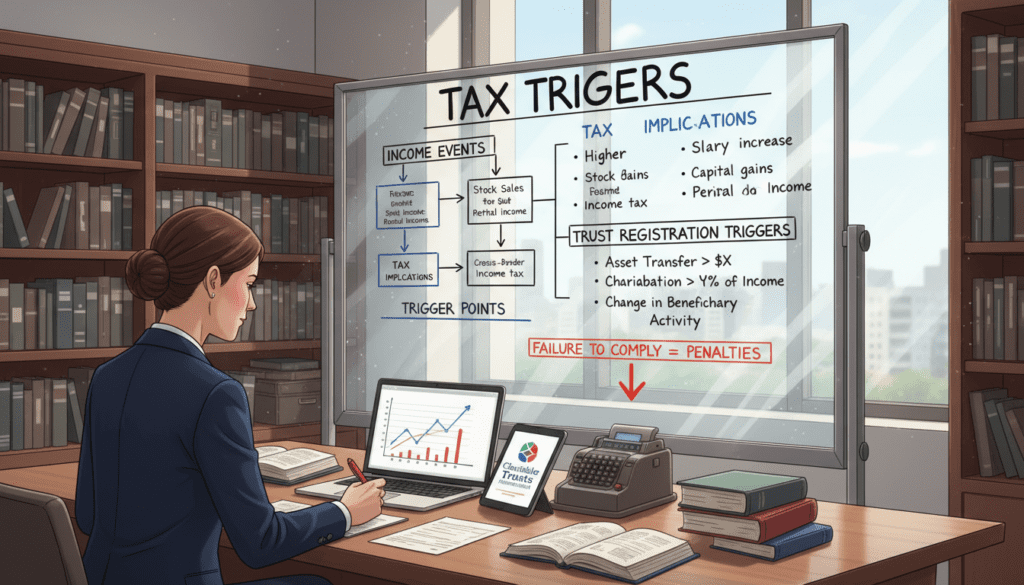
Tax triggers that make a trust registrable
A single taxable event can suddenly change a trust’s reporting obligations and start statutory deadlines running. When a UK tax liability arises, the trust must be registered on the TRS and trustees may need to file tax returns.
Income tax on income, interest and distributions
Common triggers include bank interest, bond interest, dividends and distributions from collective investment funds. Trust income tax is charged at 45% for non-dividend income and 39.35% for dividends (with the first £1,000 taxed at the basic rate). Any of these income types can create an immediate tax liability and a filing obligation. Charitable trusts may be entitled to relief from income tax, but this must be claimed — the liability arises first and the exemption is applied through the return.
Practical tip: note the date income is first received. That date starts the 90-day registration clock and may determine filing deadlines.
Capital gains tax on disposals
Selling shares, investment fund units or UK property can create chargeable gains. Trusts pay CGT at 24% on residential property gains and 20% on other assets. The trust’s annual exempt amount is currently half the individual level (currently £1,500). A single disposal producing gains above this threshold triggers a CGT liability and a reporting duty. Holdover relief may be available when assets are transferred into or out of certain trusts, deferring the CGT charge — but this must be claimed by election and is not automatic.
Keep records of acquisition dates, disposal dates, costs and proceeds. These details support any holdover relief claim and help calculate CGT correctly.
Inheritance tax and trust-related events
Discretionary trusts are subject to the relevant property regime, which can create IHT charges at three points: an entry charge when assets are transferred in (20% on value above the available nil rate band of £325,000 — for most family trusts receiving a single property below this threshold, the entry charge is zero), periodic 10-year charges (maximum 6% of trust property above the NRB — again, often zero for trusts holding a single property below £325,000), and exit charges when capital is distributed (proportional to the last periodic charge — often less than 1% and frequently nil). Changes to interest in possession trusts — such as the ending of a life interest — can also trigger IHT. Any of these events may create a reporting obligation. Note that charitable trusts may be exempt from IHT on assets held exclusively for charitable purposes, but the exemption must be properly claimed.
Stamp Duty Land Tax and UK property taxes
Purchasing UK land or property may trigger Stamp Duty Land Tax in England (or LBTT in Scotland, LTT in Wales). Property transactions by trusts often attract the higher rate surcharge. These transactions create both a tax liability and a TRS registration trigger if the trust is not already registered.
- One event is enough: any taxable income, chargeable gain, IHT charge or property tax can make the trust registrable.
- Records matter: keep trust deeds, invoices, professional valuations and bank statements secure and readily accessible.
- Real-life example: a charitable investment trust purchases a buy-to-let property, receives rental income, and later sells at a profit. This creates income tax on the rental income, CGT on the disposal gain, and potentially SDLT on the purchase — all requiring registration and reporting. Whether charitable tax reliefs apply depends on whether the property is held exclusively for qualifying charitable purposes.
Registration deadlines and key dates trustees must meet
The timetable for TRS filings is straightforward once you know which triggers to watch. We set out the main deadline rules so trustees can add them to a shared calendar and avoid penalties.

The 90-day rule for new trusts and new triggers
Key rule: newly created trusts must register within 90 days of the trust being established. If an existing trust encounters a new tax trigger — such as purchasing UK property or receiving taxable income for the first time — trustees have 90 days from that trigger to register.
This 90-day clock restarts each time a new registrable event occurs, which is why trustees need to stay alert to changes in the trust’s circumstances.
Deadlines for trusts created before and after April 2021
Historic cut-offs remain relevant. Non-taxable express trusts in existence on or before 6 October 2020 were required to register by 1 September 2022.
For trusts created before 6 April 2021 that become liable to income tax or CGT for the first time, the registration deadline is 5 October in the tax year following the year in which the liability first arose.
Where the 5 October and 31 January dates apply
- 5 October: applies to pre-6 April 2021 trusts becoming liable to income tax or CGT for the first time — trustees must register by 5 October in the following tax year.
- 31 January: the standard Self Assessment deadline. Trusts already within Self Assessment must file their SA900 trust tax return and pay any tax due by 31 January following the end of the tax year. Annual TRS confirmations for taxable trusts also typically align with this date.
Updating the register: 90-day updates vs annual confirmations
Non-taxable trusts must update their TRS entry within 90 days of trustees becoming aware of any change to the registered information. Taxable trusts generally have annual confirmations due by 31 January, in addition to the 90-day update requirement for material changes.
Practical tip: add all these dates to a shared calendar, assign clear responsibilities to specific trustees, and never assume someone else will handle it. Missed deadlines can result in penalties of up to £5,000 — and it is the trustees personally who are liable.
For help with authorising agents and managing deadlines efficiently, see our agent guidance.
What information you’ll need to register a trust
We keep this straightforward. Gather the right documents before you start the online process to avoid session timeouts and having to re-enter information.
Trust basics to have ready
Trust details: the trust name, date of creation, and whether it was set up as an express arrangement (most deliberately created trusts are). HMRC also asks whether there is a UK business relationship (relevant for non-UK trusts) and whether the trust has acquired UK land or property.
Lead trustee — the main contact
Individuals acting as lead trustee must supply their full name, date of birth, National Insurance number (if UK-resident), residential address, telephone number, nationality and country of residence. Non-UK-resident individuals provide passport details instead of an NI number.
Organisations acting as lead trustee need their name, UTR (if they have one), registered address, contact details and country of residence.
Settlor information and capacity questions
Enter each settlor’s name, date of birth, nationality and country of residence. For living settlors, HMRC will ask about mental capacity. We recommend noting capacity sensitively and factually. The system assumes capacity unless you state otherwise — if there is any doubt, take advice from a solicitor before proceeding. Where a settlor has lost capacity, a deputy appointed by the Court of Protection or an attorney under a Lasting Power of Attorney (LPA) may need to be involved.
Capturing beneficiaries
List named beneficiaries individually with their personal details. For class beneficiaries (e.g. “future grandchildren” or “employees of XYZ Ltd”), describe the class clearly and precisely. For charitable trusts, describe the charitable objects or name the specific charities. Accurate beneficiary entries at the outset reduce follow-up queries from HMRC.
UK land and property details
If the trust holds UK land or property, have the full addresses, purchase dates and approximate values ready. HMRC requests these details even when the trust’s primary purpose is charitable, because property ownership establishes a UK connection and may trigger additional tax obligations.
- Checklist: trust deed or will, identification for lead trustee(s), settlor details, beneficiary list or class descriptions, land deeds or property addresses and values.
- Keep digital copies readily accessible so you can complete the form in one session without interruption.
- If you need step-by-step help, see our concise guide: registering a trust in Britain — our step-by-step advice.
Extra information required for taxable trusts
If a UK tax liability arises, HMRC requires additional information about the type of trust and the assets it holds. Here is what to expect.
What changes when a trust is taxable: the TRS form asks for the trust’s type (e.g. discretionary, bare, interest in possession), how it was established (by trust deed or will), and any existing UTR. You must also confirm whether a Schedule 3A exclusion might otherwise apply but a UTR is needed due to a tax liability.
Type and origin
Describe the trust type clearly, using the language from the trust deed where possible. Note whether it is a discretionary trust (where trustees have absolute discretion over distributions — this is the most common type, and no beneficiary has a right to income or capital), a bare trust (where the beneficiary has an absolute right to the assets once they reach age 18 — note that bare trusts provide no inheritance tax efficiency or asset protection), or an interest in possession trust (where a life tenant receives income or use of trust property, with a remainderman entitled to capital when the life interest ends). State whether decisions are made by individual trustees or a corporate trustee.
Values for money, shares and business interests
Provide approximate totals for cash and bank balances as at the date of registration. For shareholdings, include the company name, number of shares, share class and an estimated value. Keep supporting documentation for all valuations.
Property, land and partial ownership
Enter property addresses and an estimated full market value. State what proportion the trust holds — for example, 50% of a residential property. Partial ownership affects both CGT calculations on disposal and SDLT treatment on acquisition. Where the trust holds beneficial ownership but not legal title (for example, where a mortgage is in place and legal title remains with the borrower under a declaration of trust), make this distinction clear in the registration.
Controlling interests in overseas companies
If the trust holds a controlling interest in a company registered outside the UK, provide the company name, registered address, governing law, and the date control was acquired. This helps HMRC identify potential changes in ownership structures and any UK tax implications, including on chargeable gains.
| Asset category | Details required | Example entry | Reason |
|---|---|---|---|
| Money | Total cash balance and currency | £12,500 — bank accounts | Shows liquidity and potential income |
| Shares | Company name, number, class, approx value | Acme Ltd, 1,000 A-class, £8,000 | Affects CGT on disposal and dividend income tax |
| Business interests | Business name, address, description, approx value | Smith Farm Ltd — trading, £40,000 | May create trading income or qualify for BPR |
| Property / land | Address, full value, percentage held | 12 High St, £250,000, 50% | Key for SDLT, CGT and IHT calculations |
Practical tip: keep concise valuation notes explaining how you arrived at each figure, along with copies of trust deeds and recent professional valuations. That small file saves time and protects beneficiaries if values or gains are later questioned by HMRC.
How to register your charitable investment trust using HMRC’s online service
Start the process by creating the correct type of Government Gateway account. You must use an Organisation account — an Individual account will not work for trust registration.
Create an Organisation Government Gateway account (not an Individual account)
HMRC requires an Organisation Government Gateway user ID and password for each trust you manage. You will need a dedicated email address linked to that Organisation account, the lead trustee’s full name, and a contact phone number. Keep these credentials secure — they are the gateway to the trust’s official records.
Using a separate Government Gateway ID for each trust you manage
HMRC requires a separate Organisation Government Gateway ID for each trust arrangement. This keeps records clear and ensures submissions are correctly attributed when you manage more than one trust.
Completing the Trust Registration Service submission without delays
Gather all key details before you log in. Have the trust deed ready, along with names and addresses of settlors and trustees, beneficiary information (or class descriptions), and details of any property or other assets held by the trust.
- Lead contact: agree in advance which trustee will act as lead trustee for TRS purposes.
- Login basics: a dedicated trustee email address, phone number and a secure password.
- Form order: trust details first, then people (settlors, trustees, beneficiaries, controllers), then assets and tax answers.
Save a copy of everything you submit — you will need it for future updates and as evidence when dealing with banks, solicitors or investment firms.
After registration: what you receive and what to do next
Once you submit your registration, the next steps matter as much as the form itself. Here is what to expect and which documents to save.
When a UTR arrives and how to use it
For taxable trusts: the lead trustee usually receives a Unique Taxpayer Reference by post within 15 working days. Use this UTR to file the trust’s SA900 Self Assessment tax return, to correspond with HMRC on trust tax matters, and to instruct accountants or solicitors acting for the trust.
Getting the unique reference for non-taxable cases
For non-taxable trusts: log back into the TRS after submission to retrieve the unique reference number. This number proves the trust is registered for anti-money laundering purposes and is typically what banks and regulated firms will ask to see.
Downloading proof for business relationships
Trustees can download a PDF by choosing “Get evidence of the trust’s registration” within the TRS portal. Banks, investment firms and solicitors routinely ask for this document when forming new business relationships with the trust — so keep it accessible.
Authorising an agent
You can authorise an accountant or solicitor to view and update the trust’s TRS entry on your behalf. However, remember: trustees remain legally responsible for the accuracy of the information, so always keep a copy of any authorisation and the latest submission details.
- Simple admin routine: store the UTR or reference number securely, save the evidence PDF, and note the original submission date.
- Refresh and re-download the PDF if you update any information before sharing it with third parties — an outdated version may cause delays.
Keeping the trust registered and compliant over time
Maintaining an accurate TRS registration is an ongoing part of trusteeship, not a one-off task. The responsibility continues for as long as the trust exists — and trusts in England and Wales can last up to 125 years.
We recommend a simple routine: review the trust’s registered details after any major event — a change of trustee, a death, a property purchase or sale, or any shift in who controls or benefits from the trust. Update promptly so records stay accurate and penalties are avoided.
What changes must be reported and when
Reportable changes commonly include: new trustee appointments, trustee resignations or removals, beneficiaries becoming identifiable (e.g. a class beneficiary reaching age 18), changes to the lead trustee’s contact details, and any changes to who controls decision-making within the trust.
Non-taxable trusts must update their TRS entry within 90 days of trustees becoming aware of any change.
Taxable trusts must provide an annual confirmation by 31 January after the end of the tax year, in addition to making 90-day updates for specific event-based changes.
Maintaining accurate beneficial owner information
Beneficial owner information means the facts that show who benefits from or controls the trust arrangement. HMRC requires:
- Full name, nationality and country of residence for each individual connected to the trust.
- The nature and extent of each beneficiary’s interest — whether they are named individuals or part of a class.
- Details of any change in control or decision-making powers (e.g. a new person gaining power to appoint or remove trustees).
Consequences and practical tips
HMRC may charge a penalty of up to £5,000 for failure to register or failure to keep entries current. This is a real financial risk that trustees should take seriously — particularly as it is the trustees personally who bear this liability, not the trust itself (because a trust is an arrangement, not a legal entity that can be fined in its own right).
Practical tips: agree in advance which trustee monitors for changes, maintain a secure shared file of key trust documents, and log every TRS update with the date and reason for the change.
| Change | When to update | Why it matters |
|---|---|---|
| Trustee appointments / resignations | Within 90 days | Shows who is legally responsible for trust decisions and assets |
| Beneficiary details become known | Within 90 days | Records who benefits from the trust and any tax implications |
| Lead trustee contact details | As soon as possible | HMRC and regulated firms use this to contact the trust’s primary representative |
| Change creating a new tax liability | 90 days or annual confirmation (as applicable) | May trigger UTR requirement, filing obligations and tax payments |
Protecting beneficiaries and handling information sharing
We guide you through when trust information can be shared and how to shield vulnerable beneficiaries from potential harm.
When data may be disclosed under the Money Laundering Regulations
The TRS is not a public register — unlike Companies House, members of the public cannot simply search it. However, HMRC may release trust details in narrowly defined circumstances. This typically occurs when an authorised body (such as law enforcement or a designated regulator) demonstrates that it is investigating money laundering or terrorist financing linked to a specific trust arrangement.
What can be shared: the full name, month and year of birth, nationality, country of residence and the nature of the beneficial interest held by each registered person.
Reporting a disproportionate risk of harm
If disclosing a beneficiary’s details could put them at risk, trustees can email trs.riskofharm@hmrc.gov.uk with the subject line “Beneficial owners at risk of harm”.
- Include the trust’s UTR or unique reference number and the trust name.
- Name the lead trustee and identify which beneficiaries are at risk.
- Briefly describe the specific risk — HMRC recognises fraud, kidnapping, blackmail, extortion, harassment, violence and intimidation as relevant categories.
- Provide clear reasons, an estimate of how long the risk will last, and contact details for follow-up.
How HMRC reviews notifications and the 12-month protection
HMRC assesses each notification and may apply an exemption that limits or prevents disclosure of the at-risk beneficiary’s details. If granted, this protection lasts 12 months from the date the notification is received.
Trustees should diarise the renewal date and submit a fresh notification if the risk continues — protection lapses automatically after 12 months if not renewed.
Conclusion
To sum up, a practical and organised approach is key.
If your charitable trust arrangement is an express trust, has a UK connection, or faces a UK tax trigger, you will almost certainly need to register on the Trust Registration Service. Check the Schedule 3A exclusions carefully, confirm whether the trust is taxable, and then follow the correct deadline — typically 90 days from creation or from the triggering event.
Done properly, registration means having a clear lead trustee contact, accurate beneficiary records and a plan for timely updates. Keep copies of the trust deed, identification documents and proof of filing in a secure, accessible location.
After you submit, you will receive either a UTR (for taxable trusts) or a unique reference number (for non-taxable registrations). That proof is essential when banks, solicitors or investment firms ask for evidence of trust registration — as they increasingly do.
Where matters are complex — involving property transfers, overseas companies, or detailed tax questions — seek professional advice from a solicitor or accountant who specialises in trust matters. As we often say, the law — like medicine — is broad, and you would not want your GP performing surgery. Staying organised protects the charitable aims, the beneficiaries, and the trustees personally.
FAQ
What is a charitable investment trust and how does it differ from other trust arrangements?
A charitable investment trust is a legal arrangement — not a separate legal entity — set up to hold and manage assets for charitable purposes. It has a settlor who creates it, trustees who hold legal title and manage the assets, and charitable objects or named charities that benefit. Unlike private family trusts (such as discretionary trusts used for inheritance tax planning or bare trusts where the beneficiary has an absolute right to the assets), a charitable trust’s aims must be exclusively charitable. It may also be subject to regulation by the Charity Commission for England and Wales alongside HMRC’s reporting requirements. England invented trust law over 800 years ago, and the fundamental principle — separating legal and beneficial ownership — underpins all modern trust arrangements.
Who are the key people involved and what do they do?
The settlor provides the initial assets and creates the trust. Trustees hold legal ownership of the trust assets and manage them in the best interests of the charitable objects — they owe fiduciary duties and can be held personally liable for breaches. A minimum of two trustees is required for most trust arrangements. Controllers (for TRS purposes) include anyone who exercises significant control over the trust, such as a person with power to appoint or remove trustees. All trustees must keep records and meet reporting duties to HMRC and, where applicable, anti-money laundering authorities.
Why might a charity-linked trust still need to appear on the Trust Registration Service?
Even when a trust’s purpose is charitable, transparency rules under the Money Laundering Regulations can require it to be registered if it meets certain triggers — such as having a UK tax liability, holding UK property, or entering business relationships with UK-regulated firms. Registration helps prevent the misuse of trust arrangements and provides a record of who controls the trust’s funds and assets. Note that TRS registration is separate from Charity Commission registration — a trust may need both.
What is the Trust Registration Service and why is it required?
The Trust Registration Service (TRS) is HMRC’s online register for trusts with certain reporting obligations. It was introduced under the 4th Money Laundering Directive and expanded significantly under the 5th Money Laundering Directive, which brought all UK express trusts (including bare trusts) within the registration requirement — even those with no tax liability. Its purpose is to improve transparency about who controls and benefits from trust arrangements, supporting anti-money laundering efforts. Trustees must use it when the trust meets taxable triggers or other registration criteria set by UK law. Importantly, the TRS register is not publicly accessible — information is only disclosed in specific, regulated circumstances, unlike the Companies House register.
When do trustees need a Unique Taxpayer Reference (UTR)?
A UTR is needed when the trust is liable for UK taxes or must submit a Self Assessment tax return (SA900). HMRC issues a UTR for taxable trusts so that trustees can file returns and pay any tax due. Trust income is taxed at 45% for non-dividend income and 39.35% for dividends, with only the first £1,000 at the basic rate — so even modest income can trigger a filing requirement. Even trusts that are otherwise excluded under Schedule 3A may need a UTR if a tax reporting need arises — for example, to claim a relief or report a new liability.
Does every trust connected to the UK have to register?
No. Only trusts that meet the registration criteria must register. UK express trusts generally need to register unless a specific Schedule 3A exclusion applies. Non-UK trusts with a UK connection — such as holding UK land, having a UK-resident trustee, or entering business relationships with UK-regulated firms — must also register. Trusts that arise by operation of law (resulting trusts, constructive trusts) are generally not caught by TRS requirements.
How do UK express trusts differ from non-express trusts for registration purposes?
An express trust is deliberately created by a settlor with clear terms, typically set out in a trust deed or will. These are caught by TRS registration rules unless a Schedule 3A exclusion applies. Non-express trusts — such as resulting trusts or constructive trusts that arise by operation of law — are not deliberately created and are generally outside the scope of TRS registration. However, specific circumstances may still require registration, so take professional advice from a solicitor specialising in trust matters if you are uncertain.
When does a non-UK trust with a UK connection need to be registered?
A non-UK express trust must register on the TRS if it holds UK land or property, has at least one UK-resident trustee, or enters a business relationship with a UK-regulated firm (such as a bank, solicitor or investment manager). Even relatively remote connections — such as instructing UK-based solicitors or opening a UK bank account — can trigger the registration requirement.
What tax events make a trust registrable?
Income tax on investment income (interest, dividends, rental income), capital gains tax on disposals of assets (at 24% for residential property and 20% for other assets, with a trust annual exempt amount of just £1,500), inheritance tax events (such as 10-year periodic charges or exit charges under the relevant property regime), and property taxes such as Stamp Duty Land Tax can all create a registration requirement. If any of these UK taxes apply, trustees must register the trust on the TRS and declare the relevant details.
How do I confirm whether my trust is taxable or excluded?
Start by checking whether the trust currently pays or is liable for any UK tax, or whether it fits one of the excluded categories under Schedule 3A to the Money Laundering Regulations. Schedule 3A exclusions include will trusts wound up within two years of death, certain small pilot trusts, co-ownership trusts, and some life insurance policy trusts. If you are unsure, seek professional advice from a solicitor or accountant specialising in trust matters — getting this right avoids penalties of up to £5,000 and unnecessary disclosure.
What are common excluded categories that might apply to charity-linked trust arrangements?
Trusts set up exclusively for registered UK charities, certain pension scheme trusts, will trusts wound up within two years of death, and small pilot trusts holding £100 or less (created before 6 October 2020) can all qualify for exclusion. However, exclusions are narrowly drawn: if the trust has a UK tax liability or requires a UTR to file returns, it may still need to register regardless of the exclusion category.
When does an otherwise excluded trust still have to be registered?
If an excluded trust later generates taxable income, makes chargeable gains, triggers an IHT event, or receives a UTR from HMRC, the trustees must register it on the TRS despite the previous exclusion. Schedule 3A exclusions are not permanent — they can be overridden by subsequent tax events.
What deadlines should trustees be aware of?
New trusts must register within 90 days of creation. Existing trusts facing a new tax trigger must register within 90 days of the triggering event. Different rules apply to trusts created before and after 6 April 2021 — for example, pre-April 2021 trusts becoming liable to income tax or CGT for the first time must register by 5 October in the following tax year. Taxable trusts within Self Assessment also face the standard 31 January deadline for filing returns and annual TRS confirmations.
How often must trustees update the register?
Changes to registered information must be reported within 90 days of trustees becoming aware of them