


Trusts are one of the most powerful tools in estate planning — and England invented them over 800 years ago. At MP Estate Planning, we help ordinary families use trusts to protect their homes, shield assets from care fees, and ensure wealth passes to the right people at the right time.
In England and Wales, the maximum duration of a trust is a crucial consideration for anyone establishing one. Trusts can last up to 125 years under current law, providing a long-term framework for asset protection, inheritance tax (IHT) planning, and controlled distribution of wealth across multiple generations.
In this guide, we explain the legal rules governing trust duration, the different types of trusts and how long each typically lasts, and the practical factors that determine when a trust comes to an end. Our aim is to give you clear, accurate information so you can make confident decisions about protecting your family’s assets.
Key Takeaways
- Trusts in England and Wales can last for a maximum of 125 years under the Perpetuities and Accumulations Act 2009.
- The type of trust you create — discretionary, bare, or interest in possession — directly affects how long it can operate and what it can achieve.
- Discretionary trusts are the most common type (~98–99% of family trusts) and offer the greatest flexibility over duration and distributions.
- Trustees’ decisions play a significant role in how long a trust continues — they can distribute assets early or maintain the trust for decades.
- Understanding trust duration is essential for effective inheritance tax planning, care fee protection, and safeguarding family wealth.
Understanding Trusts in England and Wales
Understanding trusts is essential for anyone looking to protect their wealth in England and Wales. A trust involves the transfer of assets to trustees, who hold legal ownership and manage those assets for the benefit of named beneficiaries. This legal arrangement — not a legal entity, as trusts have no separate legal personality — provides a flexible way to protect and distribute assets according to the settlor’s wishes.
Definition and Purpose of a Trust
A trust is a legal arrangement where one or more trustees hold assets on behalf of beneficiaries. Crucially, the trustees become the legal owners of the trust property, but they must manage it for the beneficiaries’ benefit — not their own. The person who creates the trust is the settlor, and the founding document is called the trust deed.
Trusts serve a wide range of purposes in England and Wales, including protecting the family home from care fee assessments, reducing inheritance tax liability, preventing sideways disinheritance after remarriage, and shielding assets from a beneficiary’s divorce or bankruptcy. With the average home in England now worth around £290,000 and care fees running at £1,200–£1,500 per week, trusts are not just for the wealthy — they’re for the smart.
For instance, a parent might set up a discretionary trust to ensure that their home is preserved for their children, even if the surviving parent later needs residential care. The trust separates the legal ownership from the beneficial interest, meaning the property sits outside the estate for care fee assessment purposes — provided the trust was established years before any foreseeable need for care arose.
Types of Trusts Established
There are several types of trusts that can be established in England and Wales, and the primary classification is whether they take effect during the settlor’s lifetime (lifetime trusts) or on death (will trusts). Within those categories, the most common types are:
- Discretionary trusts — the most widely used type, making up approximately 98–99% of family trusts. Trustees have absolute discretion over when and how to distribute trust assets among the beneficiaries. No beneficiary has an automatic right to income or capital, which is the key protection mechanism against care fees, divorce, and bankruptcy.
- Interest in possession trusts — a beneficiary (known as the life tenant) has a right to receive income from, or use of, the trust property during their lifetime. When the life tenant dies, the capital passes to the remaindermen (capital beneficiaries). These are commonly used in will trusts to prevent sideways disinheritance.
- Bare trusts — the beneficiary has an absolute right to both the capital and income once they reach 18 (or 16 in Scotland). The trustee is merely a nominee with no discretion. Bare trusts offer no protection against care fees, divorce, or IHT, because the beneficiary can collapse the trust once they reach majority under the principle in Saunders v Vautier.
Let’s consider a simple comparison of these trusts:
| Type of Trust | Beneficiary Rights | Trustee Discretion |
|---|---|---|
| Discretionary Trust | No automatic rights to income or capital | Full discretion — can last up to 125 years |
| Interest in Possession Trust | Right to income or use of assets during lifetime | Limited — must pay income to life tenant |
| Bare Trust | Absolute right to assets at age 18 | None — trustee acts as nominee only |

By understanding the different types of trusts and how they operate, you can make informed decisions about your estate planning. Whether it’s protecting your home from care fees, reducing your family’s IHT exposure, or ensuring assets pass to the right people, choosing the correct trust structure — and understanding how long it can last — is the foundation of effective planning.
The Duration of Trusts: Key Factors
The duration of trusts in England and Wales is governed by specific legal rules and influenced by several practical factors. Understanding these is essential for effective trust planning and long-term asset protection.
The Rule Against Perpetuities
The Rule Against Perpetuities is the principal legal constraint on how long a trust can last. Its purpose is to prevent trusts from locking up assets indefinitely, ensuring that property eventually returns to absolute ownership. In simple terms, the law says a trust cannot go on forever — there must be a maximum end date.
For trusts created on or after 6 April 2010, the Perpetuities and Accumulations Act 2009 sets a single, straightforward maximum perpetuity period of 125 years. This replaced the older, more complex rules under the 1964 Act, which used a “life in being plus 21 years” formula or an optional fixed period of up to 80 years.

To illustrate, suppose a discretionary trust is established today to protect the family home for future generations. Under the 2009 Act, that trust could theoretically continue operating for 125 years — long enough to benefit your children, grandchildren, great-grandchildren, and beyond. In practice, most family trusts don’t run for anywhere near that long, because the trustees distribute the assets when the time is right. But having a 125-year maximum gives enormous flexibility for multi-generational planning.
Relevant Legislation Governing Trusts
Several pieces of legislation govern trust duration and administration in England and Wales. The key Acts include:
- The Perpetuities and Accumulations Act 2009 — sets the 125-year maximum trust duration
- The Trustee Act 2000 — defines trustees’ powers, duties, and investment obligations
- The Variation of Trusts Act 1958 — allows courts to approve variations to trust terms on behalf of beneficiaries who cannot consent (e.g., minors or unborn beneficiaries)
- The Inheritance and Trustees’ Powers Act 2014 — modernised trustees’ administrative powers and updated the rules governing trust distributions
| Legislation | Impact on Trust Duration |
|---|---|
| Perpetuities and Accumulations Act 2009 | Sets the maximum trust duration at 125 years for trusts created after 6 April 2010, replacing the older “life in being plus 21 years” rule. |
| Trustee Act 2000 | Gives trustees statutory powers to invest and manage trust assets, enabling them to maintain the trust’s value over its full duration. |
| Variation of Trusts Act 1958 | Allows courts to approve changes to trust terms, including provisions that affect trust duration, when not all beneficiaries can consent. |
| Inheritance and Trustees’ Powers Act 2014 | Modernised trustees’ powers regarding distributions and administrative functions, supporting more flexible trust management over time. |
These legislative Acts work together to provide the framework within which trusts operate. Understanding how they interact is vital for anyone creating or managing a trust — and it’s one of the reasons specialist advice from a solicitor or trust planning professional is so important. As Mike Pugh often says, “The law — like medicine — is broad. You wouldn’t want your GP doing surgery.”
Types of Trusts and Their Lifespan
When establishing a trust, understanding the different types and their respective lifespans is crucial for effective estate planning. The type of trust you choose determines not only how long it can last, but also how much flexibility the trustees have and what level of protection the assets receive.
Fixed vs. Discretionary Trusts
Fixed trusts (including bare trusts) and discretionary trusts are two fundamentally different structures, each with distinct features, purposes, and practical lifespans.
- Fixed Trusts: In a fixed trust, the beneficiaries and their entitlements are predetermined in the trust deed. The trustees have no discretion over who gets what — they simply carry out the settlor’s instructions. A bare trust, for example, gives the beneficiary an absolute right to the capital and income. Once a bare trust beneficiary turns 18, they can demand the assets and collapse the trust entirely. This means bare trusts often have a short practical lifespan and offer no protection against care fees, divorce, or creditors.
- Discretionary Trusts: Discretionary trusts give trustees the power to decide how, when, and to whom to distribute the trust assets from a named class of beneficiaries. No individual beneficiary has any automatic right to income or capital — which is precisely why discretionary trusts are so effective for asset protection. They can last for up to 125 years, and because no beneficiary can demand the assets, they offer strong protection against care fee assessments, divorce settlements, and bankruptcy.
| Trust Type | Beneficiary Interest | Trustee Discretion | Typical Lifespan |
|---|---|---|---|
| Fixed / Bare Trust | Absolute right to assets at age 18 | None | Ends when beneficiary turns 18 and claims assets |
| Discretionary Trust | No automatic entitlement — at trustees’ discretion | Full discretion | Up to 125 years, or until trustees distribute all assets |
Life Interest Trusts and Their Duration
Life interest trusts, also known as interest in possession trusts, grant a beneficiary (the life tenant) the right to use the trust property or receive income from it for their lifetime. They are most commonly created in wills to prevent sideways disinheritance — for example, allowing a surviving spouse to live in the family home while ensuring it ultimately passes to the children from the first marriage.
- The life tenant has the right to occupy or receive income from the trust assets during their lifetime, but they do not own the capital.
- Upon the life tenant’s death, the trust assets pass to the capital beneficiaries (remaindermen) as specified in the trust deed or the will.
The duration of a life interest trust is therefore tied to the life of the life tenant. Once they pass away, the trust typically comes to an end and the capital is distributed. However, the trust deed can provide for successive life interests — for example, giving a second spouse a life interest before the assets finally pass to the children — which extends the trust’s overall duration.
It’s worth noting that life interest trusts created after 22 March 2006 are generally treated as part of the relevant property regime for IHT purposes, unless they qualify as an immediate post-death interest (IPDI) or a disabled person’s interest. This has significant tax implications that should be discussed with a specialist.
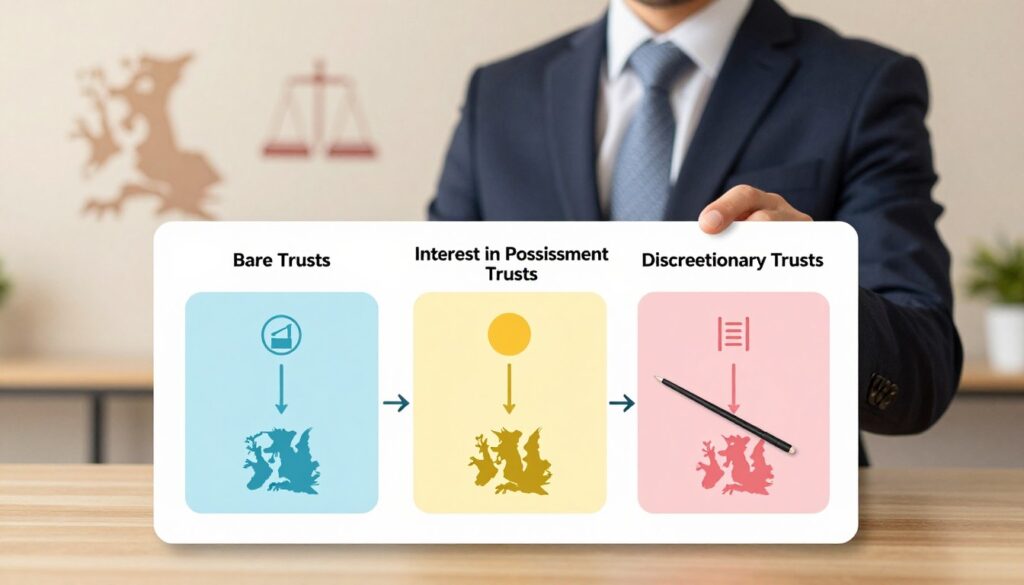
Understanding the differences between these trust types is essential for effective estate planning. By choosing the right structure — and understanding how long each type can last — you can ensure that your assets are protected and distributed exactly as you intend, for as long as your family needs.
Typical Lifespan of a Trust
In England and Wales, the practical lifespan of a trust depends on its type, the terms set out in the trust deed, and the decisions made by the trustees. While the law allows trusts to last up to 125 years, most family trusts run for a much shorter period — typically one to three generations.
Standard Duration for Specific Trusts
Different types of trusts have very different practical lifespans, even though the legal maximum is the same. Here’s what to expect for the most common structures:
- Bare Trusts: These effectively end when the beneficiary turns 18, because the beneficiary gains an absolute right to the assets and can demand them from the trustees. Practical lifespan: typically under 18 years.
- Discretionary Trusts: These can last for the full 125-year maximum. In practice, most family discretionary trusts operate for 30–60 years — enough to protect assets through one or two generations. The trustees can distribute assets at any time if it makes sense for the family’s circumstances, or they can hold them for decades if protection is still needed.
- Life Interest Trusts: These last for the lifetime of the life tenant. Once the life tenant dies, the capital passes to the remaindermen and the trust terminates. Duration depends entirely on how long the life tenant lives after the trust is created.
For a typical Family Home Protection Trust set up by a couple in their 50s or 60s, the trust might operate for 40–70 years — protecting the home through the settlors’ old age, the children’s working lives, and potentially into the grandchildren’s early adulthood.

Factors Influencing the Lifespan
Several practical factors determine how long a trust actually operates:
- The terms of the trust deed — the trust deed may specify a fixed perpetuity period (up to 125 years), conditions that trigger distribution, or events that bring the trust to an end.
- The needs of the beneficiaries — if all beneficiaries are financially stable and there’s no ongoing need for protection, the trustees may decide to wind up the trust and distribute the assets.
- Trustee decisions — in a discretionary trust, the trustees have the power to distribute some or all of the assets at any time. A well-drafted trust deed with clear powers gives trustees the flexibility to adapt to changing family circumstances.
- Tax considerations — discretionary trusts are subject to periodic (10-year anniversary) charges and exit charges under the relevant property regime. The maximum periodic charge is 6% of the trust property above the nil rate band. For most family homes below the nil rate band (currently £325,000), these charges are zero. But if trust assets grow significantly over decades, tax efficiency may influence the decision to distribute.
- Changes in legislation — future changes to trust law, IHT rules, or care fee thresholds could affect whether it makes sense to continue the trust or wind it up.
For example, if a discretionary trust holds a family home worth £280,000 at creation, and the property later increases substantially in value, the trustees might choose to distribute a portion to keep the trust assets within tax-efficient limits. Conversely, if a beneficiary faces divorce proceedings, the trustees might hold the assets longer to protect them — after all, the beneficiary can simply say, “What house? I don’t own a house.” This flexibility is one of the greatest strengths of a properly drafted discretionary trust.
The Role of Trustees in Trust Duration
Trustees play a pivotal role in determining how long a trust continues to operate in England and Wales. Their decisions and day-to-day management directly influence whether a trust runs for years or decades.

Responsibilities of Trustees
Trustees carry significant legal responsibilities that impact the administration and duration of a trust. A minimum of two trustees is required for most trusts (and the Land Registry allows up to four trustees on a property title). Their core duties include:
- Managing trust assets prudently and in the best interests of the beneficiaries
- Making distributions to beneficiaries in accordance with the trust deed — or exercising their discretion in a discretionary trust
- Maintaining accurate records and accounts of all trust transactions
- Filing the annual SA900 trust tax return with HMRC and ensuring all tax obligations are met
- Registering the trust on the Trust Registration Service (TRS) within 90 days of creation, as required under anti-money laundering regulations
- Acting unanimously (unless the trust deed provides otherwise) and avoiding conflicts of interest
It’s important to understand that the settlor can also be a trustee — this is very common in family trusts and means the person who created the trust remains involved in its management. They don’t lose control. The trust deed should also contain a clear process for removing and replacing trustees over time, since the trust may outlast any individual trustee.
How Trustees Impact Trust Lifespan
The decisions made by trustees can significantly affect how long a trust operates. In a discretionary trust — the most common type for family asset protection — the trustees have the power to distribute assets whenever they judge it appropriate. This means they effectively control the trust’s lifespan.
| Trustee Decision | Potential Impact on Trust Lifespan |
|---|---|
| Prudent management of trust property | Extends trust lifespan by preserving the value of trust assets over time |
| Strategic distributions aligned with beneficiary needs | Allows the trust to fulfil its purpose — potentially ending it when protection is no longer needed |
| Holding assets during a beneficiary’s divorce or financial difficulty | Extends the trust’s active period to protect assets when they’re most at risk |
| Failure to comply with the trust deed or HMRC requirements | May lead to legal challenges, personal liability for trustees, or forced early termination |
A well-drafted trust deed with appropriate “standard and overriding powers” gives trustees the flexibility to manage the trust’s duration sensibly — keeping it going when protection is needed, and winding it up efficiently when the time is right. The settlor can also leave a letter of wishes to guide trustees on their preferences, although this is advisory rather than legally binding.
Ending a Trust: Conditions and Processes
Trusts are not permanent — they can and do come to an end. When a trust has fulfilled its purpose, when the circumstances of the beneficiaries have changed, or when the maximum perpetuity period is approaching, the trust can be wound up and its assets distributed.
Dissolution of Trusts
A trust can be brought to an end under various circumstances, including:
- When the trust’s objectives have been met — for example, a trust established to protect a home during the settlors’ lifetime may be wound up after both settlors have died and the property is ready to pass to the children.
- When the trust deed specifies a termination event — such as a named beneficiary reaching a particular age.
- When all beneficiaries are adults of sound mind and unanimously agree to collapse the trust — known as the rule in Saunders v Vautier. However, this only works if all beneficiaries are identifiable and can consent, which is rare in a well-drafted discretionary trust with a wide class of potential beneficiaries.
- When the trustees exercise their power of appointment to distribute all trust assets to the beneficiaries.
- By court order under the Variation of Trusts Act 1958, if changes are needed that the trust deed doesn’t provide for.
- When the maximum perpetuity period (125 years) expires — the trust must end and all remaining assets must be distributed.
It’s crucial to follow the correct legal procedures when winding up a trust — this includes settling any outstanding tax liabilities with HMRC, filing a final trust tax return, and updating the Trust Registration Service.
Distribution of Trust Assets
Once the decision is made to end a trust, the assets must be distributed properly. This process requires careful attention to both the trust deed and any tax obligations.
The distribution process typically involves:
- Reviewing the trust deed to confirm the distribution provisions and any restrictions on how assets can be allocated.
- Valuing the trust assets — this is particularly important for property, as the value at the date of distribution determines any capital gains tax liability and any exit charge under the relevant property regime.
- Settling any outstanding tax liabilities — including potential exit charges for discretionary trusts (proportional to the last periodic charge, typically less than 1% for most family homes) and capital gains tax where holdover relief is not available.
- Transferring legal ownership of assets to the beneficiaries — for property, this involves a TR1 transfer form and updating the Land Registry.
The trustees are personally responsible for ensuring that the distribution is carried out correctly and that all legal and tax obligations are met before the trust is formally closed. Taking specialist advice at this stage is strongly recommended.

In summary, ending a trust is a structured legal process that requires careful planning. Whether the trust has run its full course or is being wound up early, following the correct procedures ensures a smooth, lawful, and tax-efficient conclusion — protecting both the trustees and the beneficiaries.
Trusts for Minors: Special Considerations
Creating a trust for minors involves unique considerations, particularly around how long the trust will last and what happens when the child reaches adulthood. The type of trust chosen is critical — it determines whether the minor gains automatic control of the assets at 18 or whether the trustees retain discretion to manage the assets for longer.
Duration of Trusts for Minors
The duration of a trust for minors depends entirely on the type of trust used. In a bare trust, the beneficiary gains an absolute legal right to the capital and income at age 18 in England and Wales. At that point, they can demand the assets from the trustees — and the trust effectively ends, regardless of whether the 18-year-old is mature enough to manage a significant sum responsibly.
This is why most specialist trust planners prefer to use discretionary trusts for minors. In a discretionary trust, the trustees can hold assets for as long as the trust deed allows — up to 125 years — and distribute them when they judge the beneficiary is ready. The trust deed might include guidance (via a letter of wishes) suggesting distributions at certain milestones, such as ages 21, 25, or 30, but these are advisory rather than mandatory.
We understand that families often use trusts to safeguard assets until their children are old enough to handle them wisely. According to Evelyn’s insights, trusts for children are a popular choice for parents looking to secure their children’s financial future — and choosing the right trust structure is essential.
Legal Provisions and Age of Majority
The age of majority in England and Wales is 18. This is the age at which a person can legally own property, enter into contracts, and — crucially — demand assets held in a bare trust. However, the age of majority does not automatically end a discretionary trust. In a discretionary trust, no beneficiary has any right to the assets regardless of their age, so turning 18 has no legal effect on the trust itself.
Here is a comparison of how different trusts for minors work:
| Trust Type | What Happens at Age 18 |
|---|---|
| Bare Trust | Beneficiary gains absolute right to assets — can demand everything and collapse the trust |
| Discretionary Trust | No automatic entitlement — trustees retain full discretion over timing and amounts of any distribution |
| Interest in Possession Trust (for a minor) | Beneficiary entitled to income from 18, but capital remains in trust for the remaindermen |
It’s also worth noting that trustees have a fiduciary duty to act in the best interests of the beneficiaries at all times. For trusts holding assets for minors, this includes making prudent investment decisions and ensuring the trust assets are properly managed until distribution. Trustees must also register the trust on the Trust Registration Service within 90 days of creation and file annual tax returns with HMRC as required.
In summary, trusts for minors require careful thought about both the type of trust and its intended duration. A discretionary trust offers by far the most flexibility and protection — allowing the trustees (and, through a letter of wishes, the settlor) to decide when the beneficiary is truly ready to receive their inheritance.
Modifying Trust Terms and Duration
As circumstances change over the years, it may become necessary to modify the terms or duration of a trust. Family dynamics shift, tax laws evolve, and beneficiaries’ needs change. A well-drafted trust deed should anticipate this by including appropriate powers for the trustees — but even without such provisions, there are legal routes to make changes.
Amending Trust Deeds
Amending a trust deed involves making formal changes to the original document that established the trust. This might include adding or removing beneficiaries, changing the class of potential beneficiaries, altering the conditions for distributions, replacing trustees, or even extending or shortening the trust period (within the 125-year maximum).
The ability to amend a trust deed depends on several factors:
- The powers in the trust deed itself — a well-drafted trust deed will include a power of amendment, specifying what can be changed and by whom. Mike Pugh’s trust deeds include “standard and overriding powers” that give trustees defined flexibility without making the trust revocable.
- The type of trust — discretionary trusts generally offer more scope for amendment than bare trusts or fixed trusts.
- Whether amendments affect beneficiaries’ existing interests — changes that would prejudice a beneficiary’s vested interest may require their consent or a court order.
Legal Procedures for Modifications
The legal procedures for modifying a trust depend on what changes are needed and whether the trust deed provides the necessary powers:
| Procedure | Description |
|---|---|
| Exercise of Powers in the Trust Deed | If the trust deed includes a power of amendment or advancement, the trustees can make changes by formal resolution — documented in a deed of variation or deed of appointment. This is the most straightforward route and covers the majority of modifications needed. |
| Application Under the Variation of Trusts Act 1958 | If the trust deed doesn’t provide sufficient powers, or if the proposed change would affect beneficiaries who cannot consent (such as minors, unborn beneficiaries, or those lacking mental capacity), the trustees can apply to the court for approval. The court will only approve the variation if it is for the benefit of the affected beneficiaries. |
| Beneficiary Consent (Saunders v Vautier) | If all beneficiaries are adults of sound mind, are absolutely entitled to the trust assets, and all agree, they can collectively vary or end the trust. However, this rarely applies to discretionary trusts because the class of beneficiaries is usually too wide to achieve unanimous consent. |
It’s essential to seek specialist advice before making any modifications to a trust. Even seemingly minor changes can have unintended tax consequences — for example, resettling assets into a new trust could trigger an IHT entry charge, while certain amendments might reset the 10-year periodic charge cycle.
By understanding the processes involved in modifying trust terms and duration, settlors and trustees can ensure that their trusts remain fit for purpose — adapting to new circumstances while continuing to protect the family’s wealth for future generations.
The Impact of Legislation on Trust Duration
Understanding how legislation shapes trust duration is essential for effective long-term planning. Trust law in England and Wales has evolved significantly over the centuries, and recent reforms have given families far more flexibility than was available even a generation ago.
Recent Reforms Affecting Trust Law
Several key pieces of legislation have reshaped the rules around trust duration and administration in recent years:
- Perpetuities and Accumulations Act 2009 — the most significant reform for trust duration. This Act replaced the complex “life in being plus 21 years” rule with a simple 125-year maximum perpetuity period for trusts created on or after 6 April 2010. It also removed restrictions on the accumulation of income within trusts, giving trustees greater freedom to reinvest income rather than being forced to distribute it.
- Inheritance and Trustees’ Powers Act 2014 — modernised trustees’ administrative and dispositive powers, making it easier for trustees to manage trusts effectively over their full duration.
- The Trust Registration Service (TRS) — introduced under the 5th Money Laundering Directive, this requires all UK express trusts (including bare trusts) to be registered with HMRC within 90 days of creation. While the TRS doesn’t directly affect trust duration, it has added an ongoing compliance obligation throughout the trust’s life. Importantly, the TRS register is not publicly accessible — unlike Companies House.
- Finance Act provisions — ongoing changes to IHT, the relevant property regime, and trust taxation rates affect the practical costs of maintaining a trust over long periods. For example, the nil rate band has been frozen at £325,000 since 2009 and is confirmed frozen until at least April 2031 — meaning more estates are caught by IHT each year, which in turn increases the demand for trust planning.
Future Trends in Trust Legislation
Looking ahead, trust legislation will continue to evolve. Based on current government direction and policy announcements, families should be aware of these likely trends:
- Increased scrutiny of trusts for tax purposes — HMRC continues to tighten reporting requirements and has expressed interest in how trusts are used for IHT planning. From April 2027, inherited pensions will also become liable for IHT, potentially driving more families towards trust-based planning.
- Changes to business and agricultural property reliefs — from April 2026, Business Property Relief (BPR) and Agricultural Property Relief (APR) will be capped at 100% for the first £1 million of combined business and agricultural property, with only 50% relief on the excess. This will affect how long certain trusts holding business or agricultural assets remain tax-efficient.
- Digital assets and trusts — as more people hold cryptocurrency, digital investments, and other non-traditional assets, trust law will need to adapt to accommodate these asset classes within existing trust structures.
- Care fee reform — any future changes to care fee thresholds (currently £23,250 in England) or the introduction of a care cost cap would significantly affect the role of trusts in protecting family homes. With between 40,000 and 70,000 homes sold annually to fund care, this remains one of the primary reasons families establish trusts.
As legislation continues to shape trust law, it’s crucial for trustees and settlors to review trust deeds regularly and work with specialist professionals who understand the interaction between trust duration, taxation, and asset protection. Plan, don’t panic — but do plan early.
Common Misconceptions About Trust Duration
Trust duration is a topic surrounded by myths and misunderstandings. We regularly encounter families who have been given inaccurate information — whether from well-meaning relatives, generic online articles, or advisers who don’t specialise in trust law. Let’s set the record straight.
Myths vs. Reality
Myth 1: “Trusts last forever.”
Reality: No trust in England and Wales can last indefinitely. The maximum duration is 125 years for trusts created after 6 April 2010. Before that date, the maximum was typically a “life in being plus 21 years” or a fixed period of up to 80 years. Every trust must have an end point.
Myth 2: “Trusts can’t be changed once they’re set up.”
Reality: Trusts can be modified in several ways — through powers contained in the trust deed, by trustee resolution, or by application to the court under the Variation of Trusts Act 1958. A well-drafted discretionary trust includes flexible powers that allow the trustees to adapt to changing circumstances without needing court approval.
Myth 3: “All trusts are the same — they all last the same amount of time.”
Reality: Different types of trusts have very different practical lifespans. A bare trust may effectively end when the beneficiary turns 18. A life interest trust lasts as long as the life tenant lives. A discretionary trust can run for up to 125 years. The choice of trust type is one of the most important decisions in estate planning.
Myth 4: “Putting your home in trust is complicated and only for wealthy people.”
Reality: With the average home in England now worth around £290,000 and IHT charged at 40% above the £325,000 nil rate band, trust planning is relevant to a huge number of ordinary homeowners. A straightforward Family Home Protection Trust can be set up from as little as £850 — roughly the cost of one to two weeks of care home fees. As Mike Pugh puts it: “Trusts are not just for the rich — they’re for the smart.”
Understanding Legal Boundaries
Legal boundaries play a crucial role in determining a trust’s duration. The 125-year maximum is an absolute ceiling, but the practical lifespan of most trusts is determined by the trust deed’s terms, the trustees’ decisions, and the beneficiaries’ needs.
For beneficiaries or trustees who need to understand the process of accessing trust assets, our guide on how to access a trust fund in the UK explains the legal and administrative steps involved.
| Myth | Reality |
|---|---|
| Trusts can last forever. | Maximum 125 years for trusts created after 6 April 2010 — the rule against perpetuities requires a fixed end date. |
| Trusts cannot be changed. | Trusts can be varied through the trust deed’s own powers, trustee resolution, beneficiary consent, or court order. |
| All trusts are the same. | Bare trusts, discretionary trusts, and life interest trusts have fundamentally different structures, protections, and practical lifespans. |
| Trusts are only for the wealthy. | With average house prices around £290,000, the frozen nil rate band at £325,000, and care fees at £1,200–£1,500/week, trusts are essential planning tools for ordinary homeowners. |
By understanding the realities of trust duration and the legal boundaries that govern them, you can plan effectively — protecting your family’s assets for exactly as long as they need protecting, within a clear legal framework.
Conclusion: The Future of Trusts in the UK
As we’ve explored throughout this guide, trusts are a fundamental part of estate planning in England and Wales — and understanding how long they can last is essential to using them effectively. With a maximum duration of 125 years, trusts offer multi-generational protection that no other legal arrangement can match.
Looking ahead, the future of trusts is shaped by frozen tax thresholds, rising property values, and an ageing population facing care costs of £1,200–£1,500 per week. Planning with trusts has never been more relevant for ordinary families — not just the wealthy.
Trends in Wealth Management
With the nil rate band frozen at £325,000 since 2009 — and confirmed frozen until at least April 2031 — the gap between property values and IHT thresholds continues to widen. This means more families each year are drawn into the IHT net. At the same time, care fee thresholds remain low (£23,250 in England), and between 40,000 and 70,000 homes are sold annually to fund care. Trusts — particularly discretionary trusts — remain one of the most effective tools for protecting the family home from both threats.
Planning for the Future
Effective planning with trusts requires specialist knowledge of how trust law, IHT, care fees, and property law interact. It’s not something to leave to a general practitioner or a DIY online service. As Mike Pugh says: “The law — like medicine — is broad. You wouldn’t want your GP doing surgery.” By working with a specialist trust planner, you can create a trust that protects your family for exactly as long as it’s needed — whether that’s 20 years or 120 years. Not losing the family money provides the greatest peace of mind above all else — and keeping families wealthy strengthens the country as a whole.