


Quick answer
A gift with reservation of benefit (GROB) is a lifetime gift where the donor continues to benefit from the gifted asset, the classic example is gifting your house to your children while continuing to live there rent-free. Under HMRC’s GROB rules (s.102 Finance Act 1986), the asset is treated as remaining in your estate for IHT for as long as the benefit continues, meaning the 7-year clock effectively never starts. The only watertight way around the GROB rules is to pay full market rent to the recipient, reviewed regularly. Where the GROB rules don’t apply but there is still a continuing benefit, the parallel Pre-Owned Asset Tax (POAT) regime may impose an annual income tax charge instead. Both regimes are complex and case-specific. This guide explains the HMRC rules, the safe and unsafe arrangements, and the most common mistakes families make.
Last reviewed: 24 May 2026 by the MP Estate Planning editorial team. Jurisdiction: England and Wales. Scotland and Northern Ireland have different probate and intestacy rules; the IHT thresholds are UK-wide.
By the MP Estate Planning UK editorial team · Estate planning information for England & Wales · Updated June 15, 2026
We explain a tricky tax trap that often surprises homeowners. Many think they can pass assets on and still use them. HMRC looks closely at any transfer where the giver keeps the use or enjoyment.
In plain terms: if you hand over your house but still live there rent-free, that transfer can stay liable for inheritance tax and affect IHT treatment. We will show how the seven-year countdown can fail to remove the charge.
This guide is for UK homeowners aged 45, 75 who want sensible estate planning. We outline common triggers, practical alternatives such as paying market rent, and when to seek specialist advice.
We use clear examples, not legal jargon. Our aim is to protect family wealth while keeping options open.
Key Takeaways
- Keeping use after a transfer can keep the asset in the estate for inheritance tax.
- The seven-year timeline may not apply if enjoyment continues.
- Paying market rent or changing arrangements can avoid unintended tax charges.
- Early planning helps limit IHT exposure on an estate.
- Seek specialist advice for tailored, compliant solutions.
What a gift with reservation of benefit means for UK inheritance tax
Three rule changes you may need to consider (2026/27)
1. Pensions become subject to IHT from 6 April 2027. Most unused defined-contribution pension pots currently sit outside the estate for IHT, that ends on 6 April 2027 (gov.uk policy paper). HMRC estimates around 10,500 estates will face IHT for the first time as a result.
2. Business and agricultural property reliefs capped at £2.5m per person from 6 April 2026. Above the cap, only 50% relief applies, effective IHT of 20%. AIM shares dropped to 50% relief and do not use the £2.5m allowance (Saffery, APR/BPR reforms).
3. The NRB, RNRB and £2m taper threshold are frozen until 5 April 2031 following the 2024 and 2025 Budgets (gov.uk, NRB and RNRB freeze). With inflation, more estates will be pulled into IHT each year, a process commonly called “fiscal drag.”
Many homeowners assume handing over an asset ends their tax exposure; that is not always true.
In plain English, GWROB means you transfer ownership but keep the enjoyment. That enjoyment can be obvious, living in a house, or subtle, like keeping income or occasional use.
Legally, the test sits in Section 102 of the Finance Act 1986. HMRC look at who really enjoys the property. If the donor still uses, occupies or receives income, the transfer can stay chargeable for IHT.
We simplify the HMRC terms so they make sense:
- Donor, the person who parts with legal title.
- Donee, the person who receives the asset.
- Possession and occupation, who lives in or controls the property day-to-day.
The test is factual, not formal. Paperwork calling something a gift does not decide matters. What matters is who enjoys the asset in practice.
| Concept | Plain meaning | Impact for IHT |
|---|---|---|
| Enjoyment | Use, occupation, or income | May keep value in donor’s estate |
| Donor vs Donee | Who actually lives in or benefits | Controls whether transfer is treated as effective |
| Legal test | Section 102, Finance Act 1986 | Determines GWROB treatment |
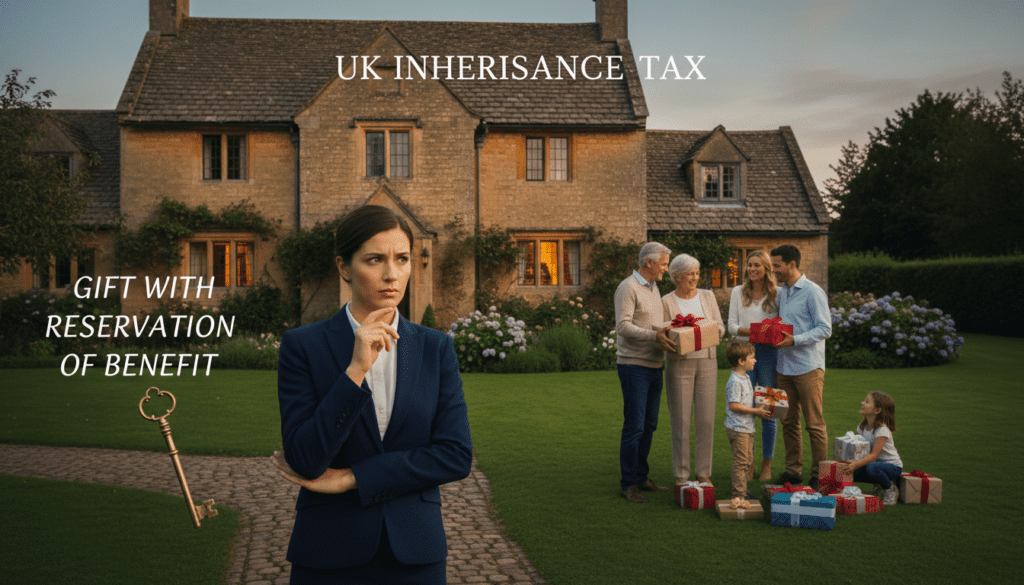
gift with reservation of benefit rules explained uk
Handing legal title away does not always end tax exposure if someone keeps using the asset.
When HMRC say a transfer has not “truly left” your estate
HMRC look at who actually enjoys the property. If the donor still occupies, receives income or uses the asset, HMRC treat the value as staying in the estate.
That means paperwork alone rarely wins the case. The test is factual: who benefits in daily life matters more than the document name.
Why relationship, intention and the passage of years do not usually change the outcome
Being related to the recipient or acting with good intentions does not alter the tax test. HMRC focus on the retained benefit, not motive.
Time also offers limited comfort. Ten, fifteen or twenty years can pass and the value may still be included while enjoyment continues.
- Common trouble spots: living rent-free after transfer, keeping income streams, or informal use arrangements.
- Practical consequence: your estate can include the market value despite legal title changing long ago.
- Warning sign: any ongoing use, however occasional, that is not documented and charged at market rates.

How GWROB interacts with potentially exempt transfers and the seven-year rule
We start by explaining the basic picture. A potentially exempt transfer, or PET, is a lifetime transfer that becomes free of IHT if the donor survives seven years from the relevant date.
But, if the donor keeps using the asset, the seven‑year clock does not run properly.

When a PET begins and why it can pause
Normally, a lifetime transfer is treated as a PET on the transfer date. If the donor survives seven years from that date, the value falls outside the estate.
However, retained use stops that timeline. HMRC treats the transfer as still in the estate while enjoyment continues.
The “new gift” date when the use ends
When the donor finally stops using the asset, that cessation is treated as a fresh transfer date. In plain terms, the PET restarts on the later date.
Taper relief and timing if death follows soon after
If death occurs within seven years of the relevant date, taper relief (HMRC IHTM14612) may reduce the IHT payable. The crucial point is the date that counts is the date the use ended, not necessarily the original transfer date.
- Key actions: record exact dates of transfer and of any change in occupation or use.
- Keep clear paperwork so the relevant date is easy to evidence in any enquiry.
Typical situations that trigger a reservation of benefit
Everyday choices about property and income can surprisingly keep assets inside your estate for tax purposes. We list the real-life examples we see most often.

Family home kept after transfer. Handing a home to children but carrying on living there rent-free is the commonest trigger. Even occasional unpaid occupation can look like retained enjoyment.
Income-producing assets. Giving shares while continuing to take dividends counts as retained income. That ongoing payment is likely to draw HMRC attention.
- Let property and business interests: retaining rental income or ongoing fees can keep the asset in the donor’s estate.
- Everyday items: cars or classic vehicles that are still borrowed, insured or stored for the original owner can create problems.
- Intangibles: intellectual property that still produces royalties is treated as enjoyment and may be taxable.
Small changes in who receives income, who occupies or who controls access often decide the outcome. For practical guidance on lifetime transfers, see our piece on inheritance outside the scope of IHT gifts.
The tax impact: how GWROB can keep value in your death estate
Retained use can pull the full market value back into a person’s estate for inheritance tax purposes. That means a transfer that felt final can still count when you die.

Full market value dragged back for IHT
If someone keeps living in or taking income from an asset, HMRC can treat the full market value as part of the death estate. The practical result is a tax bill based on current value, not the earlier transfer price.
The double charge risk
When death occurs within seven years, two routes can apply: death estate rules and a failed pet treatment. HMRC will use the method that produces the highest tax take.
“Paperwork alone rarely wins, enjoyment in practice decides tax outcome.”
- Key point: a 40% inheritance tax charge can apply even years after a transfer if use never stopped.
- Executors face uncertainty and extra work when value is pulled back into the estate.
Bottom line: half‑measures risk significant tax. We recommend clear, documented steps or specialist advice before you act.
How to avoid GWROB while still planning your estate
We outline a clear, practical route to keep your planning safe while you continue to live at home.
Pay full market rent for continued occupation. The cleanest route is to charge proper market rent and show you really pay it. That means a written tenancy or licence, regular payments into the recipient’s account, and market reviews at sensible intervals.

Making rent work in practice
Documentation matters. Use a formal agreement, bank records and periodic rent reviews. State a clear intent to pay in perpetuity, not just for seven years.
Tax and compliance for the recipient
The recipient must include rental income on self-assessment returns. That income can affect their tax position and may push them into a higher band.
On sale, the recipient may face capital gains tax if the home is not their main residence. Growth after the transfer can create a CGT bill.
Practical landlord obligations
- Gas safety certificate and electrical tests
- Valid EPC and building/landlord insurance
- Routine maintenance and repairs
Alternatives and limited occupation
Where ongoing use is truly minor, HMRC can accept the donor is virtually excluded. Examples that often pass muster include short stays for social visits, brief stays during house repairs, or medical visits kept to a modest number of nights per year.
| Action | Why it helps | Evidence needed | Tax effect |
|---|---|---|---|
| Pay full market rent | Shows commercial arrangement | Tenancy, bank payments, market reviews | Reduces GWROB risk; rental taxed to recipient |
| Document short stays | Shows use is insignificant | Visitor logs, dates, purpose | May avoid GWROB if truly limited |
| Recipient reports income | Complies with income tax rules | Self-assessment entries, receipts | Ensures transparency to HMRC |
| Prepare for CGT | Recognises future sale risk | Valuations, ownership records | Recipient may face CGT if not main home |
If the rules already apply: what changes can and cannot fix
We often see families assume that stopping occupation or income today erases earlier treatment. That is not the case. Historic retention still matters for the period when the donor enjoyed the asset.
Why simply stopping the use now does not rewrite history
Stopping the use does not undo past treatment. Any period during which the donor retained enjoyment remains relevant to HMRC’s assessment. Simply moving out today cannot erase the fact that the donor benefited previously.
How HMRC treat the end of enjoyment as a fresh transfer
When the use genuinely stops, HMRC treats that cessation as a new transfer date. From that date a fresh potentially exempt transfer (PET) can begin. The seven-year clock runs from the cessation date, not from the original transfer.
- Moving out completely, the relevant date is the day occupation ends and a new PET may start.
- Paying proper market rent, if full commercial rent begins and is evidenced, the donor’s retained enjoyment can end.
- Giving up an income stream, formally stopping payments creates a fresh transfer event for PET timing.
Evidence is decisive. Bank records, revised tenancy agreements, insurance changes and occupancy logs show the change in practice. Half-steps, sporadic payments or informal stays, often keep the reservation alive in HMRC’s view.
“Act early: the sooner the benefit truly stops, the sooner your planning has a chance to work.”
GWROB vs pre-owned asset tax: avoiding one trap without falling into another
Many families try to fix one tax exposure and, unknowingly, trigger another. We explain how two different regimes apply and what that means for your planning.
Different taxes, different legislation
GWROB sits under the Finance Act 1986 and targets inheritance tax. POAT comes from the Finance Act 2004 and is an income tax charge.
How cash planning can trigger POAT
Selling an asset and gifting cash for a child to buy a home you then occupy can avoid a direct reservation test. But HMRC can assess a POAT charge instead.
POAT valuation often uses a market rent figure or a flat percentage of capital value (commonly around 5%). That creates an annual taxable benefit based on the assessed value.
| Aspect | GWROB (IHT) | POAT (Income tax) |
|---|---|---|
| Main law | Finance Act 1986 | Finance Act 2004 |
| Trigger | Donor keeps use after transfer | Cash or arrangements that give continued use |
| How HMRC values it | Full market value dragged into estate | Market rent or % of capital value (approx 5%) |
| Practical choice | Cease use or charge full market rent | Restructure or elect into IHT where sensible |
Options are simple: stop occupying, document a commercial tenancy and pay proper rent, or restructure ownership. In some cases an election into inheritance tax treatment is the cleaner route.
We recommend joined‑up planning. Treat both regimes together, not one at a time. For wider traps and practical examples, see our overview on common tax traps and guidance for single owners on inheritance planning.
Trusts, excluded property and the shifting UK landscape from April 2025
Trusts can seem helpful, but they can also create hidden tax exposure when the settlor still benefits.
How GWROB can arise through settlor-interested trusts.
If a settlor keeps any practical link to a trust, access, income or power to regain assets , HMRC can treat that link as a reservation. That can pull trust value back into the donor’s estate for inheritance tax and stop the trust behaving as a clean separation.
Excluded property today.
Non-UK situs assets settled by someone not UK-domiciled have often sat outside inheritance tax. This can still matter for older structures but political change makes certainty less clear.
The government proposes a 10-year residence test and a 10-year tail after leaving. That brings worldwide assets into scope after long residence and can affect trusts across settlement, 10-year anniversaries and distributions.
| Scenario | Current effect | Post‑2025 risk |
|---|---|---|
| Settlor-interested trust | Can trigger inclusion in donor estate | May face trustee periodic charges and donor inclusion |
| Excluded non-UK assets | Often outside IHT now | May lose protection after residence test |
| Distribution after 10 years | Trust charge may apply | Also risks donor estate inclusion if link remains |
Key actions before 6 April 2025: test whether the settlor is truly excluded, consider restructuring or winding-up where sensible, and keep clear records of relevant dates. We recommend early, practical review rather than speculation.
Conclusion
Before you transfer anything, remember that ongoing occupation or income can change the tax picture.
If you pass an asset but keep using it, HMRC may treat the value as still in your estate for inheritance tax. Watch common triggers, mainly your home or continued income, so you spot risk early.
Survival for seven years only helps once the use truly stops. Timing and clear evidence matter. Two practical routes usually work: charge proper market rent and record it, or ensure the donor is genuinely excluded from meaningful enjoyment.
Also check income tax traps such as POAT before you act. We recommend you seek tailored advice for high-value transfers to avoid costly reversals.
Good planning keeps control, reduces surprises, and makes things simpler for loved ones. See our tips on claiming back HMRC inheritance tax here.
FAQ
What does a gift with reservation of benefit mean for inheritance tax?
It happens when you give away an asset but keep using it or taking income from it. For IHT purposes HMRC treats the asset as still part of your estate. That means the full market value can be included when calculating tax on death, even if you gave the asset away years earlier.
Which law covers this treatment?
The test comes from Section 102 of the Finance Act 1986 and related guidance. HMRC looks at whether you have kept “enjoyment of the property” after transfer, possession, occupation or income, rather than just legal title.
Who are the main parties HMRC refer to?
HMRC use common labels: donor (the person who gave the asset), donee (the recipient), and they consider the nature of the retained benefit, occupation, use or income, when deciding whether the transfer truly left the donor’s estate.
When will HMRC say a transfer hasn’t “truly left” an estate?
If the donor continues to live in, use or take income from the asset without paying full market value, HMRC can treat it as not having left the estate. Regular possession or ongoing income are strong indicators that a reservation exists.
Do family relationships or intentions matter?
Not usually. HMRC focuses on the actual facts, who uses the property and who benefits. Friendly intentions or being a close relative won’t prevent a reservation if enjoyment continues.
How does this interact with potentially exempt transfers and the seven‑year rule?
A lifetime transfer can be a PET that becomes IHT‑free after seven years. But the seven‑year clock won’t run while the reservation continues. Only when the retained benefit stops can the transfer be treated as a new gift and the clock start from that cessation date.
What happens when the retained benefit finally stops?
HMRC treats the end of the benefit as a further transfer at that moment. The original PET may then be revived as a new transfer from that date. If death occurs within seven years of that date, taper relief or full IHT can still apply.
Can the estate face a double charge to tax?
There is a risk of overlapping charges. HMRC may include the full market value in the donor’s estate while also considering earlier PET rules. In practice, HMRC applies the approach that yields the highest tax and will aim to capture the value under the correct provision.
What are typical situations that trigger this treatment?
Common examples include giving away the family home but continuing to live there rent‑free, transferring shares but keeping dividend income, retaining rent from let property, or keeping ongoing royalties from intellectual property.
Are personal items like cars or memorabilia caught?
Yes. Even occasional personal use of a gifted vehicle, classic car or similar item can trigger concern if that use is regular enough to amount to enjoyment. HMRC looks at frequency and value of the benefit.
How does this affect the value taxed on death?
If a reservation is found, the asset’s full market value is brought back into the donor’s death estate for IHT purposes. That can create a significant charge, often at the 40% rate where nil‑rate band limits are exceeded.
Can paying rent avoid the reservation?
Yes, paying full market rent to the donee for continued use is a common way to prevent GWROB treatment. The rent must be genuine: documented, paid on time, reviewed against market rates and actually received by the recipient.
What practical steps make a rent arrangement robust?
Use a written agreement, obtain independent market valuations, keep records of payments, review the figure periodically and treat the recipient as a landlord (e.g. maintenance responsibilities). These measures help show the arrangement is commercial.
Are there income tax or CGT consequences for the recipient?
Yes. Rental payments are taxable income for the recipient and must be declared on self‑assessment. When the recipient later sells the asset, capital gains tax may apply based on their acquisition value and use.
When is the donor’s retained use considered “insignificant”?
Small occasional visits or token use can be treated as insignificant. HMRC accepts de minimis occupation, for example, brief social stays or family visits, but regular, substantive occupation will not qualify.
If the reservation is already in place, can stopping the benefit reverse HMRC’s treatment?
Simply ceasing the benefit does not undo past treatment. HMRC treats the cessation as a separate transfer on that date. That may start a new seven‑year period, but it won’t erase historic inclusion where a reservation previously applied.
How is this different from pre‑owned assets and the POAT rules?
POAT (Finance Act 2004) targets ongoing use of previously owned assets and operates under different tests. While both regimes tax retained benefits, they use separate legislation and can bite in different circumstances, planning must consider both.
Could avoiding a reservation trigger POAT instead?
Yes. If you restructure to escape GWROB but continue receiving a financial advantage, POAT might apply. Professional advice is key to avoid swapping one charge for another.
How do trusts and non‑UK assets affect the analysis?
GROB issues can arise with settlor‑interested trusts if the settlor benefits. Excluded property (non‑UK situs assets) can be outside IHT now, but changes to residence‑based rules from April 2025 may alter exposure for trustees and settlors.
What practical actions should trustees and settlors consider before April 2025?
Review trust terms and patterns of benefit, consider migration or restructuring options, and seek timely advice. Proposed changes to residence‑based IHT and the ten‑year tests could produce new charges or windows of liability.
Where can I get reliable advice for my situation?
Speak to a specialist solicitor, chartered tax adviser or private client accountant who works with estate planning and IHT. They will review the facts, look at rental agreements, timing and alternatives, and recommend tailored steps to protect your family’s position.
Buying a property for your parents to live in rent-free: GWROB consequences and IHT risks
One of the more common scenarios our team encounters involves a child purchasing a property, sometimes outright, sometimes using gifted funds, and allowing their parents to live in it without paying rent. While the motivation is entirely understandable, this arrangement can create significant inheritance tax exposure that catches many families off guard.
When you purchase the property yourself
If you buy a property in your own name and a parent occupies it rent-free, you are not making a gift with reservation of benefit in the technical sense, because you have not gifted the property away. However, the arrangement may still carry IHT consequences. If your parents contribute funds toward the purchase and you allow them to live there without charge, HMRC may treat part of the property as a gift from your parents to you in which they have reserved a benefit, bringing it back into their estate under Finance Act 1986, section 102. The property’s full market value at the date of the surviving parent’s death could then be aggregated with their estate for IHT purposes, with no reduction for the years that have passed.
The IHT exposure in figures
Consider a property purchased for £400,000 using funds gifted by a parent. If that parent continues to live there rent-free, the £400,000 may remain in their taxable estate. With the nil-rate band frozen at £325,000 until at least 2030, and assuming no other reliefs apply, the IHT charge on that value alone could reach £30,000, and if the estate already exceeds the nil-rate band, the entire £400,000 is taxed at 40%, producing a liability of £160,000. Where the estate approaches or exceeds £2,000,000, the residence nil-rate band of £175,000 tapers away at £1 for every £2 above that threshold, compounding the exposure further.
Does letting a family member live rent-free create a separate deemed gift?
This is a related question our team is asked regularly. Where you already own a property and allow a family member, not just a parent, to live there without market rent, you are generally not making a gift of the property itself. Instead, HMRC may treat the foregone rental income as a series of smaller gifts. Those gifts may qualify as potentially exempt transfers or fall within the annual exemption of £3,000, depending on the amounts involved. However, if the occupying family member later inherits the property and HMRC scrutinises the arrangement, the position can become complicated. Maintaining clear documentary evidence of the intention and the basis on which occupation was permitted is typically advisable. The HMRC Inheritance Tax Manual at IHTM04071 provides further guidance on what constitutes enjoyment or benefit for these purposes. In our experience, families who document these arrangements formally, even where no GWROB technically arises, are far better placed if the estate is ever queried on a return.
Common questions about gifts with reservation of benefit
Can my parents gift me a house without tax implications in the UK?
A gift of property from parents to a child is generally a potentially exempt transfer for IHT purposes, meaning it may fall outside the scope of IHT if the parent survives for seven years after making it. However, if the parent continues to live in the property, or derives any benefit from it, after the transfer, Finance Act 1986, sections 102 to 102C treat the gift as one with reservation of benefit, and the property remains in the parent’s taxable estate regardless of how many years pass. Stamp Duty Land Tax may also apply depending on whether any consideration is paid or any mortgage is assumed by the recipient. There are rarely truly zero-consequence routes for gifting high-value property; the appropriate answer will depend on the full circumstances, and taking structured advice before any transfer is completed is typically the most cost-effective approach.
Can I buy my parents’ house and let them live in it rent free?
You can, but in most cases this will trigger GWROB if your parents contributed the funds used for the purchase, or if the arrangement is structured so that they effectively retain the benefit of the property. Where you purchase using your own independent funds, the GWROB rules do not automatically apply to you, but the property may still be treated as remaining in your parents’ estate if HMRC determines they gifted money to you specifically to acquire a home they would continue to occupy. Charging a market rent, documented in a formal tenancy agreement, is the most reliable way to sever the reservation. Our team regularly helps families structure these arrangements correctly from the outset.
What is an example of a gift with reservation of benefit?
A straightforward example: a parent transfers their home, worth £500,000, into their adult child’s name but continues to live there without paying rent. Twenty years later, the parent dies. Despite the long period since the transfer, the full £500,000 is included in the parent’s IHT estate because the reservation was never lifted. Against a nil-rate band of £325,000, the taxable portion is £175,000, producing an IHT charge of £70,000, a liability the family could potentially have avoided entirely had a market-rent tenancy been put in place at the time of the gift.
How to avoid gift with reservation of benefit inheritance tax?
The two most reliable approaches under current HMRC guidance are: first, making a clean gift and ceasing all benefit or occupation entirely; and second, where continued occupation is needed, paying a full market rent to the new owner and maintaining a properly documented tenancy agreement. Part-payment of rent does not generally suffice, the rent must reflect what a third party would pay in the open market, reviewed periodically as values change. There are also more structured solutions, including life interest trusts and equity release arrangements, that may be appropriate in specific circumstances. Each carries its own tax and legal consequences and warrants careful consideration before implementation.
What is the most tax-efficient way to gift a property?
In most cases, the most tax-efficient route involves gifting the property outright, severing all personal benefit, and surviving seven years so the transfer becomes fully outside the scope of IHT as a completed potentially exempt transfer. Where the property is the family home and the donor’s estate is below £2,000,000, the residence nil-rate band of £175,000, combined with the standard nil-rate band of £325,000, may already shelter a significant portion of the estate, reducing the urgency of lifetime gifting. For estates above the £2m taper threshold, earlier and more structured planning is typically warranted. Our team can help model the figures across different scenarios so families understand the quantified risk before making any irreversible decision.