


We help you protect your family and your assets across borders. Good estate planning for brits retiring to europe uk is about more than legal forms. It is a practical, family-focused project that reduces delay, dispute and cost.
For UK expats, rules differ by country. Inheritance tax exposure, local succession law and cross-border ownership can mean one asset is governed by more than one system. We explain these risks in plain language and show the decisions you must make.
Our shopping-list approach maps your estate, identifies risks, recommends structures and documents the outcome. We give clear examples so you can spot issues before you pay for advice and avoid expensive rework later.
Read on for step-by-step guidance and the key choices you will face. For practical next steps and specialist resources see our guide on estate planning for UK expats with assets.
Key Takeaways
- Cross-border rules can make inheritance complex; act early.
- Map assets, spot risks, then choose the right structure.
- Good plans reduce delays, disputes and extra costs.
- We use plain language and practical examples to help you decide.
- Specialist advice is often needed where property or blended families are involved.
Why estate planning matters when you retire to Europe from the UK
Moving abroad changes which rules apply to your belongings and can catch families by surprise. We explain the practical risks so you can act early and reduce costly delays.

What can go wrong without a cross-border plan
Without a valid will, local intestacy laws where each asset sits can decide who inherits. Some countries apply forced heirship, leaving little room for your wishes.
- Duplicated admin and frozen bank accounts during probate.
- Family disputes that drag out administration.
- Outcomes you never intended because different succession systems apply.
What typically sits in your estate as a UK retiree abroad
Common items include your UK home, a European holiday or retirement property, UK savings and investment portfolios, and personal possessions. Property is usually governed by the law of the country where it stands.
How this buyer’s guide helps you protect assets and beneficiaries
We set out what to put in place before you move, what can wait, and when to get regulated tax or legal advice.
- Practical steps to reduce frozen accounts and duplicated paperwork.
- Ways to secure enough liquidity to settle taxes and immediate costs.
- Checklist to spot hidden liabilities such as local taxes and property upkeep.
Our aim is simple: clear, practical protection so the right people inherit at the right time with minimum fuss.
How UK inheritance tax works for expats and non-residents
How your assets are taxed after you die depends on where they sit and which rules cover them. We set out the basics so you can estimate exposure before you move money or change ownership.

The headline rate and the nil‑rate band
UK inheritance tax is normally charged at 40% on the value above the £325,000 nil‑rate band.
This amount can rise to £500,000 where the main home is left to children (including adopted, foster and stepchildren).
Spouse, civil partner and charity rules
Transfers to a spouse or civil partner are generally IHT-free. Gifts to charity are also exempt.
Leave at least 10% of your net estate to charity and the charge can drop to 36% on the taxable portion.
What counts as UK‑situs versus overseas assets
When you die abroad, HMRC usually taxes UK‑situs assets only. That often includes UK property and certain investments.
Overseas pensions, foreign currency accounts and many OEICs or authorised unit trusts are commonly treated as outside UK‑situs.
Lifetime gifts, the seven‑year rule and taper relief
Gifts can fall out of your inheritance after seven years. If you die within seven years, taper relief reduces the charge on gifts made three to seven years before death.
Taper relief can cut the rate by up to 32% where total gifts exceed the nil‑rate band. Documenting gifts is vital, especially when beneficiaries live abroad.
- Practical next step: use our inheritance tax planning guide to estimate likely liability and spot assets that HMRC may treat as UK‑situs.
April 2025 changes: long-term residence rules and your UK IHT exposure
From 6 April 2025 the UK moved from a domicile-based inheritance system to one driven by residence. This matters because being a long-term resident (LTR) can keep your worldwide assets within UK IHT, even after you leave.

How the shift from domicile to residence changes your decisions
The change means domicile is less central and residence counts more. If you have been UK tax resident for at least 10 of the previous 20 tax years you may be treated as an LTR. That can increase your IHT exposure on assets held overseas.
When you count as a long‑term resident under the ten‑out‑of‑twenty test
The test is simple to check but easy to misread. Count UK tax years; ten or more within the previous twenty makes you an LTR. We recommend a quick residency audit before you fix move dates or sell major assets.
The residence tail and continued exposure after leaving
Leaving the UK does not always end exposure. LTRs face a “residence tail” that can keep worldwide assets within UK IHT for three to ten years, depending on prior residence length. That tail surprises many families.
What to review before and after leaving the UK
- Before departure: check ownership, wills, beneficiary nominations and a gifting plan.
- After arrival: update local compliance, confirm residency status and keep good records.
Timing matters. Coordinate move dates, gifting and sales with your adviser so you reduce exposure without losing control of your affairs.
estate planning for brits retiring to europe uk: choosing the right structure for your life abroad
Choosing the right ownership and legal structure starts with a clear map of what you own and where it sits. We begin by listing assets by country and type so nothing is missed.

Mapping your assets by country, type, and intended beneficiaries
We catalogue property, pensions, cash, investments and personal items. Each entry shows which country governs it and the intended beneficiary.
Why this matters: a missing item can create probate delays and extra tax.
Residency, residence, and how your new country may tax you
Different countries use different tests. Some apply a 183‑day rule. Others look at your centre of economic interest.
This means you may become taxable sooner than you expect. Check local rules before you change addresses.
Common liabilities retirees overlook, including property and investments
Liabilities aren’t just loans. Running costs, latent capital gains and limitations on UK accounts abroad can shrink what you leave.
We advise which assets to sell, keep or restructure to manage surprise tax bills and loss of benefits.
| Asset type | Typical country risk | Common liability | Practical action |
|---|---|---|---|
| Property | Local succession law, property tax | Maintenance, local taxes, latent CGT | Confirm local law, consider local will |
| Pensions | Taxation on withdrawal varies | Beneficiary tax rates, age rules | Review nominations and timing |
| Savings & investments | Platform access and tax treatment | Loss of UK wrappers (e.g. ISA limits) | Check platform rules, document ownership |
| Personal possessions | Home country probate or local export rules | Shipping costs, valuation disputes | Keep a clear inventory and valuations |
Next step: once your map is done, we help you choose wills, trusts, gifting or nominations that match those outcomes. That way your structure protects the people you care for, not just the paperwork.
Cross-border succession laws in Europe that can override your wishes
Cross-border succession rules can quietly change who inherits your assets abroad. Some legal systems reserve a share of the estate for close relatives. That is called forced heirship.

Forced heirship and practical risks
France and Spain often apply reserved shares. This can affect blended families and second marriages. A will written at home may not be able to override these rules.
Why property usually follows local law
Real estate is governed by the law of the place where it stands. A villa can trigger a separate succession process and extra admin for your beneficiaries.
When separate wills help
Keeping one will for UK assets and another for local assets can speed up administration. You must ensure one will does not revoke the other. Ask a solicitor about recognition, translation, notarisation and executor powers.
| Issue | Practical effect | What we recommend |
|---|---|---|
| Forced heirship | Reserved shares for heirs | Check local laws; consider local will |
| Local property | Separate probate process | Hold a local will and confirm title documents |
| Will recognition | Need for translation/notary | Ask a solicitor about formalities |
Next step: get tailored advice and use our guide on moving abroad and how it affects your to prepare your beneficiaries and reduce surprises.
Double taxation and how to reduce tax paid in two countries
When two tax systems claim the same asset, families can face an unexpected double bill. We explain how the same inheritance can be taxed in both the country where the asset sits and under UK rules depending on your status.
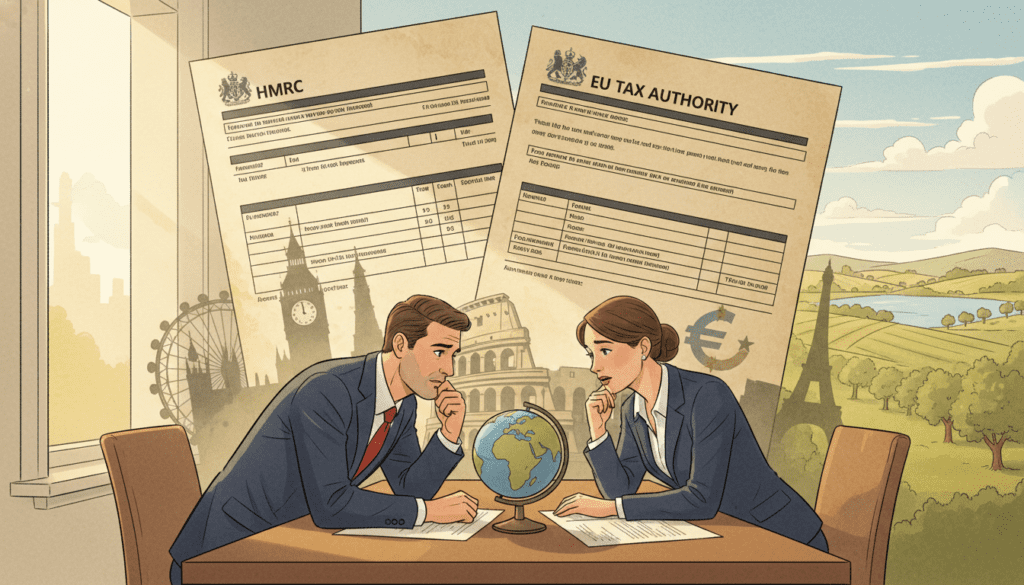
How the same inheritance can be taxed twice
The asset’s location often triggers local inheritance tax. At the same time, UK rules may apply if you remain within scope of UK IHT.
How double taxation agreements can reduce liabilities
Double taxation agreements (DTAs) sometimes allow a credit for foreign tax paid against UK inheritance tax. That credit can lower the total amount, but it rarely removes all liability.
Important: DTAs vary by jurisdiction and by the type of asset. You must check whether the DTA covers inheritance tax or only income and capital gains.
Practical examples and headline rates
To show the scale of the issue, here are common overseas inheritance tax rates:
| Country | Typical top rate | Notes |
|---|---|---|
| France | Up to 60% | High rates for distant relatives; generous allowances for close family. |
| Spain | Up to 34% (above allowances) | Regional rules can change the effective charge. |
| Germany | Progressive, up to 50% | Allowances depend on beneficiary class and amount. |
- We’ll show what double taxation looks like in practice, for example a British owner of a Spanish home still within UK IHT scope.
- Remember that the impact is more than the headline rate. Allowances, beneficiary ties and local reporting can change the real cost.
- Practical buyer’s step: confirm which jurisdictions can tax which assets, then coordinate advisers so filings and valuations match.
Core documents to buy and update before you move or soon after
A small set of legal papers makes a big difference to how smoothly your family copes after a death or incapacity.
Wills: appointing executors and aligning with cross-border assets
A will sets out who receives which assets and names an executor to act. Choose someone who can manage cross-border tasks or appoint a professional local executor.
Align each will with your asset map so that local property and foreign accounts are covered. That reduces delays and extra cost.
Probate: when a grant is required and when it may not be
A grant of probate is usually needed for substantial estates or when banks demand formal authority. It may not be required if funds are modest, jointly owned, or property passes as joint tenants.
Practical point: joint ownership often reduces probate requirements but can complicate tax or income reporting. Plan so beneficiaries are not left short of cash for immediate bills.
Lasting power of attorney for health, welfare, and financial affairs
LPAs let someone act if you lose capacity. There are two types: health and welfare, and property and financial affairs. Both must be registered with the Office of the Public Guardian.
Living abroad raises the stakes. An LPA helps manage bank accounts, pay bills and make medical decisions without lengthy court delays.
- Three must-have documents: will(s), probate plan, and LPAs.
- Pick executors who can travel, understand local laws, or grant authority to trusted local agents.
- Store originals securely, give copies to executors and solicitors, and review after any marriage, divorce, move or serious illness.
| Document | When you need it | Key action |
|---|---|---|
| Will | Always if you own assets or want to name guardians/beneficiaries | Match to asset map; consider a local will for foreign property |
| Grant of probate plan | If assets are substantial or institutions request formal authority | Identify likely jurisdictions and expected timing/costs |
| Lasting power of attorney | Before loss of capacity; essential when living abroad | Register with OPG; nominate local agents if needed |
Next step: gather documents, brief your chosen executors and attorneys, and keep a simple list of contacts and storage locations. Good paperwork gives real protection to the people you care about.
Trusts for British expats: benefits, pitfalls, and what to check by country
Trusts can give you control over how wealth moves between generations, but they are not one-size-fits-all.
How trusts work: a settlor places assets into a trust, trustees manage those assets under a written deed, and beneficiaries receive the benefit. The deed is the rulebook everyone follows.
Types to consider
Common types include discretionary, bare (fixed), interest-in-possession, and loan or gift trusts. Each type changes control and timing of distributions.
What they can do
- Succession control — keep family wishes clear across generations.
- Protection — help safeguard assets from certain claims or poor decisions.
- Flexibility — help beneficiaries in different countries.
Tax and reporting risks
Cross-border taxation matters. France demands strict reporting and can levy heavy charges. Spain may ignore the legal split and treat assets as still belonging to the settlor.
“The wrong trust in the wrong jurisdiction can create surprise tax and heavy reporting.”
UK IHT after april 2025
Long-term residence can widen IHT exposure. Excluded property trusts may lose their status if the settlor becomes an LTR. Review trusts if your residence changes.
Alternatives and complements
Multi-jurisdiction wills, targeted insurance for liquidity, and modest gifting often work alongside trusts to provide practical protection without sole reliance on one structure.
Funding your plan: gifting strategies and pensions, including the April 2027 pension IHT shift
A clear giving and pension strategy funds the practical costs that follow a death. Good documents help, but survivors need cash to pay tax, maintain property and cover immediate bills.
Using annual exemptions and timing gifts
Each tax year you can give £3,000 free of IHT. You can carry forward one year if unused.
Gifts survive IHT if you live seven years after making them. If you die sooner, taper relief may reduce the charge.
Practical tip: stagger gifts so you keep a cash buffer. Retirees often need liquidity for care or repairs.
Pensions as practical estate tools
Pension pots are usually outside the taxable estate now. Nomination forms send benefits to chosen beneficiaries.
If you die before age 75, beneficiaries often get funds tax-free up to the lifetime allowance for serious ill‑health death benefits. After 75, withdrawals are taxed as income at the recipient’s rate.
The April 2027 change and what to do next
From 6 April 2027, unused DC and DB pension funds are planned to fall within IHT at 40% above the nil‑rate band.
Scheme administrators must report and pay IHT within 60 days. Transfers to a spouse remain IHT‑exempt.
What we recommend now: review pension nominations, model post‑2027 outcomes and align gifting and trusts so beneficiaries have cash when tax falls due.
- Check pension nominations and update forms.
- Run simple models for income tax and IHT under the new rule.
- Keep a liquidity plan so heirs can settle bills and taxes promptly.
- Read our guide on how to mitigate inheritance tax on for practical steps.
Conclusion
A clear final step is to turn what you know about assets and residence into a simple, workable plan.
Retiring abroad does not automatically remove UK inheritance or other tax exposure. The April 2025 residence change can keep worldwide liabilities in play. Check your residency record and map assets by jurisdiction.
Use basic documents — wills, probate planning and LPAs — to cut delay and cost. Consider trusts carefully; their advantages vary by country and reporting rules. Pensions and well-timed gifts are powerful levers for good outcomes.
Next step: gather papers, confirm your residency status, list assets by country and get tailored cross‑border advice so your plan works when it matters most.