


Quick answer
In England and Wales, inheritance tax is typically due by the end of the sixth month following the month in which someone dies, with the current nil-rate band standing at £325,000 (gov.uk — Inheritance Tax) per person. However, the deadline may be extended in certain circumstances, and executors who fail to pay on time may face interest charges and penalties from HMRC. Estates valued below the nil-rate band are generally not subject to inheritance tax, though this threshold is currently frozen until 5 April 2028. Additionally, spouses and civil partners may benefit from transferable allowances, potentially doubling the outside the scope of IHT amount to £650,000 in some cases. This guide explains the inheritance tax payment deadline in 2026/27, how the nil-rate band affects what you owe, and strategies to potentially reduce the tax burden on your estate.
Last reviewed: 24 May 2026 by the MP Estate Planning editorial team. Jurisdiction: England and Wales. Scotland and Northern Ireland have different probate and intestacy rules; the IHT thresholds are UK-wide.
Dealing with the financial aspects of a loved one’s passing can be overwhelming. We understand that navigating the complexities of inheritance tax (IHT) is a significant concern for many families across England and Wales.
The timeline for paying inheritance tax is crucial, and getting it right is essential to avoid penalties and interest charges. Under HMRC rules, inheritance tax is due by the end of the sixth month after the month in which the person died. In practice, this means the deadline falls roughly six months after the date of death — not nine months as is sometimes incorrectly stated.
We will guide you through the process, providing a clear overview of what to expect and when. Our aim is to make this challenging time a little more manageable by offering practical guidance on inheritance tax matters relevant to UK homeowners and their families.
Key Takeaways
- Inheritance tax is due by the end of the sixth month after the month of death — interest begins accruing after this point.
- Understanding the timeline is crucial to avoid interest charges and potential penalties.
- Specialist guidance can help navigate the complexities of IHT and estate administration.
- Families across England and Wales can benefit from clear, plain-English explanations of their IHT obligations.
- Proper planning — ideally well before death — can significantly reduce your inheritance tax liability.
Understanding Inheritance Tax in the UK
Three rule changes you may need to consider (2026/27)
1. Pensions become subject to IHT from 6 April 2027. Most unused defined-contribution pension pots currently sit outside the estate for IHT — that ends on 6 April 2027 (gov.uk policy paper). HMRC estimates around 10,500 estates will face IHT for the first time as a result.
2. Business and agricultural property reliefs capped at £2.5m per person from 6 April 2026. Above the cap, only 50% relief applies — effective IHT of 20%. AIM shares dropped to 50% relief and do not use the £2.5m allowance (Saffery — APR/BPR reforms).
3. The NRB, RNRB and £2m taper threshold are frozen until 5 April 2031 following the 2024 and 2025 Budgets (gov.uk — NRB and RNRB freeze). With inflation, more estates will be pulled into IHT each year — a process commonly called “fiscal drag.”
Inheritance tax in the UK is a topic that many find daunting, but understanding its basics is crucial for effective estate planning. As Mike Pugh often says, “Trusts are not just for the rich — they’re for the smart,” and the same principle applies to understanding IHT. Let’s break down the key components.
What is Inheritance Tax?
Inheritance Tax (IHT) is a tax charged on the estate of someone who has died. It applies to the total value of their assets — including property, savings, investments, and personal possessions — above certain outside the scope of IHT thresholds. The tax is calculated on the estate’s value at the date of death, and it must be paid before assets can be distributed to beneficiaries. Importantly, it is the estate that pays the tax, not the individual beneficiaries (though beneficiaries ultimately receive less as a result). For more detailed information, you can refer to our comprehensive guide on inheritance tax per person in the UK.

Key Exemptions and Reliefs
Not all estates are subject to IHT, and there are several important exemptions and reliefs that can reduce or eliminate the tax liability entirely. Understanding these is the foundation of effective inheritance tax planning.
- Spouse/civil partner exemption: Transfers between spouses or civil partners are fully exempt from IHT, regardless of value. Additionally, any unused nil rate band can be transferred to the surviving spouse, effectively doubling the allowance to a maximum of £650,000.
- Charity exemption: Gifts to registered charities are exempt from IHT. Furthermore, if 10% or more of the net estate is left to charity, the IHT rate on the remaining taxable estate drops from 40% to 36%.
- Business Property Relief (BPR): Can reduce the taxable value of qualifying business assets by 50% or 100%. Note: from April 2026, BPR and APR will be capped at 100% relief for the first £1 million of combined business and agricultural property, with 50% relief on any excess.
- Agricultural Property Relief (APR): Can reduce the taxable value of qualifying agricultural land and buildings, subject to the same upcoming changes as BPR.
- Annual gift exemption: Each person can give away £3,000 per tax year free of IHT, with one year’s unused allowance carried forward.
- Potentially Exempt Transfers (PETs): Gifts to individuals that fall completely outside the estate if the donor survives for seven years. It’s important to note that PETs only apply to gifts to individuals — transfers into discretionary trusts are Chargeable Lifetime Transfers (CLTs), which are treated differently.
Current Inheritance Tax Rates
The standard rate of Inheritance Tax is 40% on the value of the taxable estate above the nil rate band. Unlike income tax, IHT does not vary based on the relationship between the deceased and the beneficiary — 40% applies regardless of whether assets pass to children, siblings, or friends. The only rate variation is the reduced rate of 36% available when 10% or more of the net estate is left to charity.
The key thresholds are:
- Nil Rate Band (NRB): £325,000 per person. This has been frozen since April 2009 and is confirmed frozen until at least April 2031 — over two decades without any increase. Unused NRB transfers to a surviving spouse or civil partner, giving a maximum of £650,000 for a couple.
- Residence Nil Rate Band (RNRB): An additional £175,000 (gov.uk — RNRB) per person, available only when a qualifying residential property is passed to direct descendants (children, grandchildren, or step-children). It is not available where the property passes to nephews, nieces, siblings, friends, or charities. Also frozen until April 2031. Transferable between spouses, giving a maximum of £350,000 for a couple. The RNRB tapers by £1 for every £2 the estate exceeds £2,000,000.
- Combined maximum for a married couple: Up to £1,000,000 (£650,000 NRB + £350,000 RNRB) can potentially pass free of IHT.
The fact that the NRB has not increased with inflation since 2009 — while the average home in England is now worth around £290,000 — means many ordinary homeowners are now caught by IHT. Add a modest pension, some savings, and personal possessions, and even a single person can easily exceed the £325,000 threshold. This is why proactive planning is so important. We recommend consulting with a specialist estate planning professional to get advice tailored to your specific circumstances.
The Timing of Inheritance Tax Payments
Understanding the timeline for inheritance tax payments is crucial for executors managing an estate. The process involves several key dates and deadlines that must be adhered to in order to avoid interest charges and potential penalties.
When is Inheritance Tax Due?
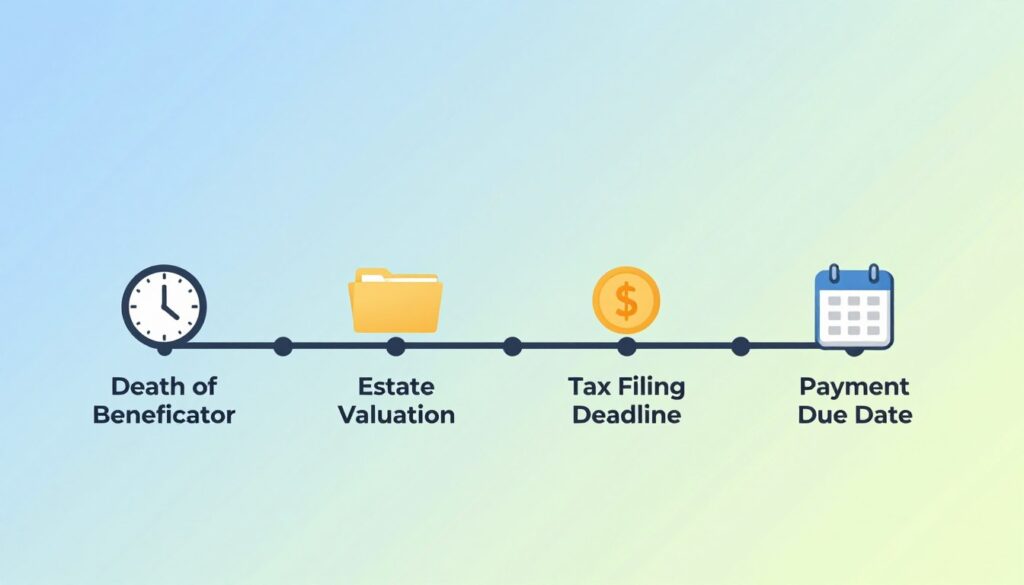
Inheritance tax is due by the end of the sixth month after the month of death. For example, if someone dies on 15 March, the IHT payment deadline is 30 September. After this date, HMRC charges interest on any unpaid tax. Crucially, executors usually need to pay at least some of the IHT before they can obtain a Grant of Probate — because the Probate Registry requires confirmation that IHT has been paid or accounted for before issuing the Grant. This creates a well-known “chicken and egg” problem: you often need access to the deceased’s assets to pay the tax, but you cannot access those assets without the Grant.
Key points executors should be aware of:
- IHT is due by the end of the sixth month after the month of death.
- Interest starts accruing from the day after the due date on any unpaid balance.
- At least some IHT typically needs to be paid before a Grant of Probate can be issued.
- HMRC’s Direct Payment Scheme allows executors to arrange payment directly from the deceased’s bank accounts before the Grant is obtained — this is often the most practical solution to the “chicken and egg” problem.
- The IHT account (form IHT400) must be submitted to HMRC within 12 months of the date of death, though in practice it is usually submitted much earlier alongside the probate application.
Importance of the Timeline
Adhering to the IHT payment timeline is vital for several reasons. Firstly, interest charges begin immediately after the due date and can add significantly to the total cost, reducing what beneficiaries ultimately receive. Secondly, the Probate Registry will not issue a Grant of Probate until HMRC has confirmed the IHT position is in order — meaning any delay in dealing with IHT delays the entire estate administration process and keeps sole-name bank accounts, property, and investments frozen.
Key considerations for executors include:
- Starting the estate valuation process as soon as possible after death — property valuations, in particular, can take time to arrange and HMRC’s District Valuer may query initial figures.
- Contacting banks and financial institutions early to establish the value of accounts and to arrange payments under HMRC’s Direct Payment Scheme if needed.
- Considering whether instalment payments are available for qualifying assets such as property (see below).
- Keeping beneficiaries informed about the progress of the estate administration and any anticipated delays.
By managing the timeline proactively, executors can fulfil their legal responsibilities and ensure the estate is handled in accordance with UK law and the deceased’s wishes. This is also where advance planning pays dividends — assets held in a properly structured lifetime trust bypass the probate process entirely, meaning trustees can act immediately upon the settlor’s death without waiting for the Grant.
How Long Does the Probate Process Take?
The length of time the probate process takes can vary significantly based on several factors. When dealing with the estate of a loved one, understanding the realistic timeframe is crucial for planning and managing expectations.
Factors Influencing Probate Duration
Several factors can influence the duration of the probate process. These include:
- The complexity of the estate — multiple properties, overseas assets, or business interests take longer
- Whether there is a valid will, or whether the estate must be administered under the intestacy rules
- The number of beneficiaries and their locations
- Any disputes or challenges to the will (including claims under the Inheritance (Provision for Family and Dependants) Act 1975)
- The efficiency and availability of the executor or personal representative
- Whether property needs to be sold to pay IHT or distribute the estate
- The time HMRC takes to process the IHT account and raise any queries
The complexity of the estate is often the most significant factor. Estates with multiple properties, business interests, or investments require more time to value and administer than those with straightforward assets like bank accounts. Estates that include gifts made within the seven years before death also require careful investigation and documentation, as these Potentially Exempt Transfers may use up part of the nil rate band.
Average Timeframes for Different Estates
The average timeframe for the full probate and estate administration process can range from a few months to several years. Here is a general breakdown:
| Estate Type | Average Probate Duration |
|---|---|
| Simple Estate (cash and personal effects only) | 3-6 months |
| Standard Estate (property, savings, investments) | 6-12 months |
| Complex Estate (multiple properties, business assets, overseas elements) | 12-24 months |
| Contested Estate (will disputes or claims) | 2-5 years |
It’s important to note that the Grant of Probate itself currently takes around 4-8 weeks to issue once the application has been submitted (online applications tend to be faster). However, the full estate administration process — including valuing assets, paying debts and IHT, selling property if needed, and distributing the estate — takes considerably longer. Where property is involved and needs to be sold, the total process commonly takes 9-18 months.
During probate, all sole-name assets are frozen — bank accounts, property, and investments cannot be accessed until the Grant is issued. The will also becomes a public document once the Grant is issued, meaning anyone can obtain a copy for a small fee. This is one of the key reasons why assets held in a lifetime trust can be so beneficial: trust assets bypass the probate process entirely, meaning trustees can act immediately upon the settlor’s death without waiting for any court process. Trust arrangements also remain private — there is no public record equivalent to the published will.

Understanding the factors that influence probate duration can help you plan and manage the estate settlement process more effectively. Being aware of the realistic timeframes involved helps set proper expectations for all beneficiaries.
Payment Options for Inheritance Tax
When it comes to settling an estate, understanding your inheritance tax payment options is crucial. Executors need to be aware of the available choices to manage the financial impact effectively and avoid unnecessary interest charges.
There are primarily two methods for paying inheritance tax: in one lump sum or through annual instalments spread over ten years (for qualifying assets). Each method has its advantages and considerations.
Paying Inheritance Tax in One Lump Sum
Paying inheritance tax in one lump sum is the standard approach for most estates. For assets such as cash, savings, and investments, a lump sum payment is required — instalments are not available for these types of assets. The key advantage of paying promptly is avoiding interest charges, which begin accruing the day after the six-month deadline.
Benefits of Prompt Payment:
- Avoids interest charges on the outstanding balance
- Simplifies the administration — a single payment settles the liability
- Allows the Grant of Probate to be obtained more quickly, speeding up the entire estate administration process
Executors can use HMRC’s Direct Payment Scheme to pay IHT directly from the deceased’s bank or building society accounts before the Grant of Probate is issued. This is often the most practical solution, as executors typically cannot access other estate funds until the Grant has been obtained. Most UK banks and building societies participate in this scheme, and executors simply need to provide the relevant HMRC reference number and payment details.
Instalment Payments Over Ten Years
For certain qualifying assets — most notably property, land, a controlling shareholding in a company, or a business — executors can elect to pay the IHT in ten equal annual instalments. This is particularly useful where the estate’s value is tied up in property that cannot be quickly sold.
Key Points About Instalment Payments:
- Available for qualifying assets including property, land, and certain business assets
- Payments are spread over ten annual instalments
- Interest is charged on the outstanding balance for property and land (but for qualifying business and agricultural property attracting BPR or APR, interest is only due if instalments are paid late)
- If the property is sold before all instalments are paid, the remaining balance becomes due immediately
- The first instalment is due by the standard six-month deadline
To illustrate the difference between the two payment methods, consider the following example for an estate owing £100,000 in IHT:
| Payment Method | Initial Payment | Ongoing Payments | Total Cost |
|---|---|---|---|
| Lump Sum | £100,000 | None | £100,000 |
| Annual Instalments (property) | £10,000 (first instalment) | £10,000 annually for 9 more years | £100,000 + interest on the outstanding balance |

Understanding the available payment options for inheritance tax is vital for executors. Whether you pay in one lump sum to keep things simple or elect annual instalments to manage cash flow on property-heavy estates, it’s essential to consider your circumstances carefully and seek specialist advice where needed.
Consequences of Late Payments
Understanding the consequences of delayed inheritance tax payments is crucial for executors. When IHT is not paid on time, it leads to additional financial burdens on the estate, ultimately reducing what beneficiaries receive.

Interest on Late Payments
The most immediate consequence of late IHT payment is interest. HMRC charges interest on any unpaid IHT from the day after the due date (the end of the sixth month after the month of death). The interest rate is set by HMRC and fluctuates in line with the Bank of England base rate. At the time of writing, the late payment interest rate is relatively high compared to recent years, making it even more important to settle the tax bill promptly. Interest is compounded, meaning the longer the tax remains unpaid, the faster the charges accumulate — and every pound spent on interest is a pound less for the family.
Penalties for Late Filing and Payment
In addition to interest, HMRC can impose penalties if the IHT account (form IHT400) is not filed within 12 months of death. Penalties can also apply where there has been a failure to take reasonable care in preparing the return — for example, undervaluing assets or failing to declare relevant gifts made in the seven years before death. The penalty regime is based on the reason for the error: careless errors attract lower penalties than deliberate ones, but even innocent mistakes can result in additional tax and interest if they lead to an underpayment.
Executors should be aware that they are personally liable for ensuring IHT is paid correctly. If an executor distributes estate assets to beneficiaries before settling the full IHT liability, they can be held personally responsible for any shortfall. This personal liability is one of the most important — and often overlooked — aspects of being an executor. We strongly recommend seeking specialist advice early in the process to ensure full compliance with HMRC’s requirements and to minimise the risk of unnecessary interest and penalties.
Special Cases and Circumstances
Special cases, such as estates involving overseas assets or trust arrangements, can affect your IHT obligations significantly. Inheritance tax is not always straightforward, and certain circumstances require specialist knowledge to navigate correctly. Let’s explore some of these situations and how they are handled under UK law.
Inheritances from Overseas
If the deceased was UK-domiciled (or deemed domiciled), their worldwide assets are subject to UK inheritance tax — not just assets located in the UK. This means that foreign property, overseas bank accounts, and investments held abroad all form part of the estate for IHT purposes. Where the deceased was non-UK domiciled, only UK-situated assets are within the scope of IHT.
Receiving an inheritance that includes overseas assets can complicate the administration significantly. Executors may need to obtain valuations in foreign currencies, deal with foreign legal systems to transfer or sell assets, and consider double taxation treaties between the UK and other countries to ensure the estate is not taxed twice on the same asset. The UK has double taxation agreements with a number of countries specifically covering inheritance tax, and where no treaty exists, unilateral credit relief may be available.

Lifetime Trusts and Inheritance Tax
Lifetime trusts are legal arrangements where assets are transferred to trustees to hold for the benefit of beneficiaries. England invented trust law over 800 years ago, and trusts remain one of the most powerful estate planning tools available today. However, different types of trusts have very different IHT implications, and understanding these differences is essential.
The most common type of trust used in estate planning is the discretionary trust, where trustees have absolute discretion over how and when to distribute income and capital to beneficiaries. Because no beneficiary has an automatic right to the trust assets, discretionary trusts provide significant protection against threats like care fees, divorce, and bankruptcy — but they fall under the “relevant property regime” for IHT purposes. Discretionary trusts can last up to 125 years under current legislation.
| Type of Trust | Inheritance Tax Treatment |
|---|---|
| Discretionary Trust (Relevant Property) | Entry charge of 20% on value above available NRB (often zero for family homes below £325,000); periodic 10-year charges of up to 6%; proportional exit charges. For most family homes, all three charges can be zero or negligible. |
| Disabled Person’s Trust | Treated as part of the disabled beneficiary’s estate — not subject to the relevant property regime’s periodic and exit charges |
| Interest in Possession Trust (pre-22 March 2006) | Treated as part of the life tenant’s estate for IHT; not subject to periodic charges |
| Post-March 2006 Interest in Possession Trust | Generally treated as relevant property (subject to periodic and exit charges) unless it is an Immediate Post-Death Interest (IPDI) or a disabled person’s interest |
| Bare Trust | Assets treated as belonging to the beneficiary for tax purposes — no IHT protection and no care fee protection. The beneficiary can demand the assets at age 18. |
It’s worth noting that for most family homes placed into a discretionary trust where the value is below the available nil rate band (£325,000 per settlor), the entry charge, periodic charges, and exit charges can all be zero. This makes trusts a highly cost-effective planning tool for ordinary homeowners — especially when you compare the one-time cost of setting up a trust (typically from £850) with the potential IHT saving of tens or even hundreds of thousands of pounds. However, the interaction between trusts and IHT is complex, and specialist advice is essential to ensure the arrangement works as intended. It’s also important to understand that transfers into a discretionary trust are Chargeable Lifetime Transfers (CLTs), not Potentially Exempt Transfers — so the seven-year PET rules do not apply in the same way.
The Role of Executors in Tax Payments
The executor’s role is pivotal in ensuring that inheritance tax is paid correctly and on time. Executors (or administrators, if there is no will) are legally responsible for managing the estate of the deceased, which includes valuing the estate, filing the inheritance tax return, and paying the tax due to HMRC.
Responsibilities of the Executor
Executors have a wide range of responsibilities, including:
- Valuing the estate: This involves assessing the total value of the deceased’s assets at the date of death, including property, investments, bank accounts, personal belongings, and any gifts made within seven years of death (Potentially Exempt Transfers) or Chargeable Lifetime Transfers into trusts. Professional valuations are often needed for property and valuable items — and HMRC’s District Valuer may challenge figures that appear too low.
- Filing the inheritance tax return: Executors must complete the appropriate IHT forms. For estates above the IHT threshold, form IHT400 must be submitted to HMRC. For excepted estates (those below the threshold with no complications), a simpler process applies as part of the probate application.
- Paying inheritance tax: Executors are personally liable for ensuring IHT is paid on time. They can use the deceased’s funds (via HMRC’s Direct Payment Scheme), arrange instalment payments for qualifying assets, or use other sources to fund the payment.
- Applying for the Grant of Probate: The Probate Registry will not issue the Grant until the IHT position has been dealt with. The executor must provide HMRC’s reference and confirmation of payment or instalment arrangements.
For more detailed information on the inheritance tax payment timeline, you can visit our page on the inheritance tax payment timeline.
How Executors Manage Inheritance Tax
Managing inheritance tax involves several key steps:
- Establishing the Estate’s Tax Liability: Executors must determine whether IHT is payable by calculating the total estate value, deducting liabilities (debts, funeral costs), applying the nil rate band (£325,000), the residence nil rate band (£175,000 if applicable), and any available reliefs or exemptions. Any gifts made within seven years of death must also be considered as they may use up part of the nil rate band. Taper relief — which reduces the tax payable, not the value of the gift — applies where gifts exceed the NRB and death occurs between three and seven years after the gift.
- Arranging Payment: Executors can pay IHT directly from the deceased’s bank accounts using HMRC’s Direct Payment Scheme, from their own funds (to be reimbursed from the estate), or by arranging a loan. For property-heavy estates, annual instalment payments spread over ten years may be elected for qualifying assets.
- Filing the Return and Obtaining the Grant: Once the IHT400 is submitted and the initial payment made (or instalment arrangement confirmed), the executor can proceed with the probate application at the Probate Registry.
- Corrective Accounts: If the estate’s value changes after the initial return — for example, if a property sells for more or less than the estimated value — the executor must file a corrective account with HMRC to adjust the IHT payable. This can result in either an additional payment or a refund.
By understanding the executor’s role in managing inheritance tax, individuals can better navigate the complexities of estate administration and ensure compliance with HMRC requirements. It’s worth remembering that executors bear personal liability — getting proper professional support from the outset can save significant stress and cost.
Planning Ahead for Inheritance Tax
Proactive inheritance tax planning can make a significant difference to what your family ultimately receives. The nil rate band has been frozen at £325,000 since 2009, while average property values have risen substantially — meaning more ordinary families are being caught by IHT than ever before. As Mike Pugh puts it, “Plan, don’t panic” — the earlier you start planning, the more options are available to you.
Estate Planning Strategies
Effective estate planning is crucial for reducing your inheritance tax liability. There are several proven strategies available under UK law:
- Lifetime gifts: Gifts to individuals are Potentially Exempt Transfers (PETs) — if you survive seven years, the gift falls completely outside your estate. The annual gift exemption of £3,000 per year (with one year’s carry-forward) can also be used. Regular gifts from surplus income that form a pattern of giving can be immediately exempt under the normal expenditure out of income exemption — but this must be properly documented.
- Lifetime trusts: Placing assets into a properly structured lifetime trust — such as a discretionary trust — can reduce your IHT exposure. For most family homes below the nil rate band, there is no entry charge. Trust assets also bypass probate delays entirely, meaning your family has immediate access. Trusts are not just for the wealthy — they are a practical planning tool for ordinary homeowners looking to protect the family home.
- Life insurance in trust: A life insurance policy written into trust ensures the payout goes directly to your beneficiaries without forming part of your estate for IHT. This means a greater portion of the payout reaches your family. Life insurance trusts are typically free to set up.
- Making use of all available reliefs: Ensuring both the nil rate band and the residence nil rate band are fully utilised, particularly by making use of the spouse transferable allowance. For a married couple, this can shelter up to £1,000,000 from IHT.
- Charitable giving: Leaving 10% or more of the net estate to charity reduces the IHT rate from 40% to 36% on the remaining taxable estate.
- Pension planning: Pensions are currently outside the scope of IHT (though from April 2027, inherited pensions will become liable for IHT). Spending other assets first and preserving pension funds can be an effective strategy, at least until the rules change.
These strategies require careful planning and specialist advice to ensure they are implemented correctly and comply with current UK law. It’s also essential to understand the difference between legitimate, tax-efficient planning and arrangements that HMRC might challenge — a specialist can guide you through this.
Consulting Estate Planning Specialists
Consulting with a specialist estate planning professional — rather than a generalist — can provide invaluable guidance tailored to your individual circumstances. As Mike Pugh often says, “The law — like medicine — is broad. You wouldn’t want your GP doing surgery.” IHT planning involves the interaction of trust law, tax law, property law, and family circumstances, so specialist knowledge is essential.
Benefits of consulting a specialist include:
- A thorough analysis of your estate to identify IHT exposure — MP Estate Planning uses a proprietary 13-point threat analysis to assess every client’s situation
- Expert knowledge of the full range of trusts and planning tools available under English and Welsh law, including Family Home Protection Trusts, Gifted Property Trusts, and Settlor Excluded Asset Protection Trusts
- Practical assistance in implementing strategies correctly, including coordinating the preparation of trust documentation, property transfers, and HMRC compliance
- Ongoing guidance as tax rules change (such as the upcoming changes to BPR/APR from April 2026 and pensions from April 2027)
When you compare the cost of professional estate planning — typically from £850 for a straightforward trust — to the potential IHT saving of tens or even hundreds of thousands of pounds, it represents one of the most cost-effective forms of financial protection available. To put it another way, a trust costs the equivalent of roughly one to two weeks in a care home — but it’s a one-time cost that protects your family for up to 125 years. Not losing the family money provides the greatest peace of mind above all else.
How to Calculate Inheritance Tax Owed
The process of calculating inheritance tax owed is crucial for executors to manage the estate’s tax liability effectively. To achieve this, two key steps are required: valuing the estate accurately and applying all relevant deductions and allowances.
Valuing an Estate
Valuing an estate involves assessing the total value of the deceased’s assets at the date of death. This includes:
- Property — including the main residence and any other real estate (buy-to-let, holiday homes, land). Professional RICS valuations are usually required, and HMRC’s District Valuer may challenge undervaluations.
- Cash, bank accounts, building society accounts, savings, and investments (shares, ISAs, premium bonds, National Savings)
- Personal belongings — jewellery, art, antiques, vehicles, and other valuables
- Business interests — shares in private companies, partnership interests, sole trader businesses
- Pension death benefits (currently outside IHT, but from April 2027 these will be within scope)
- Life insurance policies not held in trust — a common oversight that can add tens of thousands of pounds to the taxable estate
- Any gifts made within seven years of death (Potentially Exempt Transfers) and Chargeable Lifetime Transfers made at any time
For property, a professional RICS valuation at the date of death is strongly recommended. For financial assets, valuations are based on statements as at the date of death. For quoted shares, specific valuation rules apply (the “quarter-up” method). Getting valuations right is critical — HMRC regularly queries estate values, particularly property, and undervaluation can lead to penalties and additional interest charges.
Deductions and Allowances Explained
Once the total estate value has been established, various deductions and allowances are applied to arrive at the taxable estate. The key deductions and allowances include:
- Debts and liabilities: Any outstanding debts owed by the deceased at the date of death — including mortgages, credit cards, personal loans, and utility bills — are deducted from the estate’s gross value.
- Funeral expenses: Reasonable funeral costs can be deducted. This typically includes the cost of the funeral service, burial or cremation, and a headstone — but not the cost of a wake or memorial event.
- Nil Rate Band (NRB): The first £325,000 of the taxable estate is charged at 0%. If the deceased’s spouse or civil partner died before them and did not use their full NRB, the unused portion can be transferred — potentially giving a combined NRB of up to £650,000.
- Residence Nil Rate Band (RNRB): An additional £175,000 (up to £350,000 for a couple) is available where a qualifying residential property passes to direct descendants. This is not available where the estate exceeds £2 million (it tapers by £1 for every £2 over £2 million) or where the property passes to non-qualifying recipients such as siblings, nieces, nephews, or friends.
- Spouse/civil partner exemption: Any assets passing to a surviving spouse or civil partner are fully exempt from IHT.
- Charity exemption: Gifts to registered charities are exempt and may also qualify the estate for the reduced 36% IHT rate.
- Business Property Relief and Agricultural Property Relief: Where applicable, these can reduce the taxable value of qualifying business or agricultural assets by 50% or 100%. From April 2026, combined BPR and APR will be capped at 100% relief for the first £1 million, with 50% relief on any excess.
Understanding and applying these deductions correctly is vital for minimising the inheritance tax owed. We recommend working with a specialist estate planning professional to ensure all eligible deductions are claimed and the estate is not paying more IHT than necessary.
Understanding the Appeal Process
The appeal process for inheritance tax decisions is an important mechanism for resolving disputes and correcting potential errors. When executors or beneficiaries disagree with a decision made by HMRC — for example, a valuation assessment or the denial of a relief — they have the right to challenge it. This process is crucial for ensuring that inheritance tax is calculated fairly and accurately.
Grounds for Appealing Tax Decisions
There are several grounds on which an individual can dispute an HMRC inheritance tax decision. These include:
- Disagreement with the valuation of estate assets — particularly property, where HMRC’s District Valuer may place a higher value on a property than the executor’s professional valuation
- Errors in the calculation of inheritance tax — including incorrect application of the nil rate band, residence nil rate band, or transferable allowances
- Denial or incorrect application of reliefs — such as Business Property Relief, Agricultural Property Relief, or the spouse exemption
- Disputes over whether gifts were PETs or CLTs — and the application of the seven-year rule and taper relief (HMRC IHTM14612)
Understanding these grounds is essential for determining whether a challenge is justified and likely to succeed.
Steps to Take if You Disagree
If you disagree with an inheritance tax decision, there are specific steps you should take:
- Review the HMRC decision notice carefully to understand the basis for their assessment and the specific points of disagreement.
- Gather all relevant supporting documentation — including professional valuations, accounts, trust deeds, correspondence, and any other pertinent records.
- In many cases, the first step is an informal discussion with the HMRC caseworker to try to resolve the matter without formal proceedings.
- If informal resolution is not possible, submit a formal appeal in writing to HMRC within 30 days of the decision notice.
- Clearly state the grounds for your appeal and provide all supporting evidence.
- If the dispute cannot be resolved through HMRC’s internal review process, it can be referred to the First-tier Tribunal (Tax Chamber) for an independent decision.
For more detailed guidance on managing inheritance tax and potential overpayments, you can visit our page on claiming back HMRC inheritance tax.
Resources and Support for Executors
As an executor, managing the estate of a deceased loved one can be a daunting task, particularly when inheritance tax is involved. Fortunately, there are various resources available to help you navigate this complex process.
Government Guidance
The UK government provides comprehensive guidance on inheritance tax and estate administration through the GOV.UK website. This includes detailed information on IHT rates, thresholds, exemptions, reliefs, and the forms that need to be completed (IHT400, IHT205/IHT217, and others). HMRC also operates a dedicated Inheritance Tax helpline that executors can call for guidance on specific queries. Utilising these government resources is an essential first step to ensure you understand your obligations and comply with all tax requirements.
Seeking Professional Advice
In addition to government resources, seeking professional advice from a specialist can be invaluable — particularly for estates involving property, trusts, overseas assets, or potential claims against the estate. Solicitors and estate planning specialists who focus specifically on trust law, IHT, and probate can offer expert guidance that goes well beyond what general resources can provide. They can identify reliefs you may not be aware of, ensure valuations are robust enough to withstand HMRC scrutiny, and help structure the administration to minimise unnecessary costs.
Remember, the law — like medicine — is broad. A generalist may not have the specialist knowledge needed for complex IHT matters. When you consider that IHT on even a modest family home can run to tens of thousands of pounds, the cost of specialist advice is often a fraction of the potential saving. Keeping families wealthy strengthens the country as a whole — and by leveraging the right resources and seeking professional help early in the process, you can effectively manage your responsibilities as an executor and ensure a smooth, compliant administration of the estate.
FAQ
What is the deadline for paying inheritance tax after someone dies?
Inheritance tax is due by the end of the sixth month after the month of death. For example, if someone dies on 10 January, the IHT payment deadline is 31 July. After this date, HMRC charges interest on any unpaid balance. It’s important to note that some IHT usually needs to be paid before a Grant of Probate can be obtained, so executors should begin the process as soon as possible after the death.
How is inheritance tax calculated, and what are the current tax rates?
Inheritance tax is charged at 40% on the value of the taxable estate above the nil rate band (currently £325,000 per person, frozen since 2009 and confirmed frozen until at least April 2031). The rate reduces to 36% if 10% or more of the net estate is left to charity. The residence nil rate band provides an additional £175,000 per person when a qualifying home passes to direct descendants such as children or grandchildren. For a married couple who make full use of transferable allowances, up to £1,000,000 can pass free of IHT.
What are the payment options available for inheritance tax?
You can pay IHT in one lump sum or, for qualifying assets such as property and land, elect to pay in ten equal annual instalments. HMRC’s Direct Payment Scheme allows executors to arrange payment directly from the deceased’s bank accounts before the Grant of Probate is issued, which is often the most practical approach for overcoming the initial funding challenge. Interest is charged on any balance outstanding after the six-month deadline.
What are the consequences of late inheritance tax payments?
Interest begins accruing on unpaid IHT from the day after the six-month deadline. The interest rate is set by HMRC and fluctuates with the Bank of England base rate. In addition, penalties can apply if the IHT return is filed late (more than 12 months after death) or if errors are found in the return. Executors are personally liable for ensuring IHT is paid correctly, making timely action essential.
How do executors manage inheritance tax payments, and what are their responsibilities?
Executors are responsible for valuing the estate, filing the IHT return (form IHT400 for taxable estates), paying the tax due, and obtaining the Grant of Probate. They can use the deceased’s funds via HMRC’s Direct Payment Scheme, arrange instalment payments for qualifying assets, or use other sources to fund the payment. Executors bear personal liability for the correct payment of IHT, so seeking specialist advice from the outset is strongly recommended.
Can I appeal an inheritance tax decision if I disagree with it?
Yes, you can challenge an HMRC decision on inheritance tax. Common grounds include disagreement with property valuations, incorrect application of reliefs or allowances, and errors in calculating the tax. You should first try to resolve the matter informally with HMRC, and if that fails, submit a formal appeal in writing within 30 days of the decision notice. Unresolved disputes can be referred to the First-tier Tribunal (Tax Chamber) for an independent decision.
What resources and support are available to executors managing inheritance tax?
The GOV.UK website provides comprehensive guidance on IHT, including forms, rates, and exemptions. HMRC has a dedicated Inheritance Tax helpline for specific queries. Beyond government resources, specialist solicitors and estate planning professionals can provide tailored advice on complex estates, help ensure valuations are robust, and identify all available reliefs and exemptions to minimise the IHT liability.
How can estate planning strategies help reduce inheritance tax liability?
Proactive inheritance tax planning can significantly reduce your inheritance tax liability. Key strategies include making lifetime gifts (which fall outside your estate after seven years as Potentially Exempt Transfers), placing assets into lifetime trusts such as discretionary trusts, writing life insurance policies into trust, making full use of the nil rate band and residence nil rate band, and charitable giving. The earlier you start planning, the more options are available. Specialist advice is essential to ensure any strategy is properly implemented and compliant with current UK law.
How long does the probate process typically take, and what factors influence its duration?
The Grant of Probate itself currently takes around 4-8 weeks to issue once the application is submitted. However, the full estate administration process — including valuing assets, paying debts and IHT, selling property if needed, and distributing the estate — typically takes 6-12 months for standard estates, and longer for complex or contested estates. Key factors affecting duration include the complexity of the estate’s assets, whether property needs to be sold, and whether there are any disputes or claims against the estate. Assets held in a lifetime trust bypass probate entirely, giving families immediate access.
Are there any special cases or circumstances that may affect inheritance tax, such as inheritances from overseas?
Yes, several special circumstances can affect IHT. If the deceased was UK-domiciled, their worldwide assets are subject to IHT, including overseas property and foreign bank accounts. Double taxation treaties may apply to prevent the same assets being taxed in both countries. Lifetime trusts also have specific IHT implications depending on their type — discretionary trusts fall under the relevant property regime with periodic and exit charges (often zero for family homes below the nil rate band), while bare trusts offer no IHT protection. Specialist advice is essential for estates involving overseas assets or trust arrangements to ensure correct and tax-efficient administration.
A Brief History of Death Duties and How UK Inheritance Tax Compares to Estate Tax
Understanding where modern Inheritance Tax came from can help executors and beneficiaries make sense of why the rules are structured as they are today. The UK has a long history of taxing wealth on death, and the current regime — introduced in 1986 — is the product of almost a century and a half of gradual legislative reform.
From Estate Duty to Inheritance Tax: A Timeline
The first modern death duty in the UK was estate duty, introduced by the Finance Act 1894 under Chancellor William Harcourt. It applied to the total value of a deceased person’s estate and was, in its time, considered a radical measure. By the early 1920s — a period many people search for when researching death duties UK 1920 and death duties UK 1922 — rates had risen considerably as the government sought to address post-war public finances, with higher-value estates facing rates that could reach into double figures. Many landed families in this period were compelled to sell assets or break up estates to meet their liabilities.
Estate duty remained in place, with various amendments, until 1975, when it was replaced by Capital Transfer Tax (CTT) under the Finance Act 1975. CTT was broader in scope, applying to lifetime gifts as well as transfers on death. In 1986, the Finance Act replaced CTT with Inheritance Tax as we know it today, reintroducing the concept of potentially exempt transfers (PETs) and refocusing the tax primarily — though not exclusively — on transfers at death. You can read HMRC’s current technical guidance on the structure of IHT in the HMRC Inheritance Tax Manual.
When Did Death Duties Stop in the UK?
Strictly speaking, death duties in their original form — as estate duty — ceased in 1975 when Capital Transfer Tax was introduced. The term death duties is sometimes used colloquially to refer to any form of tax on death, including modern IHT, but it is no longer the correct legal terminology. If you encounter references to death duties in older wills, trust deeds, or family documents, it is generally advisable to seek professional clarification, as the provisions may have been drafted under a different legal and tax framework.
UK Inheritance Tax versus US Federal Estate Tax
It is worth briefly addressing a point of confusion that arises with some frequency, particularly among UK residents who have assets or family connections in the United States. UK Inheritance Tax and US federal estate tax are structurally different. In the UK, IHT is charged on the estate of the deceased person — it is the estate (via the executor) that bears the liability, not the individual beneficiary receiving an inheritance. In the United States, a federal estate tax similarly falls on the estate, but individual states may also levy a separate inheritance tax on beneficiaries depending on their relationship to the deceased and the value received.
UK residents sometimes search for estate tax when they mean IHT, or vice versa. In an England and Wales context, the two terms are typically used interchangeably in everyday language, but it is worth being precise: there is no separate UK tax called estate tax. The applicable charge on death in England and Wales is Inheritance Tax, levied at 40% on the value of a chargeable estate above the available threshold — or at a reduced rate of 36% where 10% or more of the net estate is left to a qualifying charity. In our experience, clarity on this distinction can be particularly important where cross-border estates are involved, and specialist advice from a regulated professional with international experience is generally appropriate in those circumstances.
Common Questions About Inheritance Tax
How do death duties work in the UK?
Death duties is an older term broadly referring to taxes levied on a person’s estate when they die. In the modern UK context, this means Inheritance Tax (IHT), which is charged on the net value of a deceased person’s estate — including property, savings, investments, and certain gifts made in the seven years before death — above the available tax-free threshold. The executor of the estate is responsible for calculating the liability, completing the relevant HMRC returns, and arranging payment before or during the probate process. The current headline rate is 40% on the chargeable portion of the estate, though a reduced rate of 36% may apply where qualifying charitable gifts are included.
When did death duties stop in the UK?
Estate duty — the original form of death duties introduced in 1894 — was formally abolished in 1975 and replaced by Capital Transfer Tax. The current Inheritance Tax regime has been in place since 1986. While the phrase death duties is still sometimes used informally, it has no specific legal meaning under current legislation.
How much can you inherit in England without paying taxes?
The amount you can pass on outside the scope of IHT depends on the reliefs and exemptions available. The standard nil-rate band is £325,000, a threshold that has remained unchanged since 2009 and is currently frozen until at least April 2030. Where the deceased owned a qualifying residential property and it passes to direct descendants, an additional residence nil-rate band (RNRB) of up to £175,000 may also be available. For married couples and civil partners, both thresholds can be transferred to the surviving spouse, meaning a combined potential threshold of up to £1,000,000 may be achievable in some circumstances. However, the RNRB begins to taper for estates valued above £2,000,000, reducing by £1 for every £2 of excess value, so larger estates may not benefit in full. Each estate is different, and our team would always recommend a personalised review rather than relying on general figures alone.
How do I avoid 40% inheritance tax in the UK?
There is no single method that is appropriate for every estate, and it would be misleading to suggest otherwise. That said, there are a number of legitimate planning strategies that may help to reduce an IHT liability over time. These typically include making use of annual gift exemptions, potentially exempt transfers (PETs), contributions to pension arrangements, charitable legacies, business property relief, and agricultural property relief where applicable. Lifetime trust arrangements may also be relevant in certain circumstances. Effective IHT planning generally requires action well in advance of death — many reliefs have minimum ownership or survival periods attached. We would strongly encourage anyone with a concern about IHT to engage a regulated professional at an early stage. HMRC publishes a useful overview of available reliefs at gov.uk/inheritance-tax/overview.
Do I need to complete R185?
Form R185 (Estate Income) is typically required where an estate generates income during the administration period — for example, from rental property, dividends, or interest — and that income is subsequently distributed to a beneficiary. The executor or administrator uses R185 to certify the amount of income paid to each beneficiary and the tax already deducted, so that the beneficiary can account for it correctly in their own tax return. Not every estate will require an R185; it is generally only relevant where the estate has produced taxable income before the final distribution. If you are unsure whether R185 applies in a particular estate, HMRC’s guidance on form R185 Estate Income sets out the circumstances in which it is needed, and a qualified accountant or tax adviser can assist with completion.